Practically seven months after the Eurovision Song Contest in Basel, enduring contractions, cold sweats, and an exhausting labor, the European Broadcasting Union finally delivered. The contest organizers were already in deep water when the amniotic sac broke. With broadcasters and audiences shouting “Push! Push!”, the expectant mother couldn’t delay delivering the decision any further. Premature or overdue, the newborn resolution said: Israel stays.
Can the Eurovision Song Contest, whose perception is now completely hijacked by Israel, survive its unprecedented collapse?
At the EBU General Assembly in Geneva, on December 4-5, washed out from dodging questions and eschewing accountability for the greatest mess Eurovision has ever seen, the parent organization couldn’t even muster the courage to put Israel’s participation in Eurovision to a vote.
Instead of letting its members decide whether the project can proceed with a representative of a genocide-committing state (that vote was repeatedly rescheduled), the EBU polled broadcasters on a new voting system and rules designed to stop governments from manipulating audiences with paid influence campaigns. Israel’s sin that inspired the reform would not be sanctioned.
Faced with the fact that the EBU was ghosting them for months, Spain, Ireland, the Netherlands, and Slovenia were the first to walk out. The toll of not upsetting Israel might see more countries sacrificing their participation.
Can a contest whose perception is now completely hijacked by Israel survive this unprecedented collapse? Does the EBU truly believe this will all blow over in time for Eurovision’s 70th anniversary, when everything will again be covered in good old glitter?
Israel’s new era of artwashing has been given a green light. But imagining that the rest of Europe will stay a silent tabula rasa is wishful thinking at best. For broadcasters still clinging to the wobbling laundromat, this green light is really a red flag. Perhaps the only flag that Eurovision, in its bizarre tactics of avoiding political controversies, had to ban.
UPDATE:

On December 10, Iceland became the fifth country to decide not to compete in the 70th Eurovision Song Contest because of Israel. RÚV, the Icelandic National Broadcasting Service, stated that the participation of Israel's KAN has "created disunity" among both EBU members and the general public, and that this complex matter "has already damaged the contest's reputation and EBU". "According to public discourse in Iceland and the response to EBU's decision last week, RÚV's participation will neither be a source of joy nor peace", they explained in their withdrawal statement.

The same day, 11 of the 16 competing acts at Festival da Canção announced they would not represent Portugal at Eurovision if they won, in protest against Israel’s inclusion in the contest. "We do not accept complicity with the violation of human rights", seventeen signatories said in a joint statement. The broadcaster RTP has reaffirmed it will still send its representative to Eurovision in Vienna.

On December 11, Eurovision 2024 winner Nemo (Switzerland) announced they will return their trophy back to the EBU, reminding that Israel's participation during what UN's Independent International Commission of Inquiry has concluded to be a genocide, is in conflict with the ideals of unity, inclusion, and dignity Eurovision stands for. "The contest was repeatedly used to soften the image of a state accused for severe wrongdoing, all while the EBU insisted Eurovision is 'non-political'", said the artist. "Live what you claim. If the values we celebrate onstage aren't lived offstage, then even the most beautiful songs lose their meaning."

December 12 brought another laureate's protest against Israel's ESC return. This time, Eurovision 1994 winner Charlie McGettigan (Ireland) decided to give his trophy back to the EBU as well.
How to Smuggle a War Narrative Into Eurovision
What began in 2024, with Eden Golan’s “October Rain” (forced to be renamed as “Hurricane”), and continued with Yuval Raphael’s 2025 entry “New Day Will Rise”, has been Israel’s political narrative camouflaged into passable Eurovision performances.
The EBU has historically drawn its red lines quite confidently. Georgia was benched in 2009, Belarus in 2021, and Russia in 2022. Even poor Joost Klein – the Netherlands’ 2024 representative – was ejected at breakneck speed after criticizing Israel, before the EBU bothered to verify the harassment incident allegations. The “no politics” rule, it seems, can be applied with stunning punctuality when convenient.
And yet Israel, with its “angelic voices” singing about storms and dawns, somehow floated through Eurovision’s hyper-sensitive political radar, despite barely pretending not to be political.
Yuval Raphael, who survived the October 7 attack by playing dead among corpses, as instructed by her father (a phone call that somehow ended up recorded), was elevated into a mascot of Israel’s “righteous” war with Hamas.
“She needs to play her father’s recording. She needs to shock people”, declared TV show judge Shiri Maimon after Yuval’s ‘Hakochav Haba’ (Rising Star) victory.
The show host chimed in: “Her story is something no one there will be able to stay indifferent to.”
“I hope so, I hope so”, his colleague added.
Israeli President Isaac Herzog personally sent Yuval Raphael off to Switzerland, wishing her “the best of luck in this mission”.
The same president who signs bombs being launched at Gaza and produces perfectly preserved “Mein Kampf” from a Palestinian child’s room, boosted the young singer with these words: “You have a wonderful personality, your story is incredible, and every time I hear the song, my heart swells with pride. We want so much for you to succeed.”
It didn’t stop with warm wishes and patriotic pep talks.
If you're wondering who could or should represent Israel at Eurovision 2026, check out these unofficial entries!
Israel’s Eurovision Ad Campaign
Just moments before Yuval would step on Basel’s Eurovision stage, Israel’s Prime Minister (and wanted war criminal) Benjamin Netanyahu asked his Instagram followers to vote for “New Day Will Rise” twenty times, the maximum allowed by EBU.
Israel’s official accounts stimulated fans across Instagram and TikTok to cast at least ten votes apiece.
And the most controversial of all, the Israeli Government Advertising Agency (Lapam), the same bureau that produced ads featuring Hamas’ executions of so-called “collaborators”, also paid for Yuval’s targeted ad campaign. Israel’s Eurovision ads on YouTube even popped up during the official live broadcast of the final.
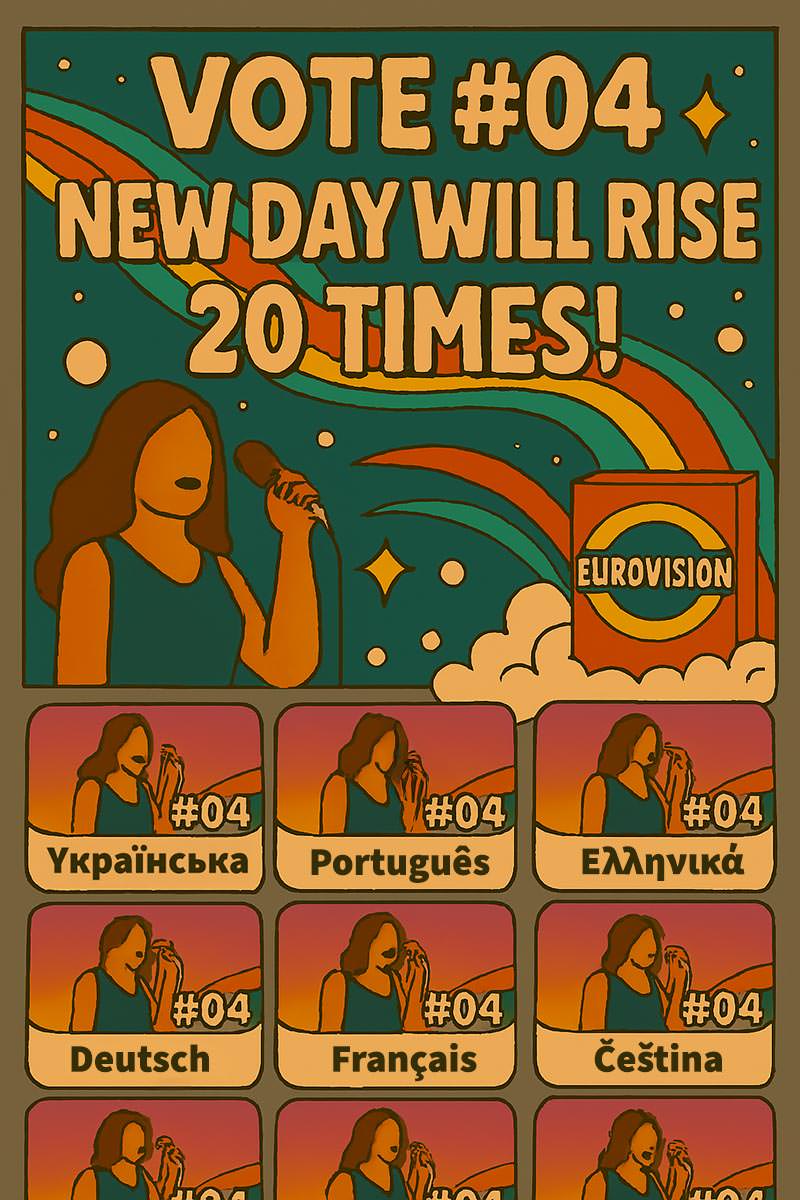
One of the problematic ad videos, now deleted from the “Vote #04 New Day Will Rise” account but still archived via the Wayback Machine, amassed over 25 million views in two weeks. For perspective, Yuval’s official Grand Final video gained barely 4.3 million views in the last 6 months! The entire Eurovision Grand Final was seen “only” 13 million times.
Clearly, the massive ad campaign investment paid off. Israel received a staggering number of maximum douze points (the highest score from 12 participating countries, as well as from the ‘Rest of the World’ vote). A song that was not popular on charts or streaming platforms (meaning people didn’t listen to it much) suddenly topped the televotes across Europe.
Figures released for countries like Spain and Belgium do show eyebrow-raising voting patterns. Televotes in the Grand Final multiplied tenfold while viewership only quadrupled (in the Spanish case), or even dropped (only 952,634 Belgians watched the final, yet 220,554 votes were cast).
So Israel’s song that professional juries placed in the bottom half of the table (awarding it just 60 points, and ranking it 14th out of 26) ended up being the audience’s undisputed champion. Yuval’s act got 297 points from the viewers, leaving behind fan favorites such as Estonia’s “Espresso macchiato” and Sweden’s “Bara Bada Bastu”.
In September, Eurovision News Spotlight revealed that the Israeli government paid Google nearly €40 million for advertising over just six months.
Concerns and Deeply Held Views – ISIS Against Israel
“Eurovision is a competition between broadcasters, not governments.”
Whenever anyone questioned Israel’s eligibility to compete, this was the EBU’s go-to response. If you followed, you’ve heard it numerous times.
But then it was discovered that Israel’s government had financed Yuval’s voting campaign. Instead of picking up the phone and firmly telling Isaac Herzog the very same mantra (“Sorry, Mr. President, but Eurovision is a competition between broadcasters, not governments”), the EBU responded to vote-rigging criticism with an immediate acquittal: there was no violation of rules.
Check out how Palestine protests marked the Turquoise Carpet event in Basel 2025 – footage you couldn’t have seen on Eurovision’s official channel! (However, in the ESC’s live broadcast of the event, you could hear their commentator Tanja Dankner saying “Music really unites people” just after the Israeli delegation endured some extremely loud whistles from the crowds, muted in the final footage.)
The loudest in demanding transparency were Ireland, Spain, Iceland, and Slovenia (coincidentally, the acronym spells out ISIS, Israel’s favorite boogeyman), later joined by the Netherlands, a country hosting the Hague Tribunal that accused Israel’s leadership of war crimes.
Whenever these countries would reach out to EBU, asking why Israel was not treated like Russia (evicted in 2022 for invading Ukraine), the organization would parrot a robotic phrase: “We understand the concerns and deeply held views around the current conflict in the Middle East.”
Every. Single. Time.
Whether it was EBU’s spokesperson, director Martin Green, or a general press statement, the same words flowed out, usually followed by something like: “It is not our role to make comparisons between conflicts.”
The repetitive PR platitudes sounded as if someone had asked artificial intelligence, “how to diplomatically reject the request for the exclusion of Israel from Eurovision”.
To test it, I asked ChatGPT exactly that. The proposed answer was strikingly similar: “While we acknowledge the serious and deeply held concerns regarding the ongoing conflict in the Middle East, the EBU’s role is not to make judgments on geopolitical matters, but to maintain an inclusive space where dialogue, understanding, and peaceful cultural exchange can continue.”
Was there a human working in the EBU?
Fun fact: Google the phrase “concerns and deeply held views”, and you’ll get dozens and dozens of results. All pointing to articles on – Eurovision. Talk about a corporate catchphrase! Maybe this should be Eurovision’s slogan.
The Jerusalem Weekend Getaway That Wasn’t Political
At the Geneva assembly, Roland Weissmann, chairman of Austria’s ORF and the man preparing to host Eurovision 2026 in Vienna, recited the familiar line from the EBU’s PR book: “This contest is a competition for broadcasters, not governments.”
The man who claimed now was “the time for diplomacy” also added that he personally had advocated for Israel’s participation.
What did that diplomacy look like? A month before meeting his European colleagues, Weissmann spent a pleasant weekend in Jerusalem, where he arrived to meet none other than Israel’s President Isaac Herzog himself (yes, that same guy who autographs bombs killing children, women, and, not less important, journalists).

Warmly welcomed at the Presidential Residence (because why would Israel’s President travel to Vienna to lobby when the servants seem perfectly happy to come to his lobby on their own), Weissmann declared his allegiance to “the mission”: “Eurovision will mark its 70th anniversary next year, and Israel is an inseparable part of the contest.”
The spokeswoman of KAN, Israel’s broadcaster, interpreted that Weissmann’s visit was aimed at “working to ensure that Israel participates in the Eurovision Song Contest”.
To demonstrate how completely normal it is for the Eurovision host broadcaster to visit the president of one of the would-be contestants, Herzog even offered some remarks on media freedoms, stressing how important it is to maintain “KAN’s editorial and operational independence as Israel’s public broadcaster.”
Back in Austria, the newly minted diplomat Weissman told reporters that his team was engaged in conversations “with broadcasters such as Spain, Ireland and Slovenia to address concerns around Israel’s participation”.
But RTVE President José Pablo López quickly clarified that no such conversations had taken place: “The president of Austria’s public broadcaster has met with the President of Israel, which says a lot about the Contest’s politicization. I thought broadcasters, not countries, were the ones taking part. That’s what the EBU keeps insisting. No shame.”
For those who won't be able to attend Eurovision in Vienna, the EBU invented a series of summer concerts. But the Eurovision Song Contest Live Tour doesn't go beyond the new Iron Curtain! Check out how this very peculiar concentration camp came to be.
Delay, distract, delete – the EBU’s postponement Olympics
Instead of answering the growing calls for an independent audit of the public vote and sanctioning KAN for breaking the Code of Conduct (which bans any political promotion “during or in relation to the event”), the EBU spent the entire year making sure Israel’s fate at Eurovision would never be in the hands of its members.
In July in London, they didn’t vote on expelling Israel because the BBC (whose former reputation for unimpeachable journalism has been eroded by its Gaza coverage) asked for a delay until winter. They linked the decision to “the outcome of the war in Gaza”, as though a ceasefire would magically wash Israel’s bloody hands.
EBU then scheduled the online vote on Israel’s participation for early November. This one was postponed after Hamas released the final hostages. As if that was somehow related to the fact that a genocide-committing state is allowed on a song-contest stage.
By December, the EBU found its most elegant escape route yet. They somehow managed to fuse the Israel question with a vote on new contest rules. If broadcasters approved these rules, no vote on Israel would take place. And so it was.
The EBU’s official Assembly statement doesn’t even mention Israel. Not once. Instead, it simply declares that everyone who accepts new rules is eligible to take part.
And the new rules themselves? Juries return to the semi-finals and expand with young professionals, governments are gently discouraged from bankrolling promo campaigns, and viewers can now cast 10 votes instead of 20.
None of these cosmetic tweaks explains why a vote on Israel’s participation had to disappear in their shadow. It’s not as if the first voted question was “Can a country engaged in aggression against neighbors perform on the Eurovision stage?”, which would make a specific Israel poll redundant.
One cartoonist lost his job for drawing Benjamin Netanyahu performing at Eurovision. Art criticizing Israel's PM often gets labeled as 'antisemitic'. Check out how pricey Bibi portraits can be.
Eurovision as €-vision
While the new rulebook was accepted by the majority of broadcasters, many critics see these changes as insufficient to stop manipulations. Without requiring that the now lower number of maximum votes go to different songs, the risk of organized voting schemes remains.
Ever since the voting window ballooned from 15 minutes to an entire Eurovision evening, and each voter got 20 chances to vote (supposedly to support large families whose members may disagree on their favorites), it was clear that EBU is that “large family”. And that it cherishes the televote income far more than the integrity of the televote outcome.
Obviously, “one person – one vote” is an ideal that EBU doesn’t plan to consider, as it would only create massive holes in the budget.
The union that defends the independence of public broadcasters revealed a vulnerable underbelly when it comes to money. Eurovision’s dependence on its biggest sponsor, Moroccanoil (despite its name, this is an Israeli company, generously sponsoring the event since 2019), has long cast a shadow over whether Israel receives truly neutral treatment. Even in this new context, the sponsorship was extended for 2026. Eurovision seems to devalue perception.

No matter how dirty money arriving from shady sponsorships, YouTube paid campaigns, and possibly coordinated voting farms might be, all of this forms a lucrative machinery that feeds Eurovision, which is getting pricier and pricier every year.
As for the four countries leaving Eurovision, the language around their exit was telling: their departure was primarily counted as a financial loss, less a cultural one. Still, the financial risk is “very manageable”, calculates utterly unworried Herzog’s best buddy Roland Weissmann. “Should one or two countries not participate, it is absolutely feasible”, the Austrian public broadcaster said.
Israel can’t afford to miss Eurovision
The Eurovision boycott over Israel was never addressed with due concern for the future of this event. As it now seems, the near future either brings true reforms of the entire ecosystem or the complete crumbling of the institution under the weight of political scandals.
The politics in Eurovision is hardly a topic that will disappear if EBU just ignores it. No “United by Music” slogan can hypnotize thinking citizens to blindly hum rhymes like their corrupt and complicit governments (and public broadcasters) sometimes do. People don’t switch off their conscience just because a theme song tells them to.
It’s easier not to hear screams of 140 Palestinians killed by Israel’s attacks on the Grand Final day when you’re anxiously waiting whether Yuval Raphael will nail a high note
German and Austrian officials defending Israel’s participation dismissed boycotts as “dumb and pointless” (ironically, these smart and purposeful thinkers threatened to boycott Eurovision if Israel was excluded). Critics of contest walkouts claim cultural bans punish artists born under the “wrong flag”, and have no impact on governments.
Well, Israel’s religious attachment to Eurovision suggests the opposite.
Noa (Achinoam Nini), who represented Israel alongside Arab artist Mira Awad in 2009, proposed a diplomatic route for her country: she urged Israel to voluntarily sit out one year “as an act of solidarity with ALL who have suffered and are still suffering”.
But the official Israel doesn’t want a break, even when staying in the entertainment spotlight clearly hurts its public image. As KAN’s lawyer says, “Eurovision is more than a song contest for them”.
Often interpreted as Israel’s soft power that legitimizes its culture, projects normalcy and the positive image of the country abroad, Eurovision is even more important as a domestic balm, despite being just a temporary stage for distraction.
Simply put, it’s easier not to hear screams of 140 Palestinians killed by Israel’s attacks on the Grand Final day when you’re anxiously waiting whether Yuval Raphael will nail a high note.
Eurovision as Cultural Detergent
For Israeli opinion makers, the scoreboard is irrelevant. Israel wins even when it loses.
Hannah Brown at The Jerusalem Post celebrated Eurovision as proof that the world isn’t against Israel: “The fact that European audiences have embraced Israeli participants and given them their votes contradicts the narrative that Israel is a hated, pariah state.”
Itxu Diaz in Tablet recognized the enemy in the “leftist European governments” allegedly trying to rig the contest: “Maybe the Eurovision popular vote is an indication that Europeans no longer want to be slaves to political elites who side with terrorists.”
Meanwhile, Amy Spiro at The Times of Israel unveiled a conspiracy behind the “hate” against Yuval: “Some analysts have predicted that the professional juries could deliberately downgrade or snub Raphael regardless of what they think of her performance, in order to counteract a landslide in the public vote, or to confirm their countrymen’s ambivalence toward Israel.”
Or Amini, in the same publication, read the televote as a moral compass: “Apparently, ordinary Europeans look up to Israel as a symbol. (…) They know that the war here is justified out of self-defense, despite what others might say. And that apparently translated into the myriads of 12 points in the popular vote.”
Whether the message is “the entire world hates us” or “the entire world loves us”, heavily disturbed societies find comfort in “us versus them” rituals. Social media memes only reinforce the narrative – Eden Golan in a white dress, Bambie Thug as a black witch – suggesting who stands on the “right side of history”.
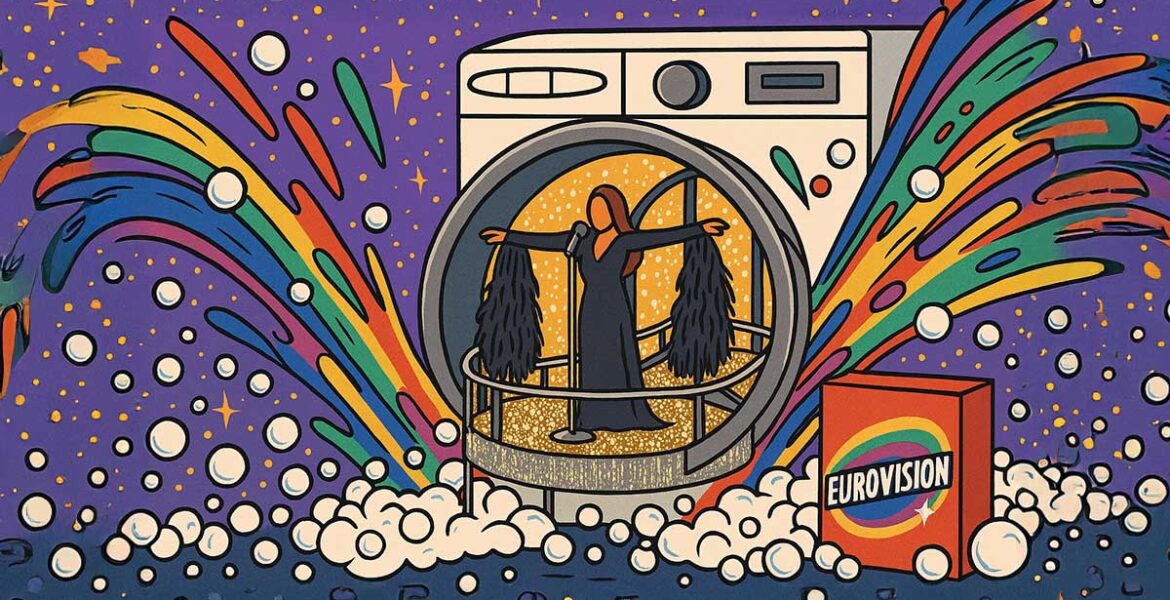
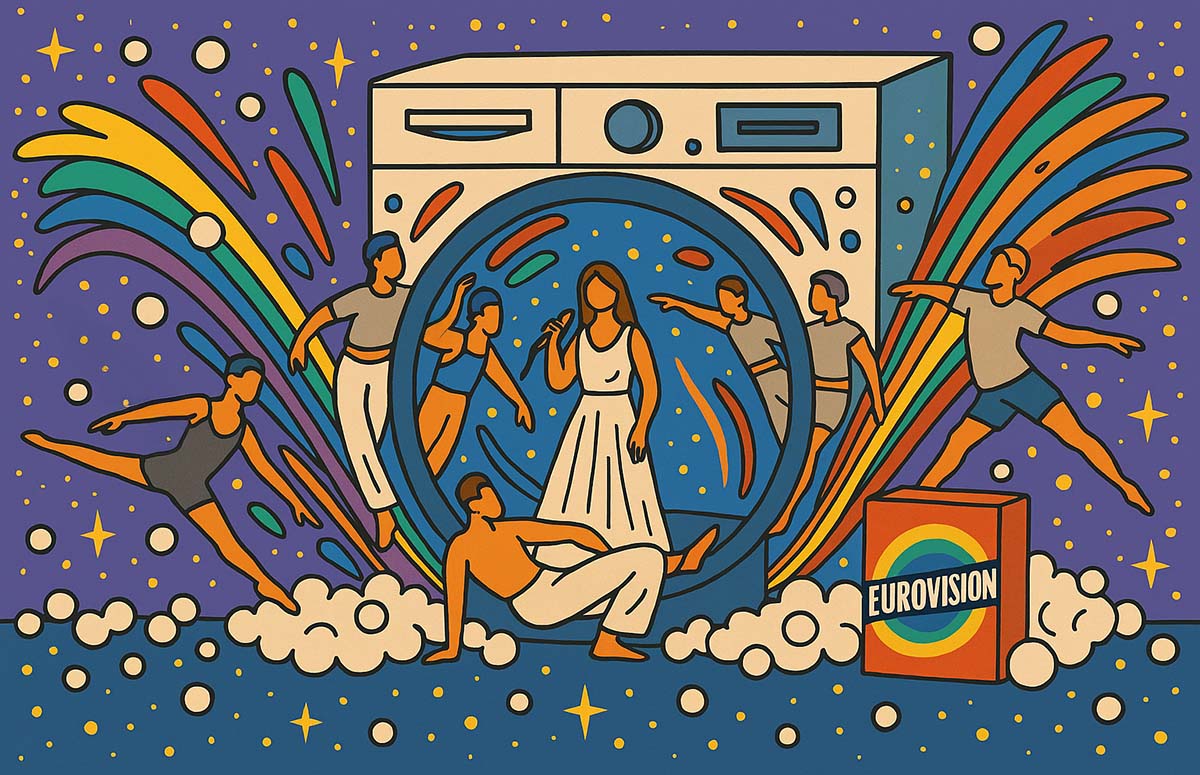
For the same reasons Vladimir Putin resurrected Intervision (not for his love of music), Eurovision serves as a stage for Israel’s political theater. The contest functions as a cultural detergent, scrubbing away inconvenient truths and establishing more convenient myths.
12 Points for Artwashing – A New Day Will Not Rise Here
During the interval act “Made in Switzerland”, Hazel Brugger and Sandra Studer – hosts of Eurovision 2025 in Basel – offered a lesson on the contest’s supposed neutrality: “And now you understand, that like the Swiss, Eurovision is non-political, strictly neutral. Doesn’t matter if you’re good or brutal, welcome gender diversity, but with decency and no nudity.”
However, Christian Knecht, the author of these bizarre lyrics, got it wrong; it does matter whether you’re good or brutal. It matters a lot.
The EBU leadership might not care more than robotically acknowledging “concerns and deeply held views”, but in this representative spectacle where audiences wave national flags instead of signs with singers’ names, decency and nudity should not be the only criteria for excluding a country.
Instead of flying its representatives to European institutions such as the International Criminal Court, Israel sends Benjamin Netanyahu’s human shields to entertain us on Eurovision stages
Nazi Germany also sponsored traveling art exhibitions and concerts to soften its image, contrasting its classical sculptures with “degenerate art” (similar vocabulary now used to degrade the music of Eurovision-boycotting countries), or employing orchestras to play Beethoven and Wagner as a distraction from wartime aggression. While cultural diversions served Reich propaganda (which, nota bene, suppressed Jewish contributions), they didn’t legitimize artwashing.
The operation in Gaza terminated over 70,000 “human-shield” lives to rescue a handful of hostages. Instead of flying its representatives to European institutions such as the International Criminal Court, Israel sends Benjamin Netanyahu’s human shields to entertain us on Eurovision stages.
With the EBU’s silent blessing, a country that enabled some of the gravest atrocities of our era – the holocaust in Gaza – is allowed to launder its deranged military actions through pop songs. Glitter becomes camouflage. The world’s clapping hands, fake applause, and manipulated votes become approval. This spectacle doesn’t help Israeli society confront reality. On the contrary, it deepens the denial and historical idea of grandeur, delaying, rather than delivering any real new day.
What is your view of Israel’s Eurovision victory?
Did EBU open the door for future artwashing as well?
Leave a comment below and pin the article for later!