
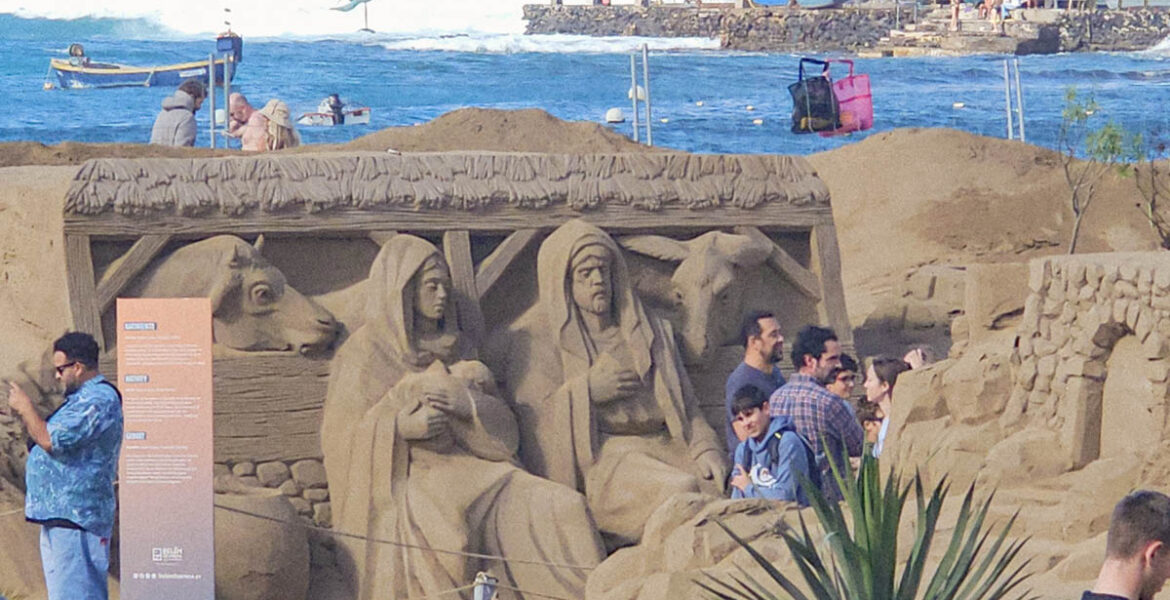
Playa de las Canteras in Las Palmas routinely finds itself on lists of the world’s best urban beaches. It boasts three kilometers of golden sand, calm waters protected by La Barra reef, and thanks to Gran Canaria’s stable subtropical climate, it’s in use throughout the year. Swimmers, snorkelers and surfers share the water; volleyballs, padel rackets and board games claim the sand. But when Christmas comes to town, Playa de las Canteras doesn’t just display bodies sculpted from sports. Carved from the beach itself, Belén de Arena in Gran Canaria is the largest sand nativity scene in the world.
In the winter of 2025/2026, 120,000 people visited Gran Canaria’s sandy Bethlehem over 24 days
The sound of waves replaces carols and church bells, bikinis stand in for heavy coats, and the only impression you can leave on the ground by sweeping your arms and legs is a sand angel… This might not be your typical Christmas. Yet, Biblical figures rising along the Atlantic shore depict a well-known story, more than two thousand years old.
Following the footsteps of the Three Kings, 120,000 people would visit this sandy Bethlehem over 24 days, gathering to glimpse the infant Jesus and, inevitably, to collect a generous supply of Belén de Arena photos, tagged #belendearena.
Sand nativity scenes do exist elsewhere. To find another Belén de Arena, you’d have to travel to the Catalan resort of La Pineda (Vila-seca, Tarragona), or to Italy, where coastal towns like Rimini and Jesolo have nurtured their own sand-carved Christmas traditions.
In recent years, other Canarian municipalities have begun experimenting with sand-crafted nativity scenes, which, if continued, will make the Spanish archipelago off Africa’s northwestern coast the world center of this Christian art form. Arucas, a town without a beach, inaugurated its own sand nativity in 2020 inside the historic Casa Gourié, now home to the Arucas Municipal Museum. There, artist Óscar Rodríguez offered contemporary interpretations in which the Holy Family might coexist with The Beatles, or consult Google Maps while searching for the way out of a war zone. In 2023, Arrecife in Lanzarote joined the movement, unveiling its own Belén de Arena at Playa de El Reducto.
Still, Belén de Arena at Playa de las Canteras in Las Palmas remains unrivalled, in both scale and conviction. For a few weeks each year, the beach becomes an open-air art gallery, reminding visitors that even the most familiar stories can be retold in unfamiliar ways.
What does Belén in Spanish mean?
In Spanish, Belén means Bethlehem, the biblical birthplace of Jesus Christ. The word itself comes from the Hebrew Beit Lehem, literally translated as “house of bread”.
Over time, Belén also came to mean the nativity scene itself: the familiar Christmas display that recreates the manger, usually in miniature form.
In Spanish-speaking countries, asking someone if they have put up their Belén doesn’t mean inquiring about geography; it means checking whether Christmas has officially begun in their living room.
What does Belén represent at Christmas?
At its core, the Belén is a story of simplicity. The Holy Family appears not in a palace, but in a stable, surrounded by animals, shepherds, angels, and the Three Wise Men. It is a visual shorthand for humility, faith, and continuity – values passed down as carefully as the figurines themselves.
The tradition traces back to St. Francis of Assisi, who in 1223 staged the first live nativity scene in a grotto near Greccio, Italy. His goal was disarmingly practical: to help ordinary people see, feel, and understand the humble circumstances of Christ’s birth.
Eight centuries later, the idea still works, whether the figures are carved from wood, molded from clay, or sculpted from sand.
Where can you find a Belén in Spain?
Almost everywhere. In Spain, Belenes appear wherever there is space, patience, and a sense of tradition. They inhabit private homes and church corners, town halls and shop windows. Madrid installs one in its city hall. Mollina, in Málaga province, dedicates an entire museum to them (Museo de Belenes).
Some villages go bigger. Benijófar in Alicante is known for large-scale displays, while parts of Andalusia take the concept further with belenes vivientes – living nativity scenes complete with costumed performers, choreography, and markets.
Postojna Cave in Slovenia also hosts spectacular living nativity scenes. Check it out!
The most ambitious Spanish regions even create nativity routes (rutas de belenes), inviting visitors to wander from scene to scene, whether in major destinations like Valencia and Mallorca or smaller towns such as Gáldar.
In this national landscape of devotion and creativity, Belén de Arena stands out not by reinventing the tradition, but by relocating it – from shelves and courtyards to the open beach.
What is Belén de Arena?
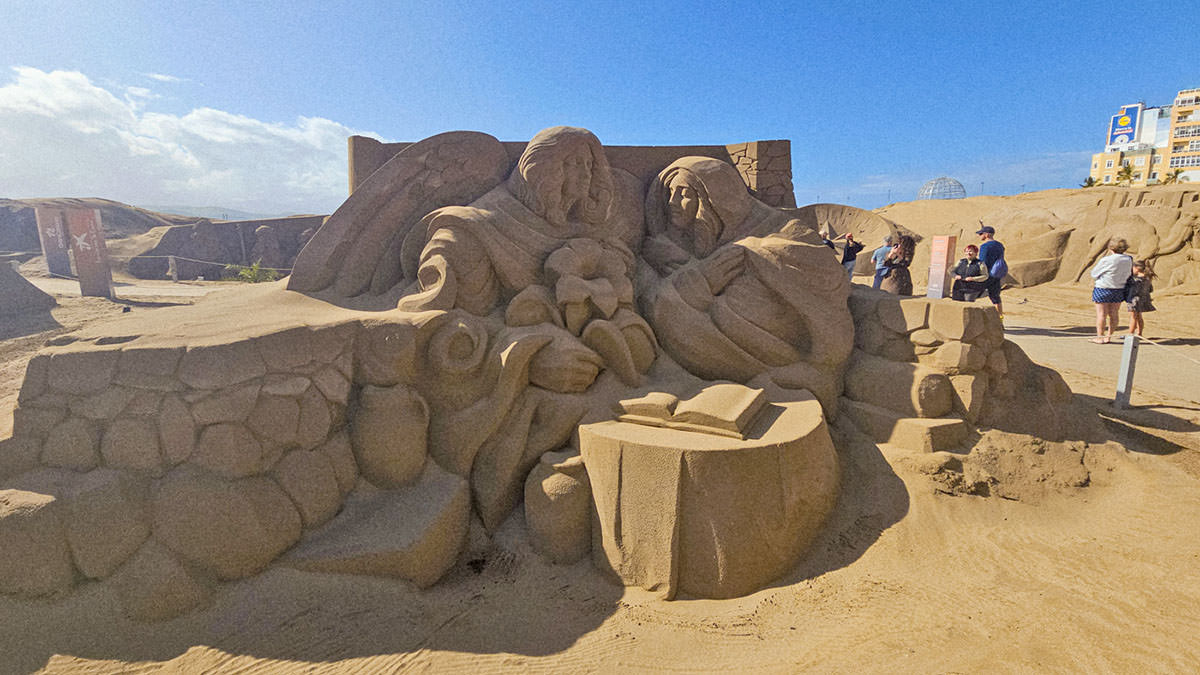
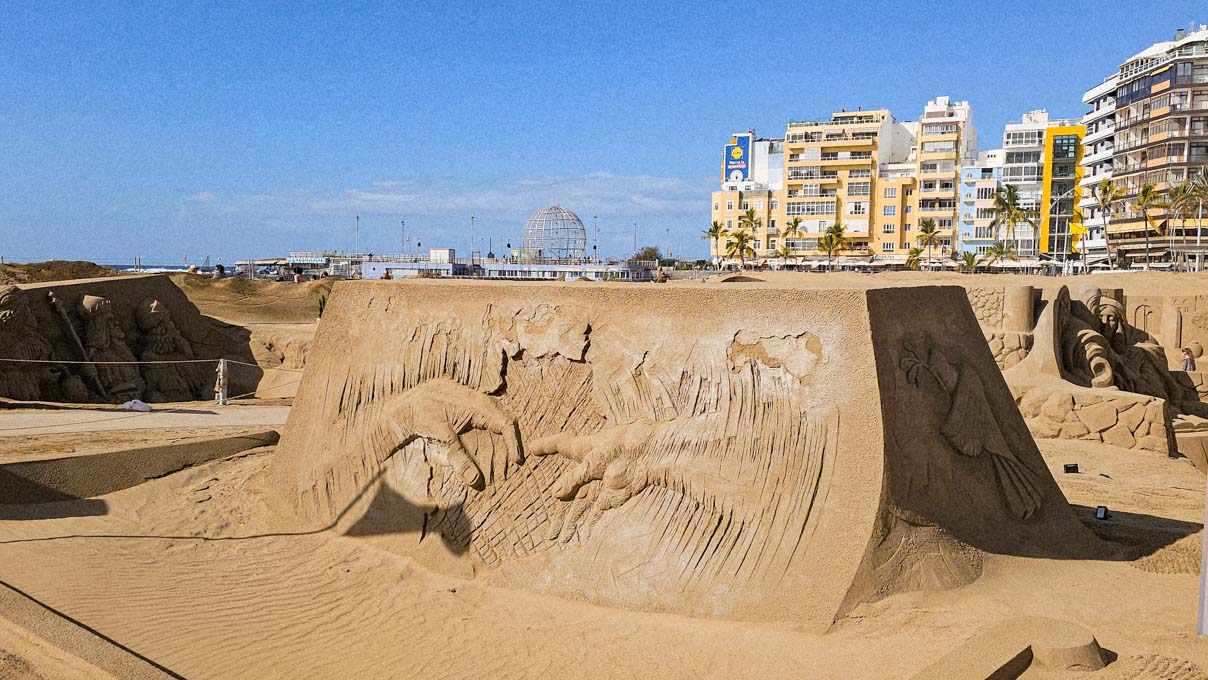
Belén de Arena is exactly what the name promises – a nativity scene sculpted entirely from sand.
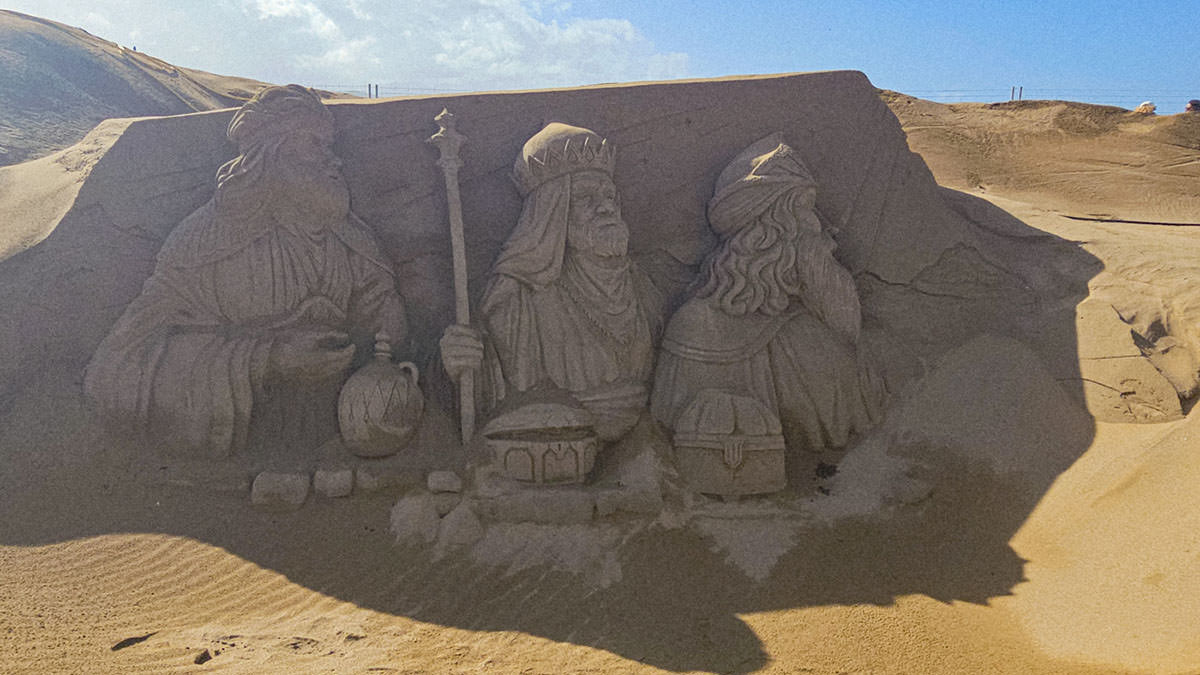
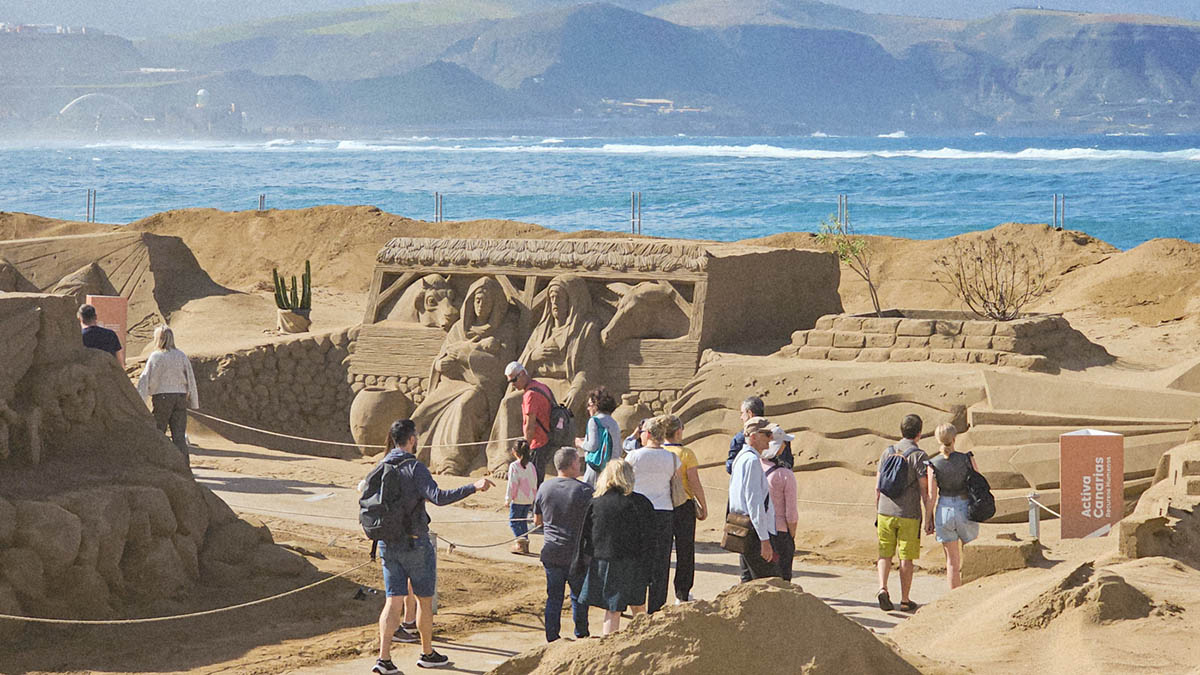
The most famous Belén de Arena is the one constructed on Playa de las Canteras in Las Palmas de Gran Canaria. Each December, the beach becomes a temporary workshop where professional sand sculptors from as far away as Canada, Australia, and Ireland work alongside local Canarian talent. Armed with little more than sand, water, and patience, they carve monumental biblical scenes just meters from the Atlantic, shaping figures that seem improbably permanent despite their fragile material.
The scale is deliberately excessive. The exhibition is built from around 1,500 cubic meters of compressed sand, with individual sculptures consuming up to 60 tons each. Some motifs in this XL Belén de Arena can rise nearly three meters high.
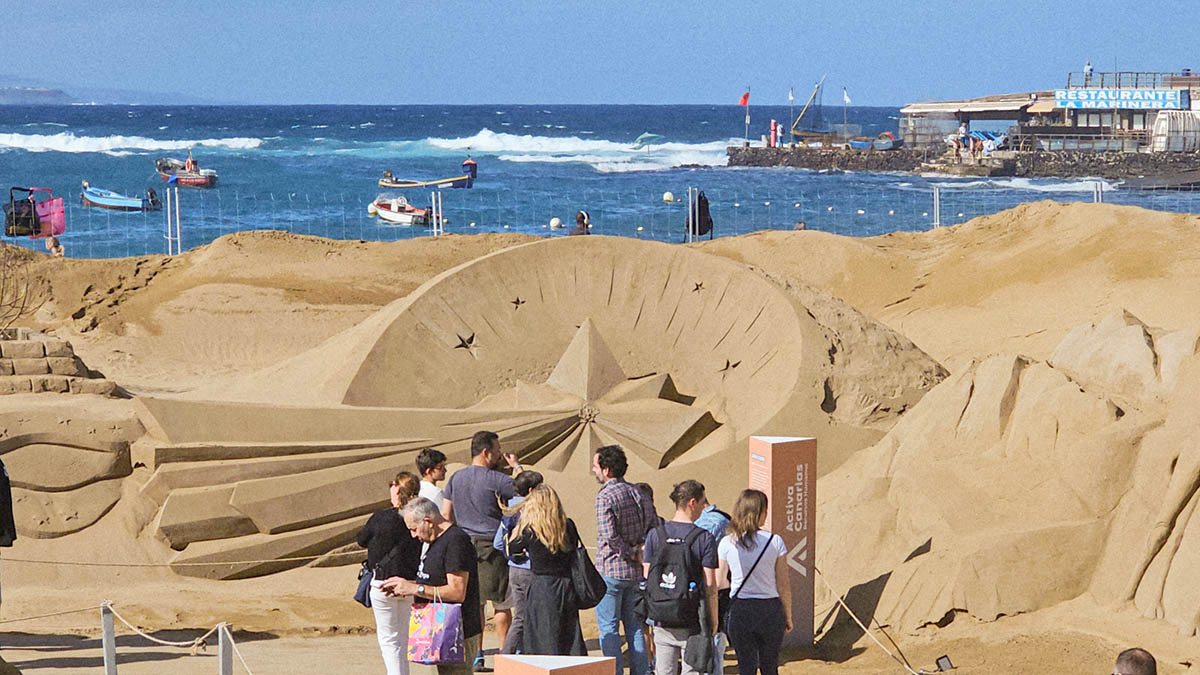
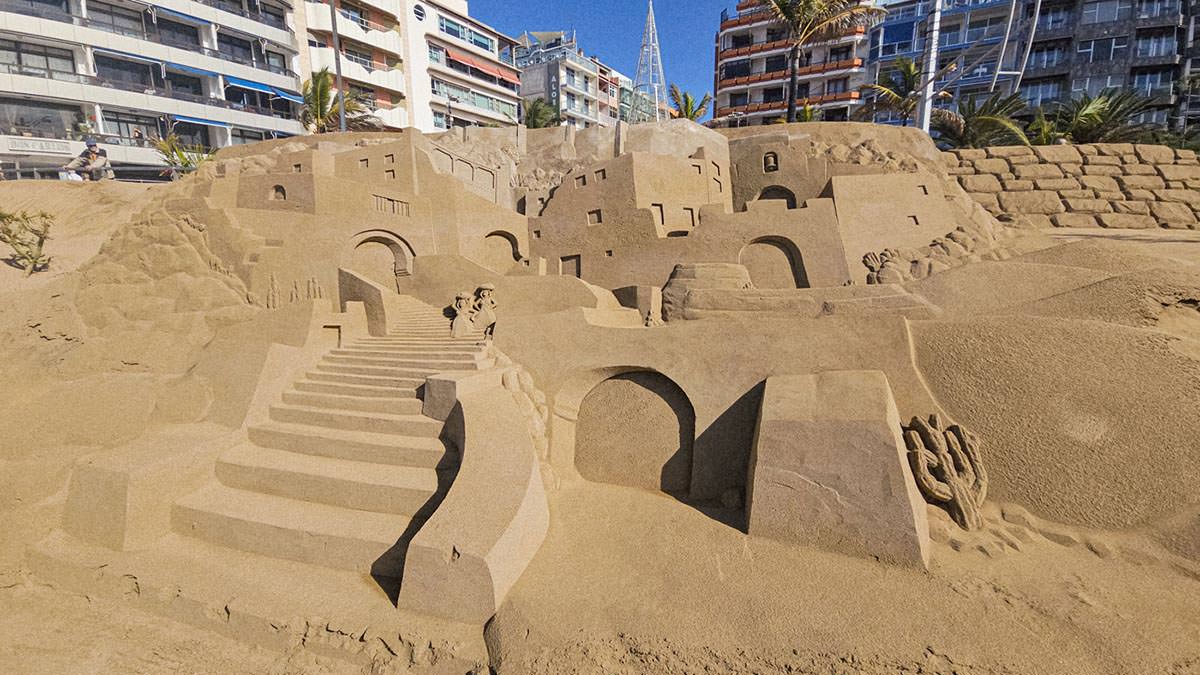
The scenes themselves follow familiar ground – the Manger, the Three Wise Men, the Star of Bethlehem – but they rarely stop there. Elements of Gran Canaria’s landscapes and cultural identity are subtly woven into the compositions, anchoring the biblical narrative to the island rather than transplanting it unchanged.
Unlike traditional nativity displays confined to churches or living rooms, Belén de Arena is:
- temporary
- exposed to wind and weather
- rebuilt from scratch every year
Its beachside location is not merely practical, for the abundant sand supply. There is a symbolism here. In Las Palmas, the beach is not a backdrop to life, but a place where life happens. Belén de Arena is built on Canarian identity and its beach culture.
How Sand Nativity Scenes Are Made
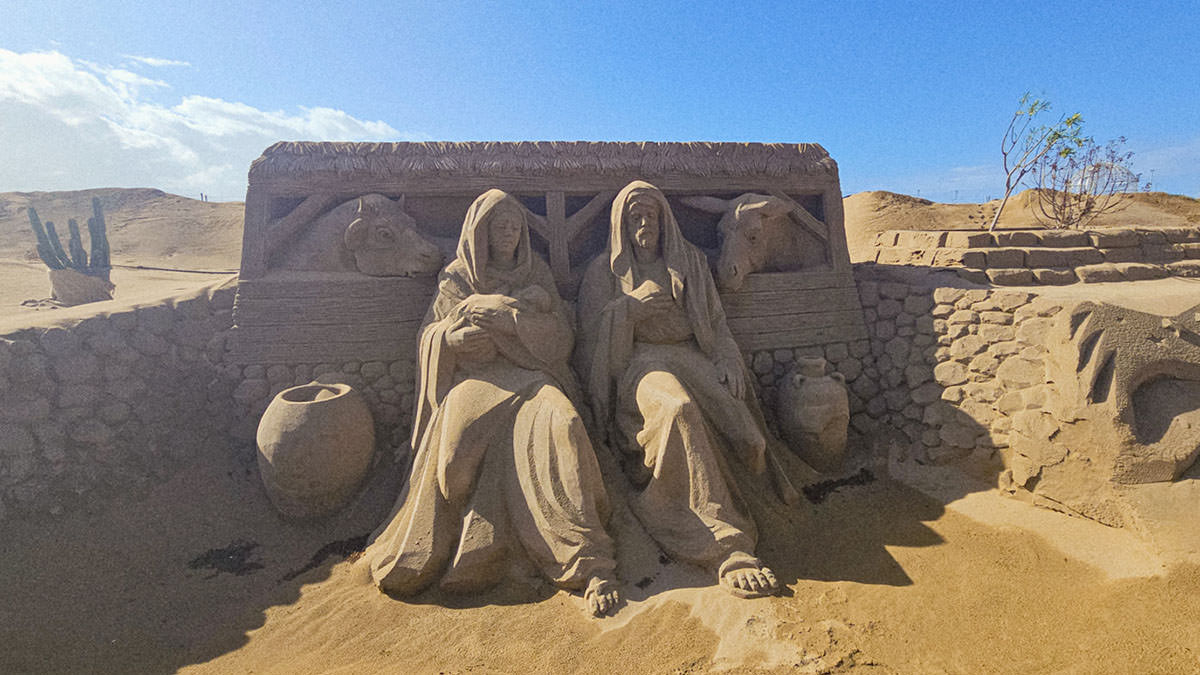
Professional sand nativity artists rely on an almost comically modest toolkit as well as materials. There is no concrete, no glue, no hidden steel skeleton holding things together. Just sand, water, gravity.
The process begins with sand thoroughly mixed with large amounts of water until it reaches a dense, mud-like consistency. This mixture is packed into large, bottomless plywood molds, layer by layer, and compacted until it forms solid blocks. Once the molds are removed, sculptors carve from the top down, carefully releasing figures that were “already there”, waiting under pressure.
The tools are simple but varied:
- Shovels and trowels – for rough shaping.
- Palette knives and spatulas – for defining lines, shapes, and details.
- Loop tools – for removing sand during sculpting.
- Brushes, brooms, and rakes – for smoothing surfaces.
- A plastic straw – for blowing away loose grains of sand from delicate areas.
Unlike small-scale hobbyist sand art, no glues or internal fixatives are used in large public displays like Belén de Arena. Stability depends entirely on proper sand processing and compression, as well as constant misting to prevent sculptures from drying out.
If you want to create sand art yourself, start with something simple, such as this sand nativity scene kit. Sprinkle colored sand into predefined spaces, and create your own miniature Belén at home.
Belén de Arena History – From Three Figures to a Quarter Million Visitors
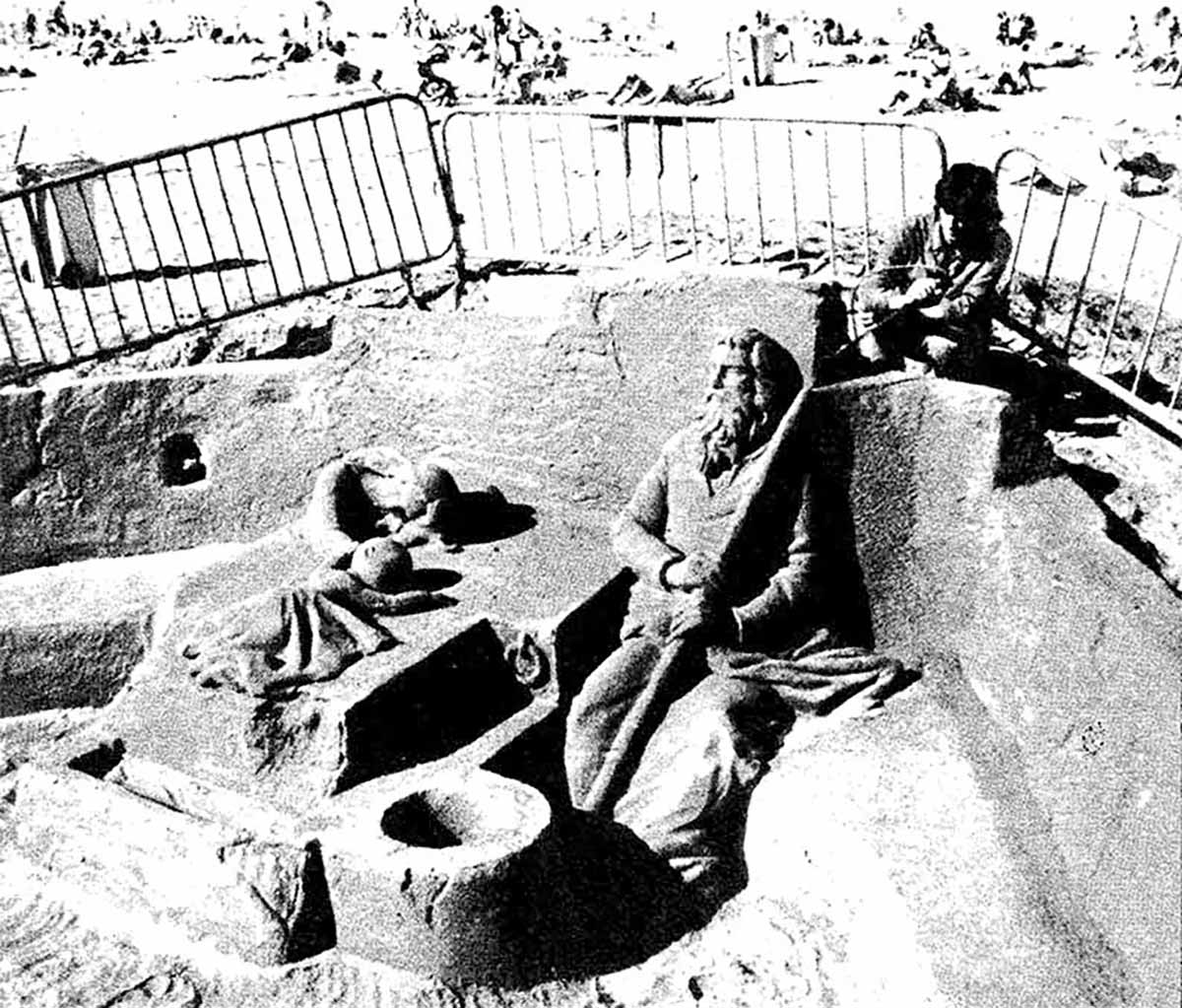
The first Belén de Arena in the Canary Islands was installed on Playa de las Canteras in 1987. With financial support from the City Council of Las Palmas de Gran Canaria, sand artist Etual Ojeda created a simple nativity scene depicting Mary, Joseph, and baby Jesus.
However, the real Belén de Arena inauguration, in the form we know today, happened at Las Canteras in 2006. Under the artistic direction of founder Miguel Rodríguez, the project included eight artists and eight large-scale sculptures, enough to attract 180,000 visitors.
Except for 2011, when 40 thousand people visited Belén de Arena, the attendance fluctuated between 100 and 200 thousand each season. The 2024 edition set a new benchmark, attracting 259,305 visitors, the highest figure in its history.
As the crowds grew, so did the ambition. What began as a local initiative evolved into an international artistic collaboration, welcoming sand sculptors from around the world while remaining firmly rooted in Las Palmas.
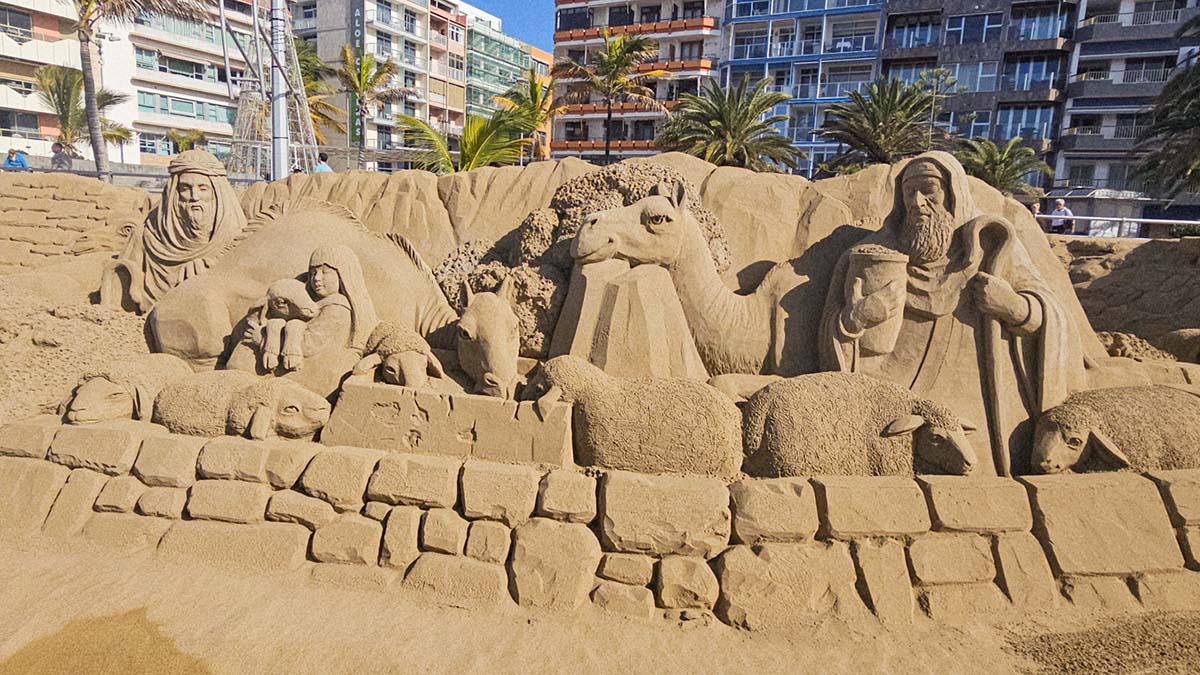
Each edition brought new compositions, refined techniques, and fresh narrative interpretations. Figures changed, scenes expanded, and craftsmanship deepened. Yet, one principle never shifted: everything is made of sand, and everything will eventually return to it.
From the beginning, Belén de Arena also insisted on being more than an art installation. Entry has always been free, but visitors are encouraged to donate, with proceeds traditionally directed toward local soup kitchens and social organizations supporting the homeless.
The 20th edition of Belén de Arena (2025/2026) raised 15,000 euros for humanitarian needs, while in 2015, a record €28,032 was collected. Over two decades, 288 thousand euros have been redirected to social causes, showing that this tourist attraction is also a community project, with a purpose that goes beyond spectacle.
Visiting Belén de Arena at Playa de las Canteras: Schedule and Tickets
Location and Setting
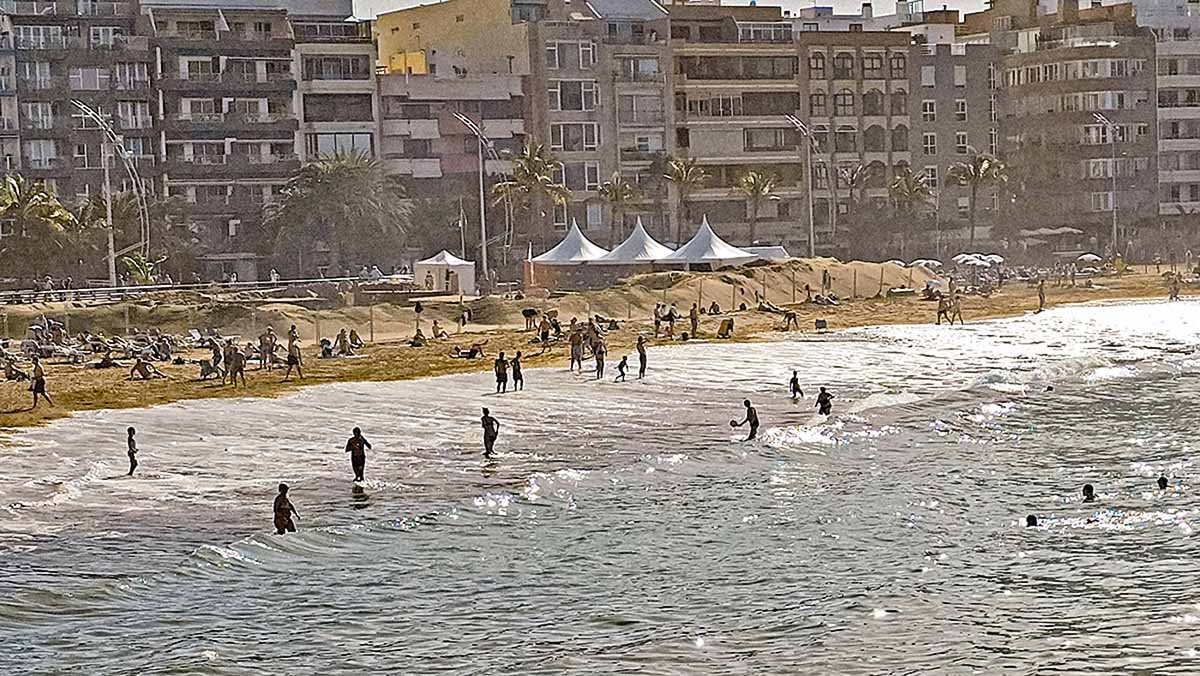
Belén de Arena is located directly on Playa de las Canteras, at the northern end of the beach (La Puntilla). Reaching it requires no more effort than a leisurely walk along the promenade.
The exhibition exists in the very space where people sunbathe, swim, jog, and walk their dogs for the rest of the year.
That openness is a defining feature of the experience. Las Palmas sand sculptures share the surroundings with passing runners, curious children, and the steady soundtrack of the sea, keeping the visit informal and unceremonious.
Opening Dates, Times, and Entry
Belén de Arena typically opens in mid-December and remains accessible until early January (just after Three Kings’ Day), covering the entire Christmas and New Year period.
Standard opening hours are 10 am to 10 pm, with earlier closures at 8 pm on Christmas Eve (24 December), New Year’s Eve (31 December), and the eve of Epiphany (5 January).
Practicalities are refreshingly simple:
- Entry: Free admission, no booking required
- Donations: Voluntary but highly encouraged (Belén de Arena is a solidarity event)
- Access: Open-air and fully accessible, including for visitors with reduced mobility
At the entrance, staff will politely ask where you are from – a question asked for statistical purposes rather than existential reflection – and then step aside, leaving you free to wander among the sculptures at your own pace.
Best Time to Visit
Belén de Arena subtly shifts personality over the course of the day:
- Daytime highlights the craftsmanship, textures, and proportions of the sculptures.
- After sunset, subtle lighting turns the exhibition almost theatrical, with shadows adding depth and drama. Powered by solar panels, the illumination is entirely sustainable – proof that even Christmas atmospheres can run on sunlight.
Evenings tend to be busier, but they also deliver the most memorable impressions.
Visitors seeking fewer crowds may prefer weekdays, while those who enjoy slow, unhurried exploration can even opt for a virtual visit, available for the current and some past editions – a rare opportunity to revisit a work of art designed to disappear.
Best Places to Stay at Playa de las Canteras

Playa de las Canteras offers no shortage of beachfront accommodation, many of them just steps away from Belén de Arena and the everyday pleasures of the promenade. Whether you prefer spa indulgence, surf culture, or silence, there is a bed here with your name on it.

If a four-star stay with extras sounds appealing, Bull Reina Isabel & SPA is hard to beat. The hotel features a rooftop pool, free spa access, a gym, and even complimentary beach loungers and parasols. Breakfast is unapologetically generous; expect everything from fresh orange juice to cava, and yes, even vodka. Rates are available via Booking, Agoda, Trip, and Expedia.

Another four-star beachfront option is Sercotel Playa Canteras, located in the very heart of the promenade. Its understated décor and ocean views make it especially popular with couples looking for comfort without excess. Available on Booking, Trip, and Expedia.

Just a few steps from the sand nativity scene, the three-star Hotel Aloe Canteras scores high for location and comfort. Bright, modern rooms face the Atlantic, and the surrounding neighborhood is packed with restaurants. For late-night cravings, the hotel’s vending machines stand ready around the clock. Compare prices on Booking, Agoda, Trip, or Expedia.

Travelers who prefer a bit more independence may enjoy Chez Abel, an apartment-style stay with a kitchenette and outdoor dining area – ideal for slow breakfasts or improvised dinners after a beach walk. Apartments can be reserved via Booking, Agoda, or Trip.

If your idea of a holiday includes doing everything possible to avoid squeaky voices, Wavia Hotel offers an adults-only alternative. Located just north of Playa de las Canteras, it’s a favorite for two-person trips and quiet mornings. Find it on Booking, Trip, or Expedia.

Surfers should aim south, where the waves are more cooperative. Agüita Surf Lodge sits near the best surf conditions on the beach and includes a solarium – useful if the Canarian sun somehow fails to satisfy. Bookable through Booking or Agoda.

And when beachfront access only truly matters if it comes with company, La Ventana Azul Surf Hostel delivers the social side of Las Canteras. Dormitories, a game room, and activities ranging from yoga and windsurfing to fishing trips and film nights make it a lively base. Reservations are available via Booking, Agoda, Trip, Expedia, or Hostelworld.
Belén de Arena in Gran Canaria – Art Made to Disappear
Christmas in Gran Canaria follows its own rules. There is no frost on the ground, no visible breath in the air, and no collective rush indoors to escape the cold.
While much of mainland Europe shivers, visitors to Belén de Arena arrive in short sleeves, some even in swimsuits. They can admire world-class sculpture, and then wander a few meters farther to take a dip in the Atlantic Ocean.
Belén de Arena turns the Christmas story into a literal lesson in presence. What stands before us will not be there forever
With around 5,000 visitors a day, the exhibition quietly proves that democratization of access to art still matters. In December, Belén de Arena at Playa de las Canteras becomes Spain’s third most visited “museum”, surpassed only by Madrid’s Prado and Reina Sofía.
Created in barely ten days and dismantled in a matter of hours, the sculptures of Belén de Arena were never meant to endure. Vulnerable like street art, they are designed to exist for a moment and to be erased in the next one. It is art that shines like the brightest comet in the sky, and then burns as soon as it enters our atmosphere, accepting its disappearance.
Artists know that sand is an unforgiving material. Wind softens sculptures’ edges, humidity reshapes surfaces, and rain can undo hours of work in minutes.
Belén de Arena turns the Christmas story into a literal lesson in presence. What stands before us will not be there forever.
Even if, by miracle, a sculpture survives the season intact, it is ultimately leveled, its sand returned to beach towels, flip-flops, and children’s castles.
Until the next year, when new artworks will rise, formed from the same grains.
Did you like this guide to Belén de Arena at Playa de las Canteras?
Pin the article for later!
Disclosure: This post may contain affiliate links, meaning if you click on them and make a purchase, Pipeaway may make a small commission, at no additional cost to you. Thank you for supporting our work!
