You might have ended up here wondering: In Toy Story 5, who is the villain? Stick around, and I’ll tell you at the end. But this isn’t a review of Pixar’s 2026 blockbuster. The playground for the toy stories discussed in this text is art and media galleries, not multiplexes. Here, the main character believes his critics should be replaced by loyal and obedient pull-string cowboy dolls, with the flashiest toy in the box – the buzz word of the lightyear: antisemitism. The hero’s name is Benjamin Netanyahu.
Not many would call the guy a hero. But Galerie Gleis4, the same Basel gallery that, last autumn, presented Donald Trump’s crucifixion with a cruci-fictional dilemma “Saint or Sinner?”, is now asking the public whether Bibi, the most wanted war criminal on the planet, is “Hero or Villain”.
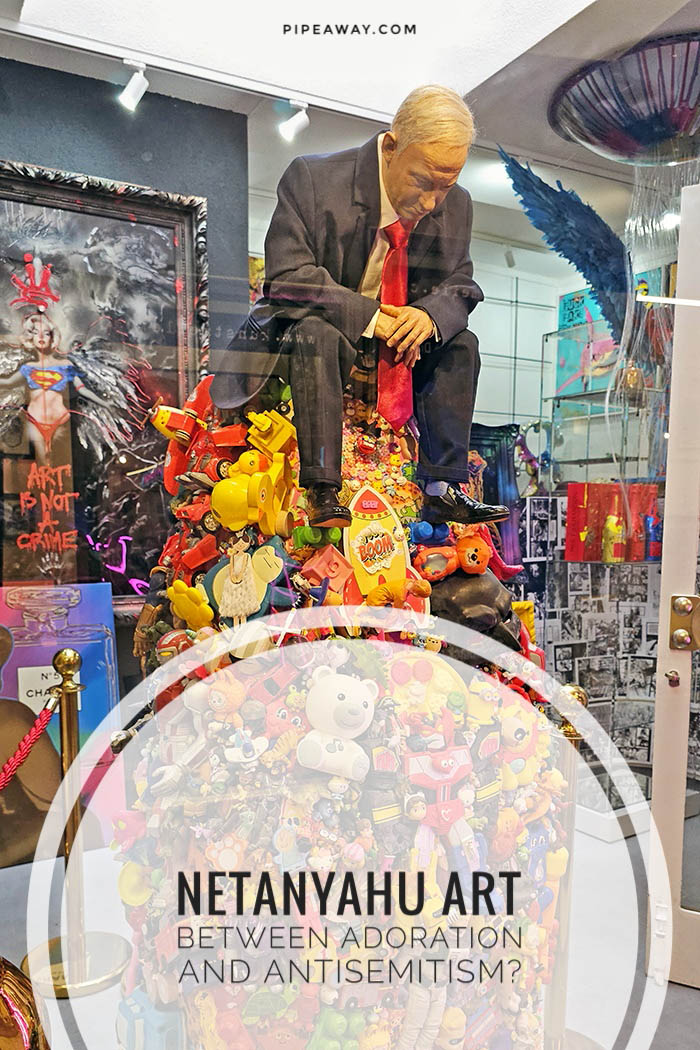
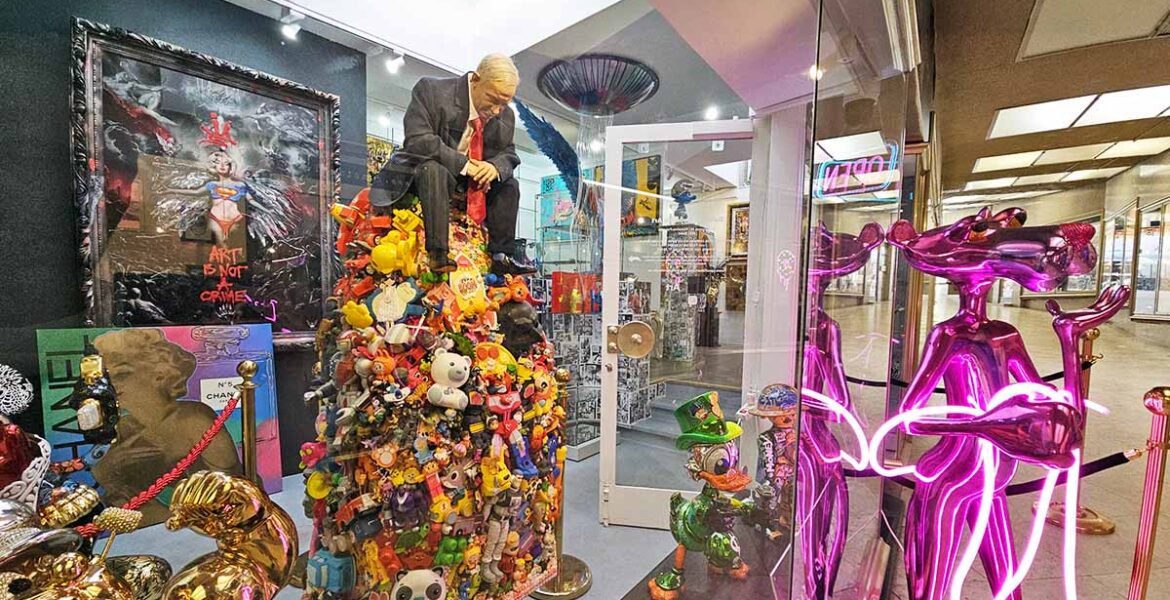
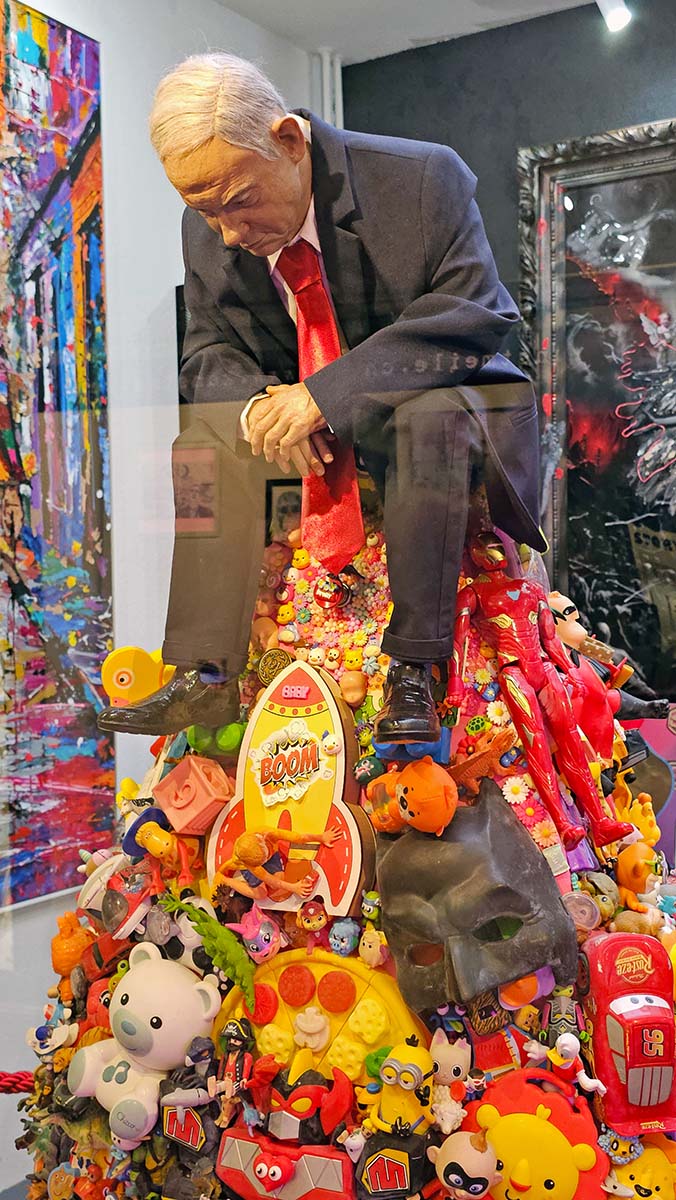
Israeli Prime Minister Benjamin Netanyahu sits on a pile of children’s toys, contemplating over “The Gates of Hell”
The British wannabe-provocateur Mason Storm returned to the Swiss art mecca, bragging about breaking his own sales record, having sold his idea of a controversy to “a renowned Basel art collection, for an undisclosed sum”, sight unseen.
He named the latest lucrative sculpture – “Toy Stories”. Is it a plural because of the copyright? The logo in the gallery window clearly rips off a singular “Toy Story” title.
A miniature version of Israeli Prime Minister Benjamin Netanyahu sits on a pile of children’s toys, deep in thought. Surely, you assume, a reference to the record-breaking number of children killed and injured in Gaza. Or to the record-breaking number of amputated children’s limbs, unable to reach for the toys beneath the Storm’s contemporary version of Rodin’s “Thinker”, contemplating over “The Gates of Hell”.
But no. The artist insists this isn’t about the man depicted at all: “It’s about you, the viewers.”
The courageous Mason Storm, who prefers to keep his face hidden, is, once again, questioning the audience’s instinct to “quickly judge” – straight out of Pontius Pilate’s moral handbook.
“How can reasonable people look at the same person, the same idea, the same fact – and come to completely opposite conclusions?”, the artist wonders, innocently. “Some see a hero. The others a villain. Some see courage, others danger. Some hope, others threat. And often both sides talk about exactly the same thing.”
Provocation in Gloves Doesn’t Work
Mason Storm’s “Toy Stories” are designed as a “provocative work”. The artist’s press materials openly anticipate that the work will trigger attacks and criticism. Nevertheless, “art does not exist to affirm people in their comfort zone. It is intended to ask questions, create friction, enable discussion”, we are taught.
There are two very interesting dimensions here.
First, people feel uncomfortable when being asked this-or-that questions with obvious answers. They might entertain the conversation out of politeness, but in that case, the attached discomfort tells us nothing about whether the art itself has any teeth.
Second, strip away the unveiling news coverage and the artist’s own statements, and “Toy Stories” generated no substantive art criticism whatsoever. Despite the subject matter and timing, there was no condemnation from Israeli officials or passionate public reaction. No protests, no vandalism, no social media firestorm.
In 2026, an artwork referencing Israel that doesn’t trigger a single antisemitism accusation or, at least, pro-Palestinian protests, is maybe not provocative after all.
What we have learned from the history of Netanyahu’s PM chair (which he occupies for so long that, in the future, it could be used as a casting mold for authentic sculptures of his buttocks), or the history of authoritarian regimes with similarly extended governing tenures, is that leader-portraits appear either as the cheapest form of idolatry, or, usually much pricier, critical voice against their wrongdoings.
Mason Storm might deserve his own category: political-topic monetization engineered specifically not to offend anyone with a checkbook.
The number of reactions might be inversely (and perversely) proportional to the bank balance, but a “provocative” Netanyahu portrait that fails to provoke a single response from the usual zionist watchdogs should probably reconsider what it’s actually selling.
Bibi in Israeli Art – Between Adoration and Death Threats
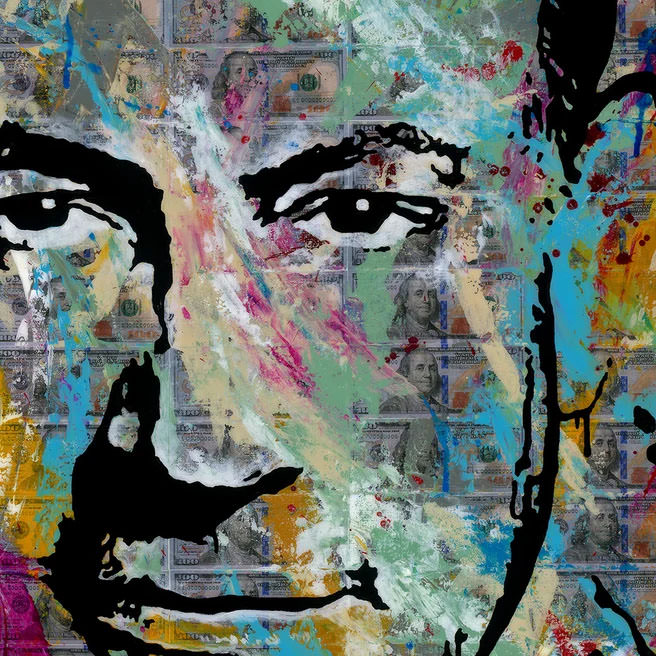
Nobody takes Bibi as a muse for his exceptional cheekbones. The inspiration for portraying such a public persona is never aesthetic, and always political.
Among the rare reverent entries is Israeli mural artist Doron Viner’s portrait of Benjamin Netanyahu rendered across dozens of $100 bills. As an art print reproduction, the work is currently listed for $120 on the artist’s website. But the description of Netanyahu is priceless: “one of the best who served well during his terms”, “known for his ability to grow businesses and has proven to bring the Israel economic growth to new heights”.
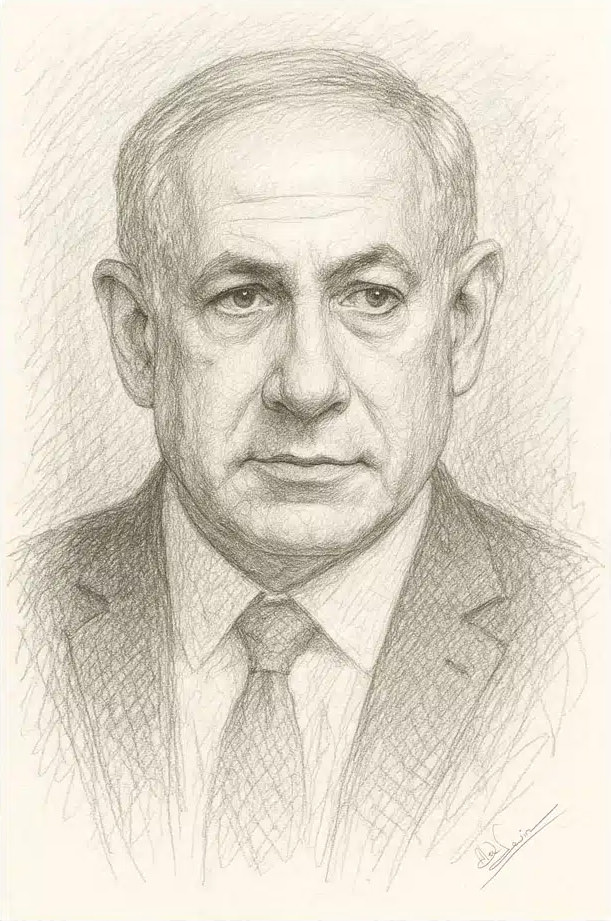
Israeli artist Alex Levin, compared to Rembrandt by one enthusiastic Facebook commenter, shared a pencil portrait carrying “a message of gratitude to the Prime Minister for his leadership”. The image of Netanyahu with a “focused and determined expression, reflecting a moment of inner strength and resilience” went viral.
As Levin explains, his work is seen as “not only a reflection of beauty and faith but also as a mirror of Israel’s collective consciousness, where art and civic identity intertwine in powerful and meaningful ways.”
Those artists in Israel who approach their governing holy cow with even the most subtle criticism are a mere toothpaste stain on that distorted mirror, a proof of a hygienic attempt screaming for removal.
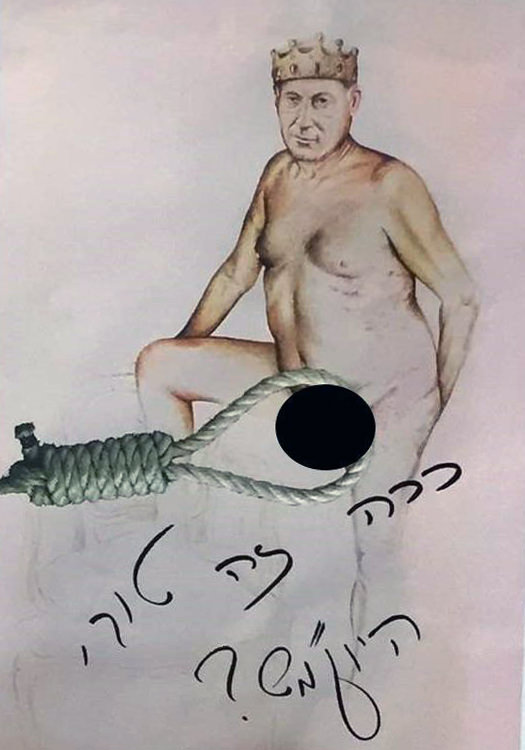
In December 2016, police entered Israeli art schools to investigate an 18-year-old student’s coursework.
A piece depicting Netanyahu with a hangman’s noose was read as an “artistic talent used to incite and murder” by Culture Minister Miri Regev, demanding the state defund the Bezalel Academy of Arts and Design in Jerusalem over it.
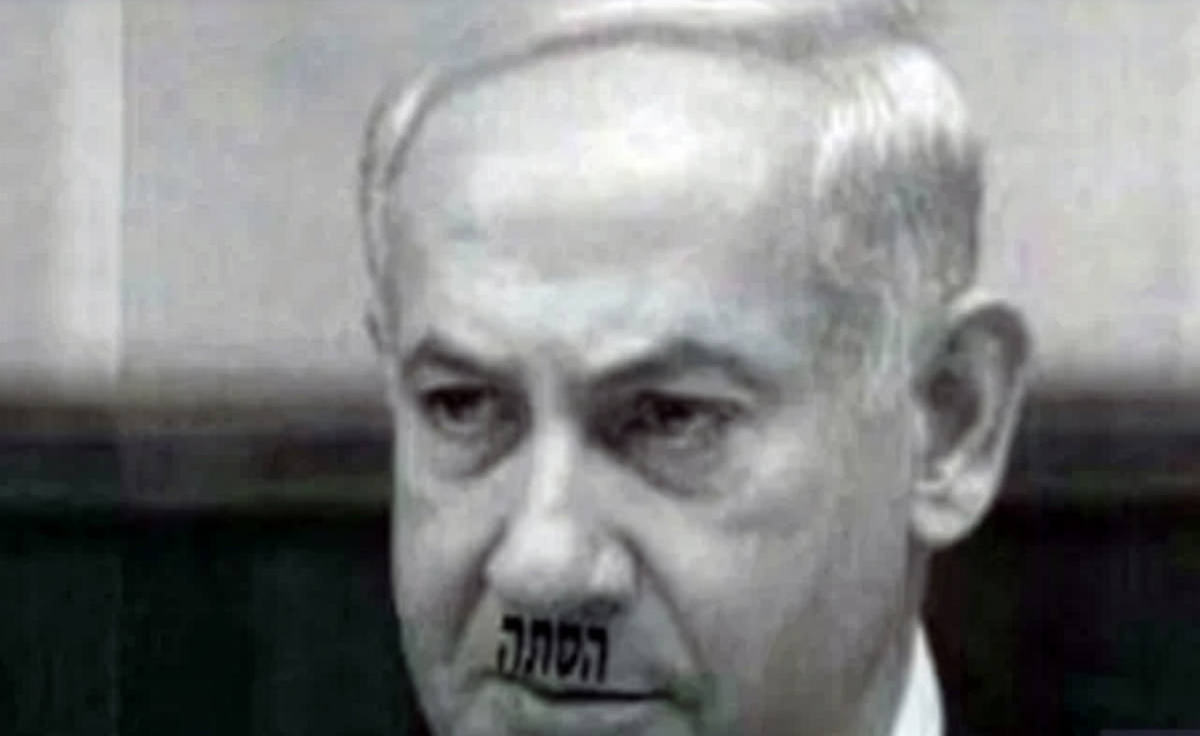
Amid the student protests, another Netanyahu portrait surfaced at Ramat Gan’s Shenkar College of Art in Tel Aviv – Prime Minister’s face with a Hitler-style mustache spelling “incitement”.
The critique was on point; Netanyahu has his own history with incitement accusations, having joined 1995 rallies branding then-PM Yitzhak Rabin a “Nazi” for signing a peace deal with the Palestinians. The “Nazi” tag, evidently, is only antisemitic when it’s pointed the other way. Rallies carrying both etiquettes and real coffins resulted in Rabin’s assassination.
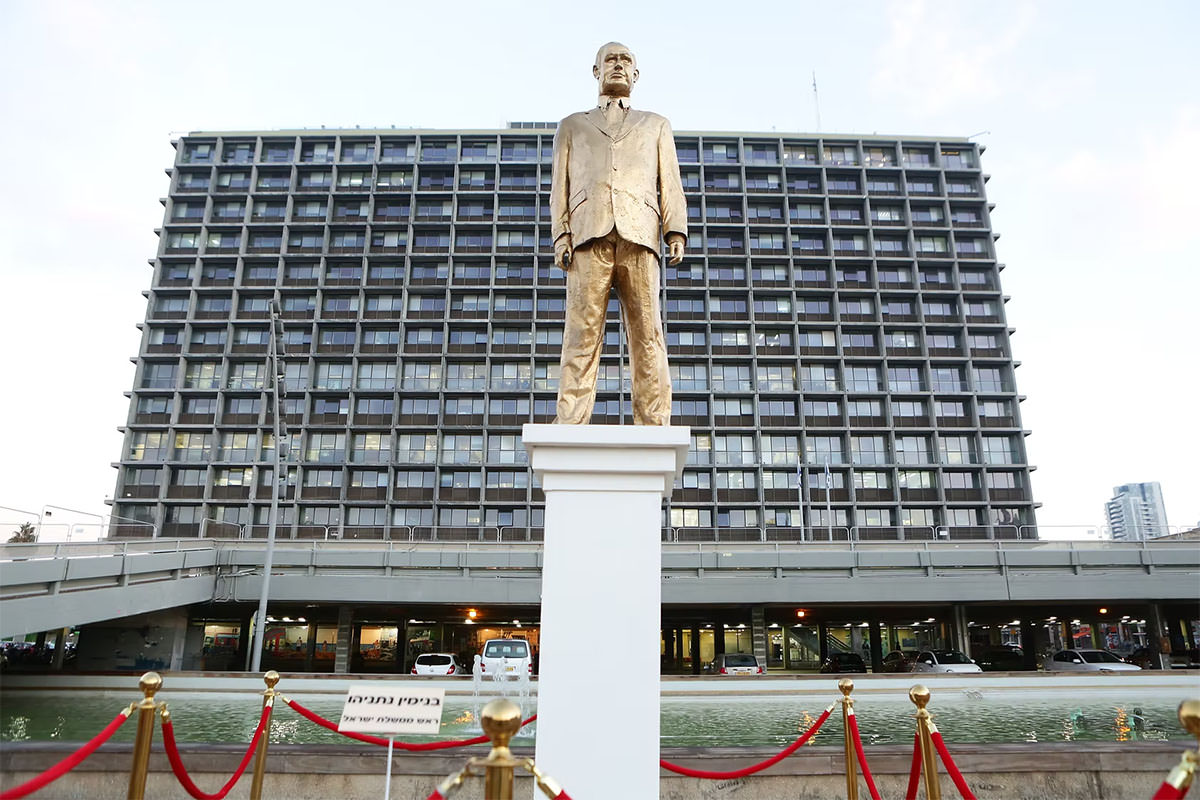
That same December 2016, sculptor Itay Zalait erected a golden statue of “King Bibi” on Tel Aviv plaza once known as Kings of Israel Square. Regev, famous for demanding loyalty to the state as a condition for government funding, was shocked again, and called the act an “expression of hatred toward Netanyahu”.
Zalait returned for round two during the 2020 protests against the PM with “The Last Supper” installation – Bibi, “the savior of Israel”, presiding over a lavish final meal. This time Netanyahu responded personally, calling it “the shameful threat of crucifixion”.
The History of Netanyahu’s “Antisemitic” Art
Unreachable for Israeli police intervention and defunding threats, Mason Storm wasn’t even judged worthy of the antisemitism label – now the zionist regime’s go-to tool for controlling the narrative among its critics.
That’s awkward to report on, because, you see, even this sentence could be considered an exploitation of an old antisemitic trope – the idea that “Jews control the world”.
But Nazi-era obsession with Jews has nothing to do with an indisputable fact that, in a media landscape with steadily shrinking scrutiny of Israeli policy, any sufficiently sharp critique of Benjamin Netanyahu tends to get relabeled as hatred of an entire people.
International Criminal Court chief prosecutor Karim Khan? “One of the great antisemites in modern times.” US campuses protesting against the war in Gaza? “Antisemitic mobs.” Antigovernment demonstrators in Israel? “Exactly like fascists.” A Norwegian mural of Anne Frank wearing a Palestinian keffiyeh? “Pro-Hamas Nazis.”
Weaponizing Holocaust memory to shield a war criminal suspect doesn’t just miss the point. It dilutes the perception of real antisemitism in the world.
And, also, it just doesn’t work. Kippah is not a magical force field against criticism. Using it to deflect attention from the real topic is now a trick seen a time too many.
Here are eighteen Bibi artworks that found that out the hard way.
1. Strings Attached
(The Guardian, Steve Bell, November 2012)
Steve Bell drew Netanyahu on a podium with Israeli missile-resembling flags while puppeteering UK PM Tony Blair and Foreign Secretary William Hague, under a “Vote Likud” banner.
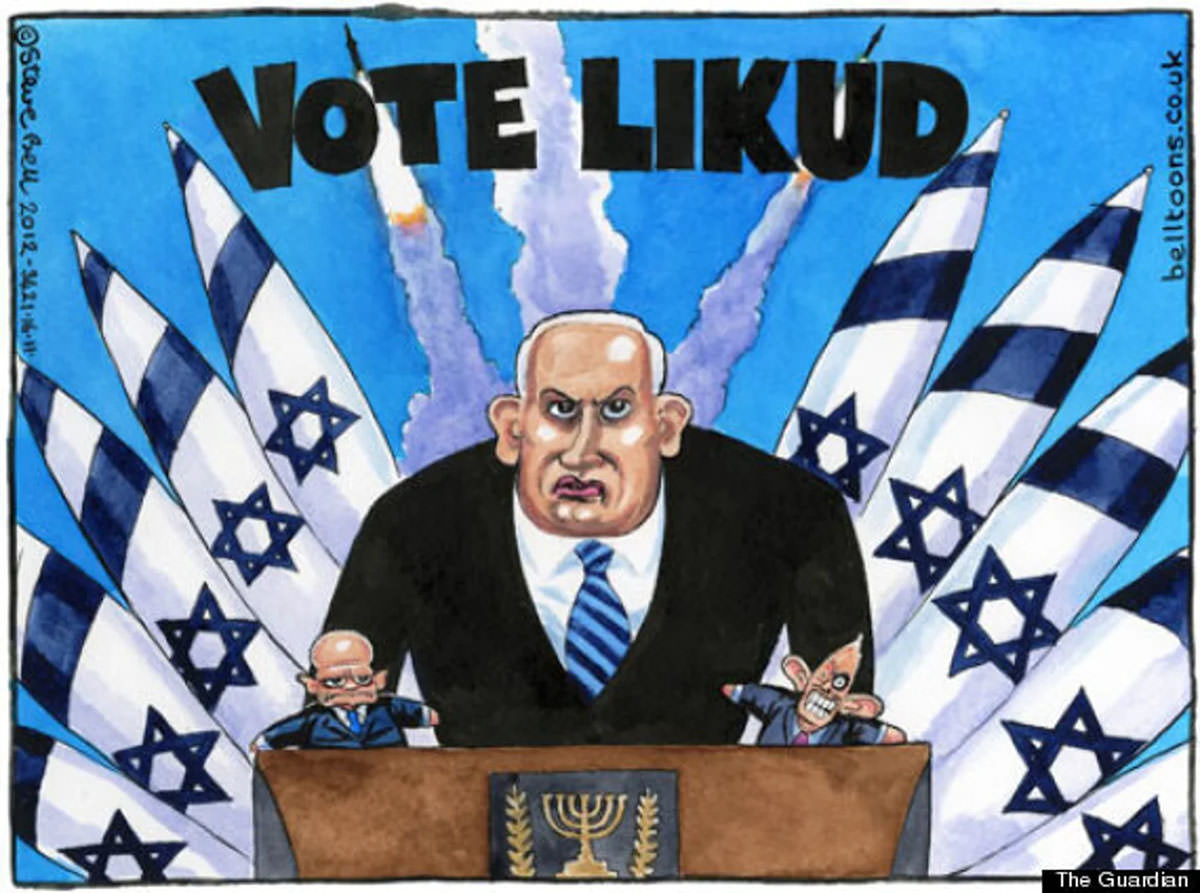
The reactions immediately rained on the author, with Jewish Times columnist Giles Coren calling him “Nazi c***”.
The Community Security Trust, a Jewish advisor on antisemitism, called it “an unoriginal way of visualising the old antisemitic charge that Jews are all-powerful”.
Now, it is true that Nazi propaganda has been using an image of Jews as puppet masters of world politics, but Bell wasn’t having it: “This is not about the Jews: it’s about Benjamin Netanyahu. (…) It is about the cynical manipulation of a situation by a specific politician and NOT about cynical manipulation by ‘the Jews’. I refute completely any charge of antisemitism, since I would never conflate the two.”
2. Blood and Mortar
(Sunday Times, Gerald Scarfe, January 2013)
Netanyahu building a wall out of Palestinian bodies, captioned: “Israeli Elections: Will cementing peace continue?”
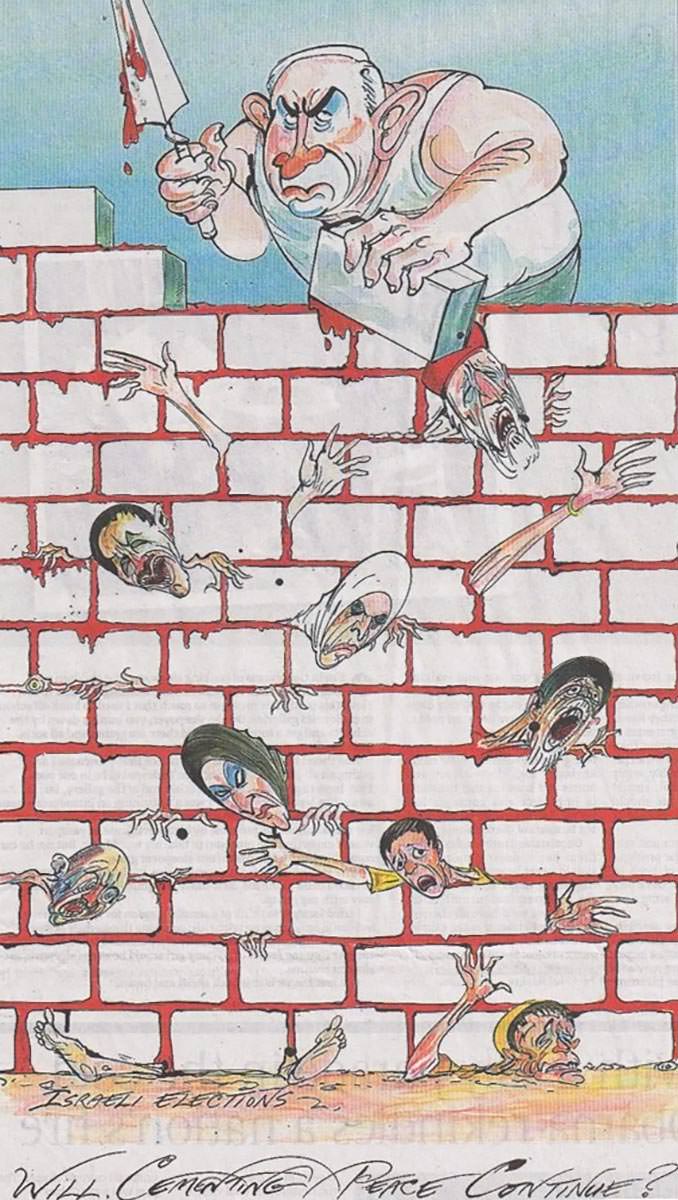
Gerald Scarfe’s grotesque caricature initiated a wave of reactions for its “antisemitism”.
Netanyahu’s “large, bulbous red nose” was depicted as one of those antisemitic tropes, as if a political caricature classic was appropriated by the Nazi cartoons preceding the Holocaust.
“The Sunday Times has clearly lost its moral bearings, publishing a cartoon with a blatantly antisemitic theme and motif which is a modern-day evocation of the ancient ‘blood libel’ charge leveled at Jews”, said Michael Salberg from the Anti-Defamation League. “This is the stuff which historically justified hatred of Jews and led to the wholesale slaughter of Jews.”
The World Zionist Organization Israel claimed that the cartoon crosses “all lines of decency and morality”.
Knesset speaker Reuven Rivlin called it “reminiscent of the vicious journalism during one of the darkest periods in human history”.
Israel’s ambassador to London met with the newspaper’s editor and demanded an apology, but the media owner Rupert Murdoch was quicker: “We owe major apology for grotesque, offensive cartoon.”
The papers’ own spokesperson disagreed: “It is aimed squarely at Mr. Netanyahu and his policies, not at Israel, let alone at Jewish people.”
3. Next Year, No Job
(Süddeutsche Zeitung, Dieter Hanitzsch, May 2018)
Netta Barzilai’s Eurovision win got Bibi drawn in her costume, rocket in hand, shouting: “Next year in Jerusalem!”
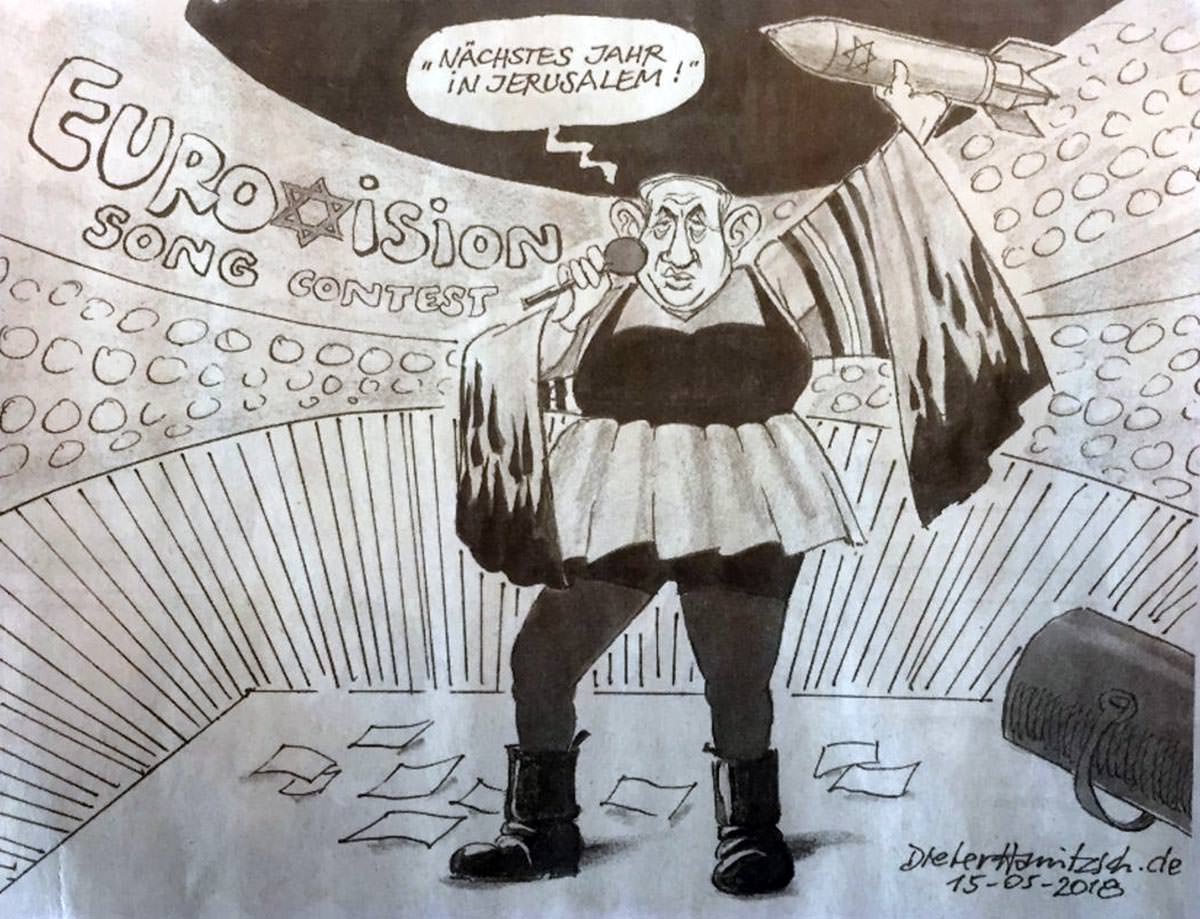
The caricature criticizing the Prime Minister’s exploitation of the Eurovision victory in the context of the country’s current policies made a commotion, and the author lost his job.
Editor-in-chief Kurt Kister explained that the drawing relied on antisemitic stereotypes and clichés: “In the face of the caricatured person you could see a very large nose and rather thick lips. The ears were very big. (…) Stereotypes, even if they are not meant to be so in every case, can support racism or be racist themselves.”
Nazi-period representations of Jews’ physiognomies were not the only antisemitic element the out-of-office editor recognized after returning to his desk. The Star of David, clearly used here to identify the context, reminded him of the Nazi magazine Der Stürmer, which used it as an optical mallet to “signal to even the stupidest: It’s about Jews.”
“It frightens me when I see a caricature in which the Star of David is twice used to suggest that the ESC is somehow Israeli (no: Jewish) and Netanyahu’s missiles or bombs too. (…) For a caricaturist in this country, the Star of David must be something other than ‘just’ a national symbol such as the Union Jack or the Stars and Stripes”, wrote the editor after saying ‘goodbye’ to his long-time employee over the dispute, despite agreeing the cartoon was “not antisemitic”.
Nevertheless, the newspaper apologized for the possibility of the drawing being “understood as antisemitic”. The author Dieter Hanitzsch refused to issue an apology, and said he wants to be able to criticize Netanyahu’s policies as a German.
Read how Israel uses Eurovision for artwashing.
4. Some Animals Are More Fired Than Others
(Jerusalem Report, Avi Katz, August 2018)
A George Orwell riff turning Netanyahu’s Likud selfie, celebrating the law that defines Israel as a nation of Jewish people, with an “exclusive right to self-determination”, into a lineup of pigs. Avi Katz quoted the “Animal Farm” directly: “All animals are equal. But some animals are more equal than others.”
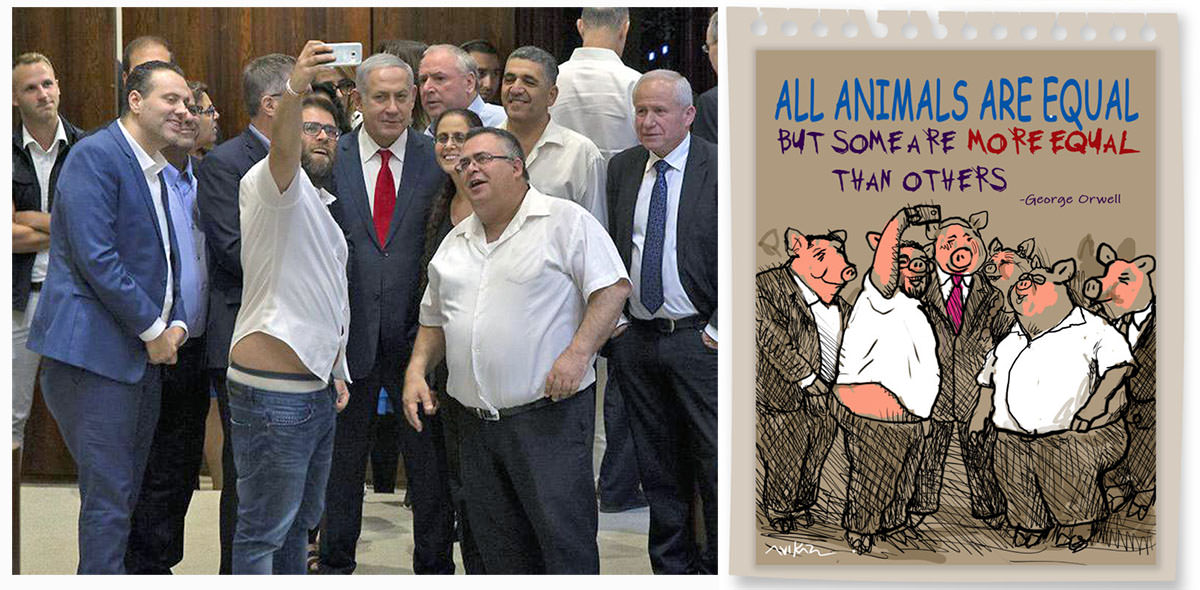
Criticizing the celebration over discrimination against Israel’s non-Jewish residents didn’t sit well in online forums. The publisher backed off, saying that the cartoon crossed the line from criticism to “incitement and hatred”, especially as Judaism considers the pig one of the most unclean and impure animals, used as an antisemitic image for over eight centuries.
The Nazis indeed called Jews Judensau, with folk art showing them suckling on large pigs. But Katz’s drawing had nothing to do with the antisemitic trope. It was exposing the authoritarian government. The exposé was paradoxically confirmed when this Jew lost his job over “antisemitism”.
A similar cartoon by Ze’ev, depicting the government of Prime Minister Menachem Begin as Orwell’s pigs, was published in 1980, with nobody ringing the antisemitic alarm bells.
5. Benched
(Dagbladet, Finn Graff, October 2018)
As a reaction to the same discriminatory Jewish Nation-State law, the Norwegian newspaper’s Finn Graff cartooned Netanyahu punching a Druze man off a “whites only” bench.
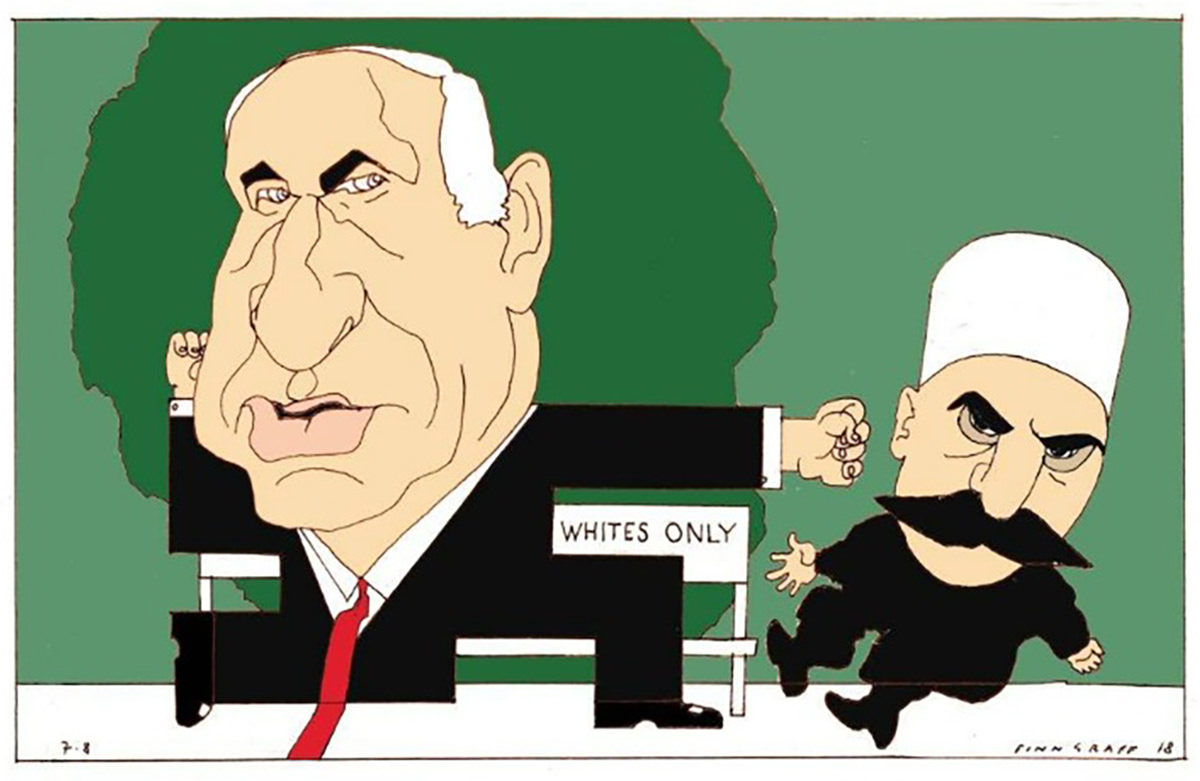
Raphael Schutz, Israel’s ambassador to Norway, demanded the removal of the “sickening image” and an apology, calling the piece “an example of the most repulsive imaginable antisemitic imagery”.
Anti-Defamation League director Jonathan Greenblatt reacted as well: “The cartoon showing the Israeli prime minister’s body shaped into a swastika is outrageous and deeply offensive. It takes one of the symbols of the Nazi Holocaust and twists it to make a political point against the very people who were singled out for death in the Nazi gas chambers.”
However, Benjamin Netanyahu was never singled out for death in the Nazi gas chambers. And the commentary definitely aimed at him, not the victims of the Holocaust. The newspaper ignored the protest, stood its ground, and refused to remove the cartoon.
6. Hugging It Out, Nazi-Style
(O Dia, Renato Aroeira, January 2019)
Following the inauguration, Brazil’s new president Jair Bolsonaro and his distinguished guest and “brother” Benjamin Netanyahu embrace at their arms forming the shape of a swastika.
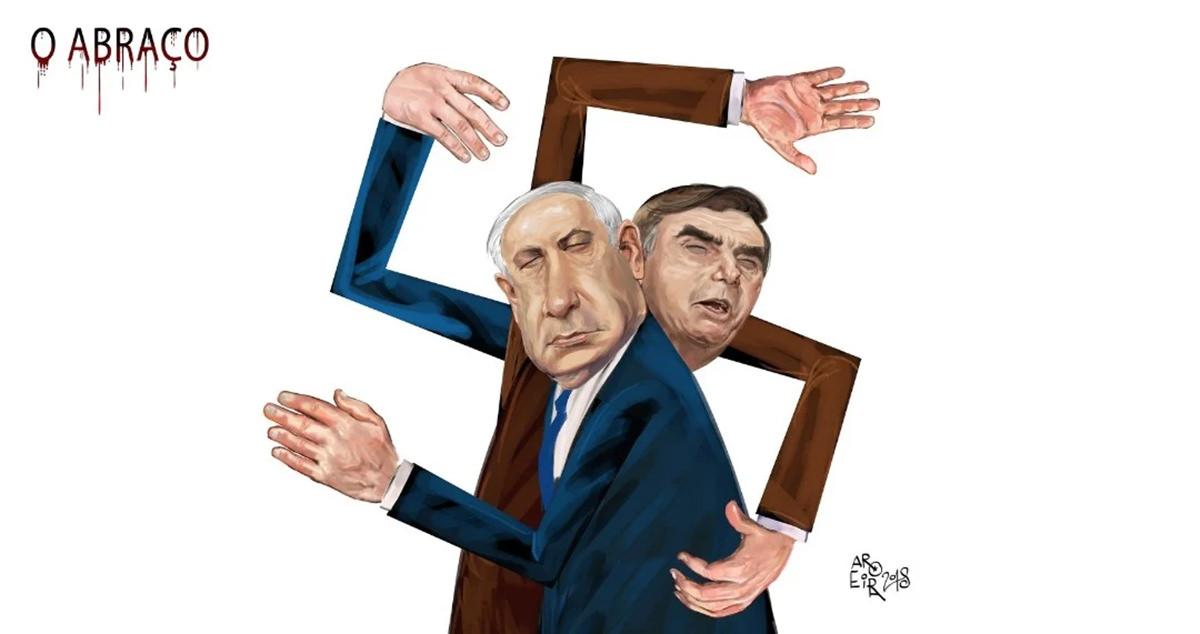
The Jewish Federation of Rio de Janeiro threatened to sue the author Renato Aroeira, calling the work antisemitic.
“Art can never be used to offend the memory of millions of people who died in World War II. The issue will be viewed with severity. We can’t tolerate the offense to Jews and other minorities”, the federation’s president, Arnon Velmovitsky, said on TV.
It is not known whether the lawsuit was ever officially filed.
7. Leading the Blind
(NYT syndication of Expresso, António Moreira Antunes, April 2019)
Netanyahu as guide dog leading a blind Trump.
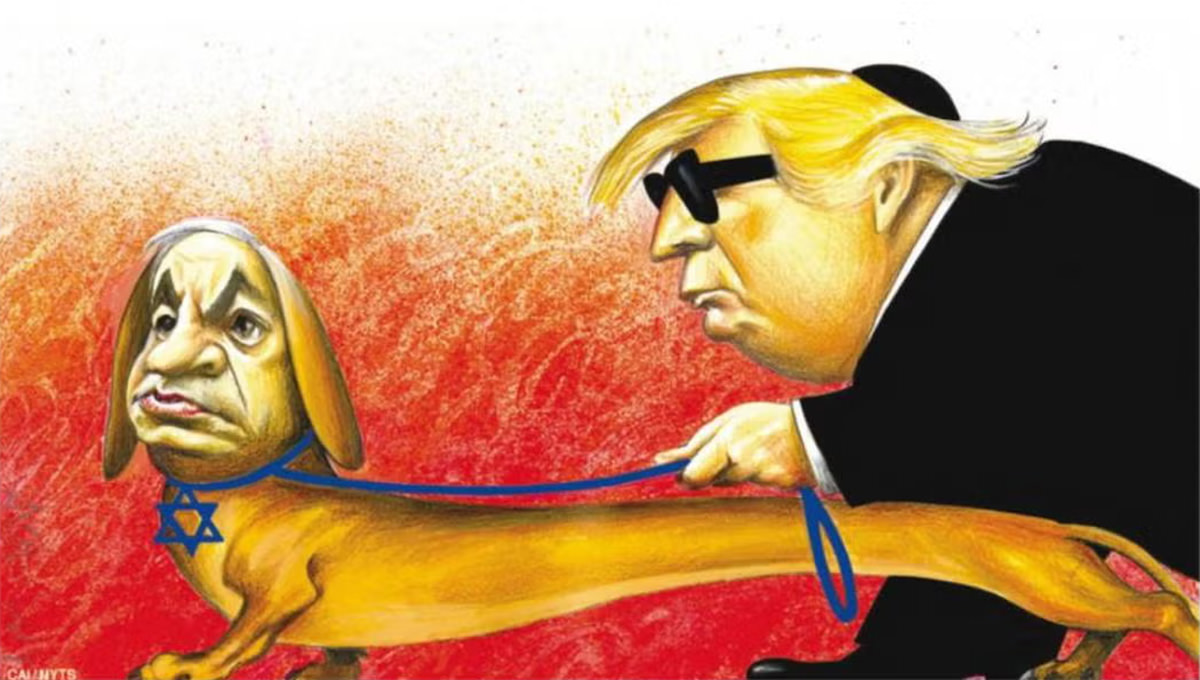
Widely denounced as flagrant antisemitism, from Donald Trump Jr. to the American Jewish Committee.
The author António Moreira Antunes rejected accusations: “Trump’s erratic, destructive and often blind politics encouraged the expansionist radicalism of Netanyahu. (…) What will be the reason why I cannot do a critique of Israeli policy without being immediately categorized as antisemitic? I have nothing against the Jews, but I have many things against the politics of Israel.”
The New York Times, however, stood with the critics. It deleted the cartoon from its syndicate website, calling it offensive, and later fully apologized for antisemitic tropes, while committing itself to “making sure nothing like this happens again”.
They meant it. The paper stopped running political cartoons entirely.
However, Expresso, the original Portuguese outlet, while apologizing to “those who may have felt offended”, rejected interpretations of the drawing as antisemitic and said it “has always defended freedom of expression and opinion, principles we will never renounce”.
8. Gutted
(The Guardian, Steve Bell, October 2023)
Netanyahu operating on his own belly, the incision shaped like Gaza, boxing gloves on. Message: “Residents of Gaza, get out now.”
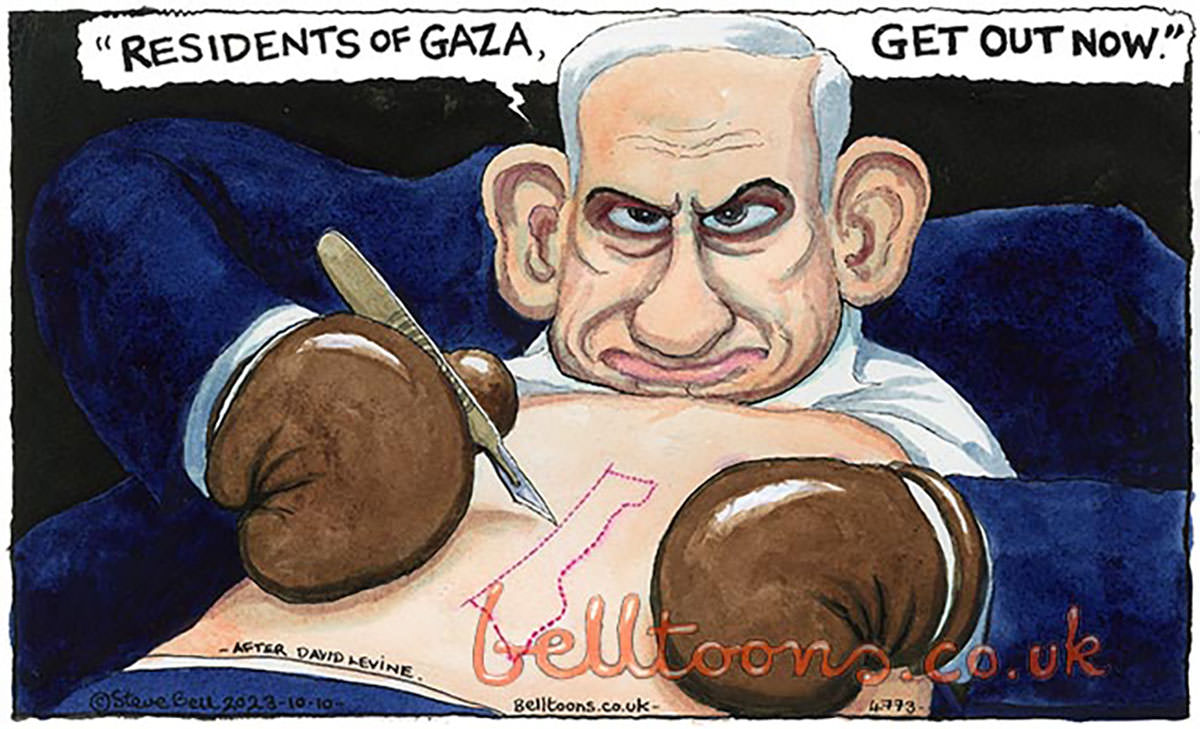
Rabbi Zvi Solomons called the author “an inhumane antisemitic blood libeling beast”.
Editors have also recognized an antisemitic trope: Shylock, a greedy Jewish moneylender in Shakespeare’s “The Merchant of Venice” who demands a ‘pound of flesh’ as security on a loan.
“There is no reference to that play in my cartoon”, Steve Bell said, receiving accusations as nonsensical. “The image itself was inspired by the late, great David Levine’s cartoon of President Lyndon Johnson (LBJ) showing off his operation scar, which Levine draws in the shape of a map of Vietnam.”
The explanation wasn’t satisfying. After 42 years of cooperation, The Guardian fired the cartoonist.
9. Setting the Table
(Bob Moran, January 2024)
Netanyahu feasting on children at a blood-soaked table, with a backdrop of Gaza ruins and ‘Kosher’ title. The US President Joe Biden and British PM Rishi Sunak serve as butlers.
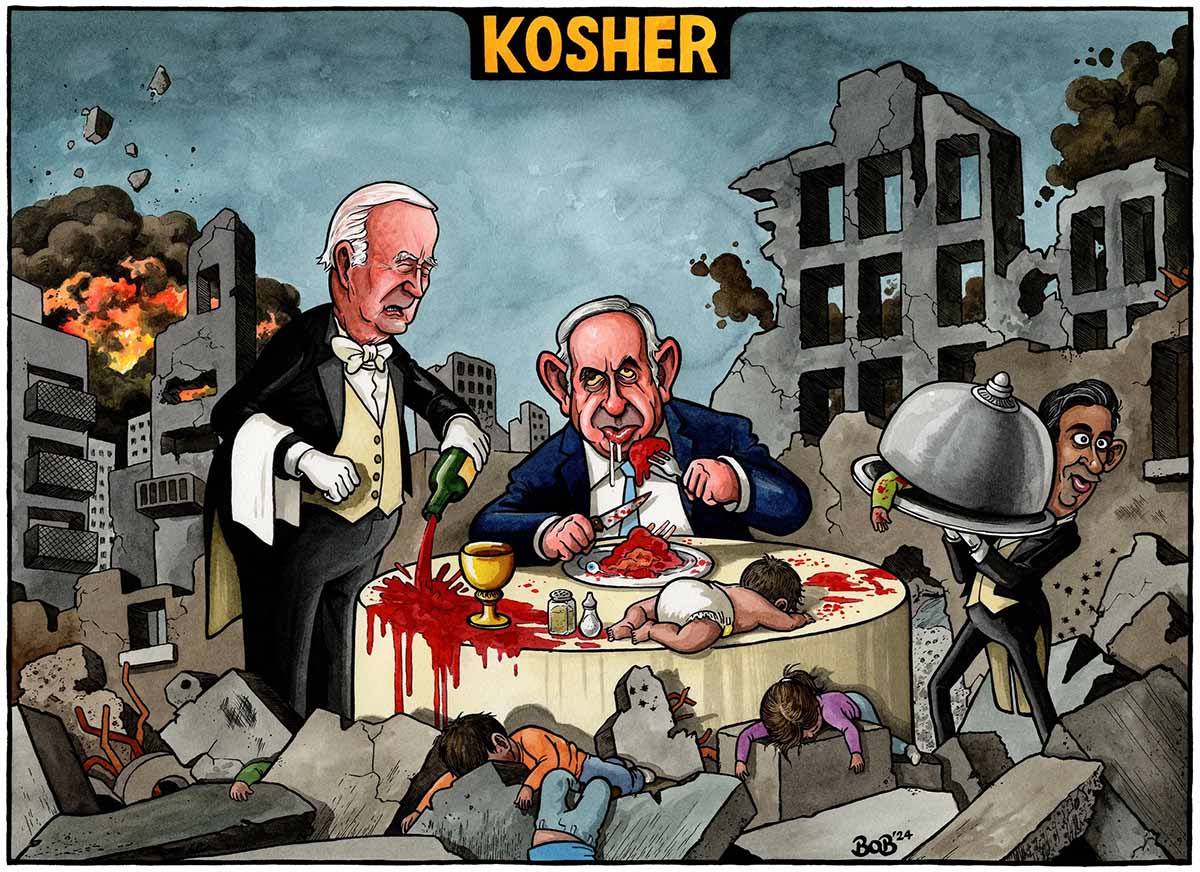
The reactions on X were calling for police intervention, as commenters recognized the antisemitic tropes of medieval blood libel (Jews feasting on Christian babies), and secret control of foreign governments. Some compared it to Nazi propaganda.
“There are no Jews in that cartoon”, Bob Moran replied. “If you think the man in the middle is a Jew, you have no understanding of the Jewish faith. Or any faith. Or basic morality.”
Indeed, there is a crucial difference between Moran’s work and “Nazi-style slurs against Jews” – it doesn’t portray “a Jew”, but a very specific public persona, responsible for his extremely far-reaching political actions.
The artwork sold for £32,000.
10. Nosfenyahu Rises
(La Presse, Serge Chapleau, March 2024)
Bibi as Count Orlok vampire from 1922 movie “Nosferatu”, with long claws and pointed ears, “en route to Rafah”.
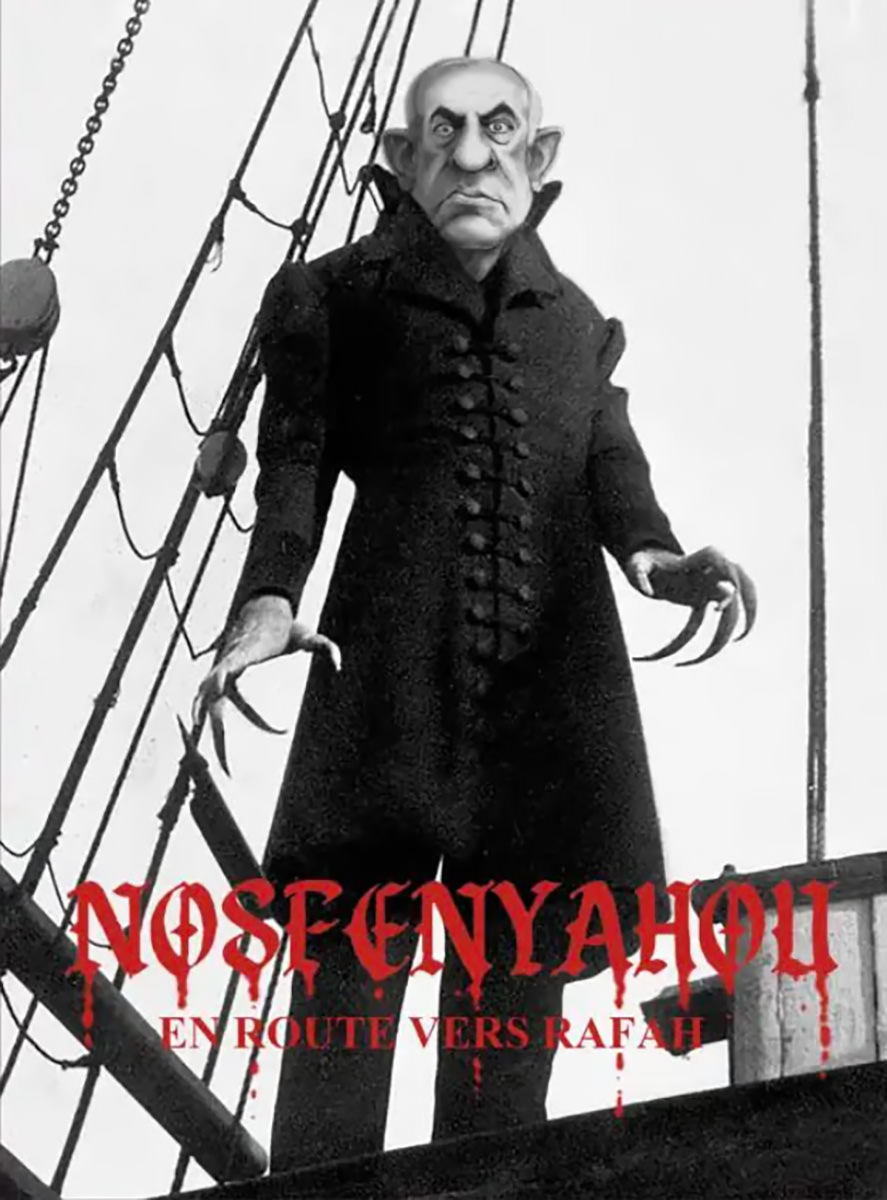
Jewish leaders criticized the image published online, calling it antisemitic and “extremely hurtful”.
“It is unacceptable to bring back antisemitic tropes and allusions like that,” Canadian Prime Minister Justin Trudeau said, following the comparison with 1930’s Nazi portraits of Jews as vampires. “It is distasteful and exactly the wrong thing to do in these times.”
“It’s a caricature based on an old character Nosferatu, an old vampire who goes and invades another country”, the author Serge Chapleau responded. “That’s all, it’s not worse than that. (…) It’s not antisemitic, it’s not that at all.”
“It targeted the Israeli government, not the Jewish people”, agreed Stéphanie Grammond, the newspaper’s editor-in-chief. “It was never our intention to promote antisemitism or harmful stereotypes.”
Still, the publisher pulled the cartoon away and issued an apology.
11. Puppet State
(Chicago Cultural Center, Chicago-Based Protest Puppeteers, January 2025)
A giant Netanyahu puppet clutching a bloodied MK-84 bomb, Uncle Sam weeping behind him.
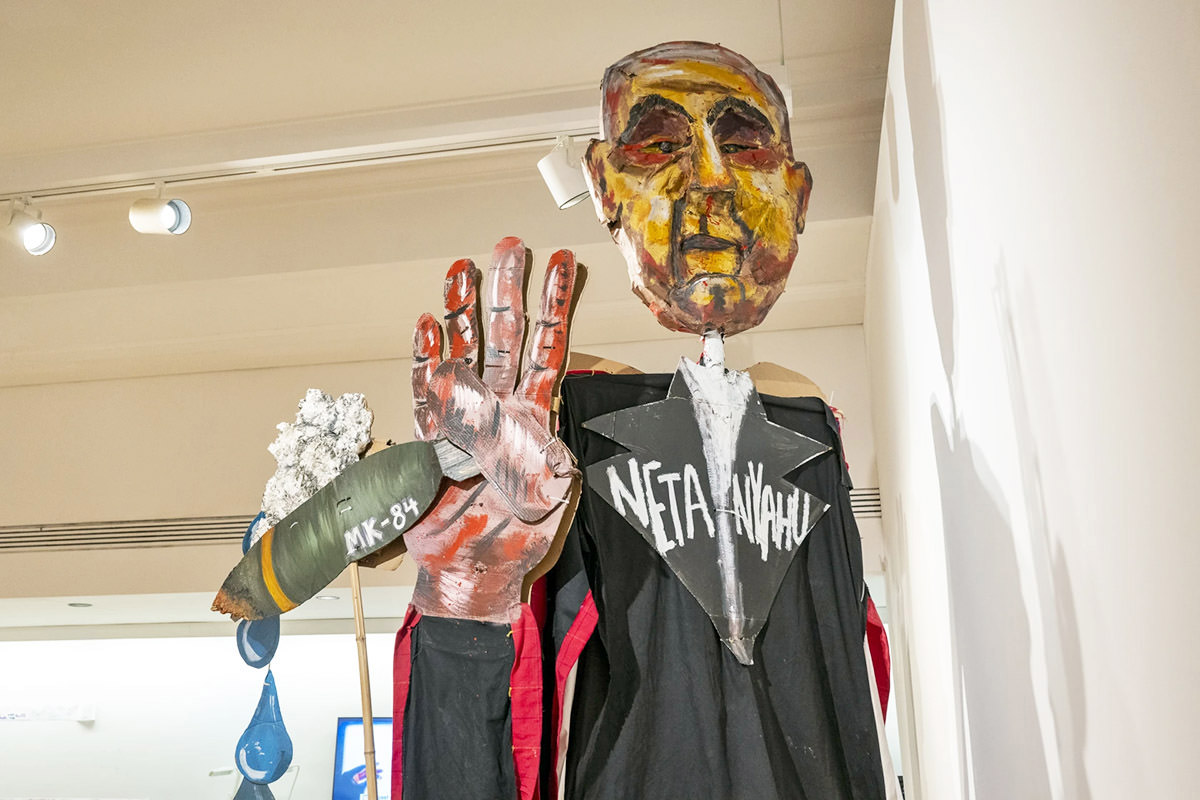
The “US-Israel War Machine” art installation by Chicago-Based Protest Puppeteers caused a stir among the city council members, demanding removal because it promotes “hate and bigotry toward the Jewish community”.
“The description said the U.S. was supporting Israel, sending arms to Israel and working together with Israel – and called them child killers. That’s very offensive. It crosses the line into hate. The whole display is… anti-American and antisemitic”, Debra Silverstein, the council’s only Jewish member, said.
David Goldenberg, Midwest regional director of the Anti-Defamation League, called the puppet display “deeply offensive” because it “spreads lies and misinformation about Jews.”
According to Abby Palen, the group’s artistic director, the artwork is actually an anti-war statement, “a criticism of governments, not people”.
One alderman, David Moore, agreed: “If it was directed against any ethnic group, I would be the first to condemn it. But it’s pointing a finger at the government. That’s something we can’t censor.”
The puppet stayed, but the placard with its title and a death toll in Gaza was removed, as a concession. A “may-contain-sensitive-content” warning was added.
12. Melting Point
(Museo de Cera, Mexico City, January 2025)
A museum visitor attacked Netanyahu’s wax figure at Mexico City’s Museo de Cera with red paint and a hammer, saying: “With respect to the Jewish people, whose identity has been kidnapped by these genocide perpetrators, I have to kill this war criminal. Long Live Palestine. Long live Sudan. Long live Yemen. Long live Puerto Rico.”
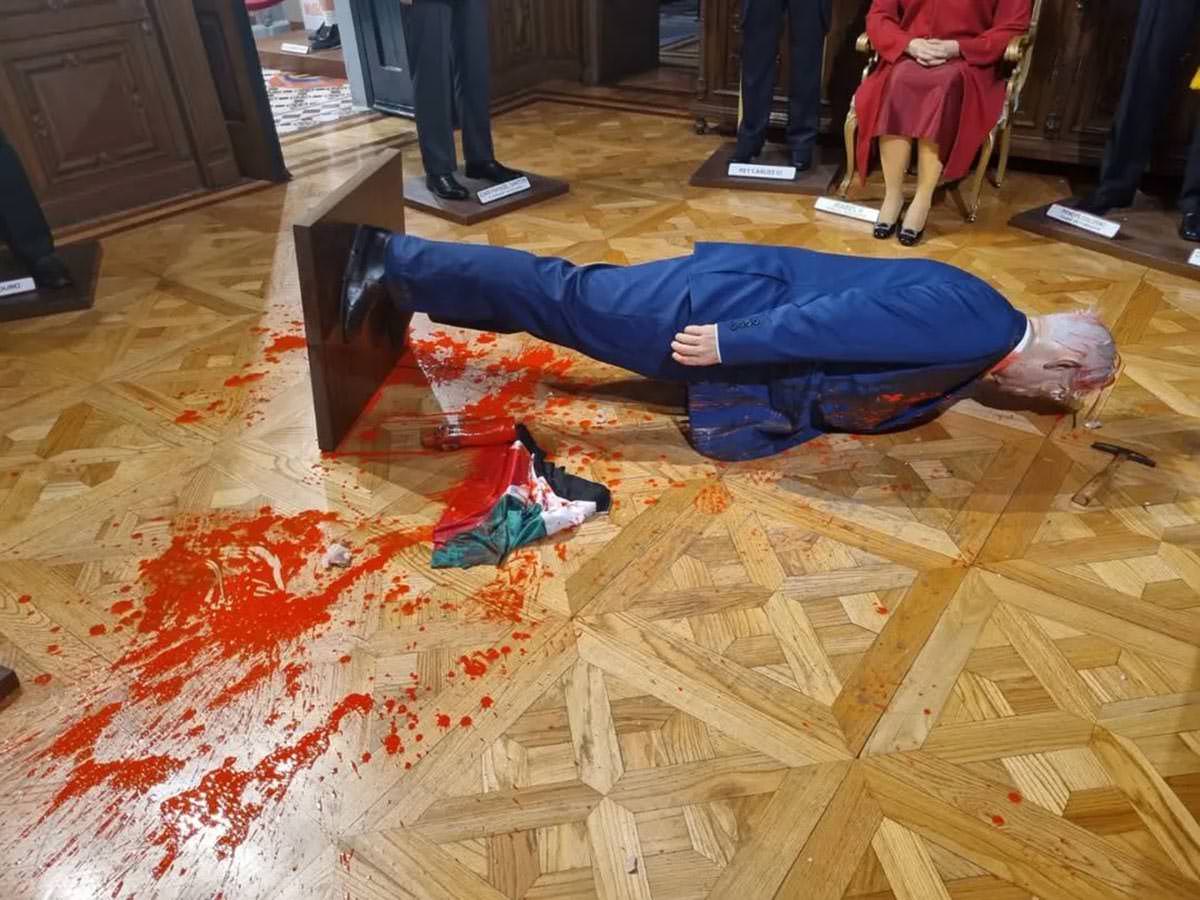
Israeli media, such as Jerusalem News Syndicate, immediately branded him a “pro-Hamas activist”, with no supporting evidence.
“The aggression committed against the statue of Prime Minister Benjamin Netanyahu is a detestable action that sends a dangerous message of violence, intolerance and hatred, which exceeds any legitimate criticism”, the Israeli embassy stated.
13. Two-Faced
(The Other Art Fair, London, James Early, March 2025)
An oil painting stitching together Netanyahu’s and Hitler’s faces, titled “Monster”. Pulled after The Other Art Fair‘s opening night in London amid waves of hate and insults.
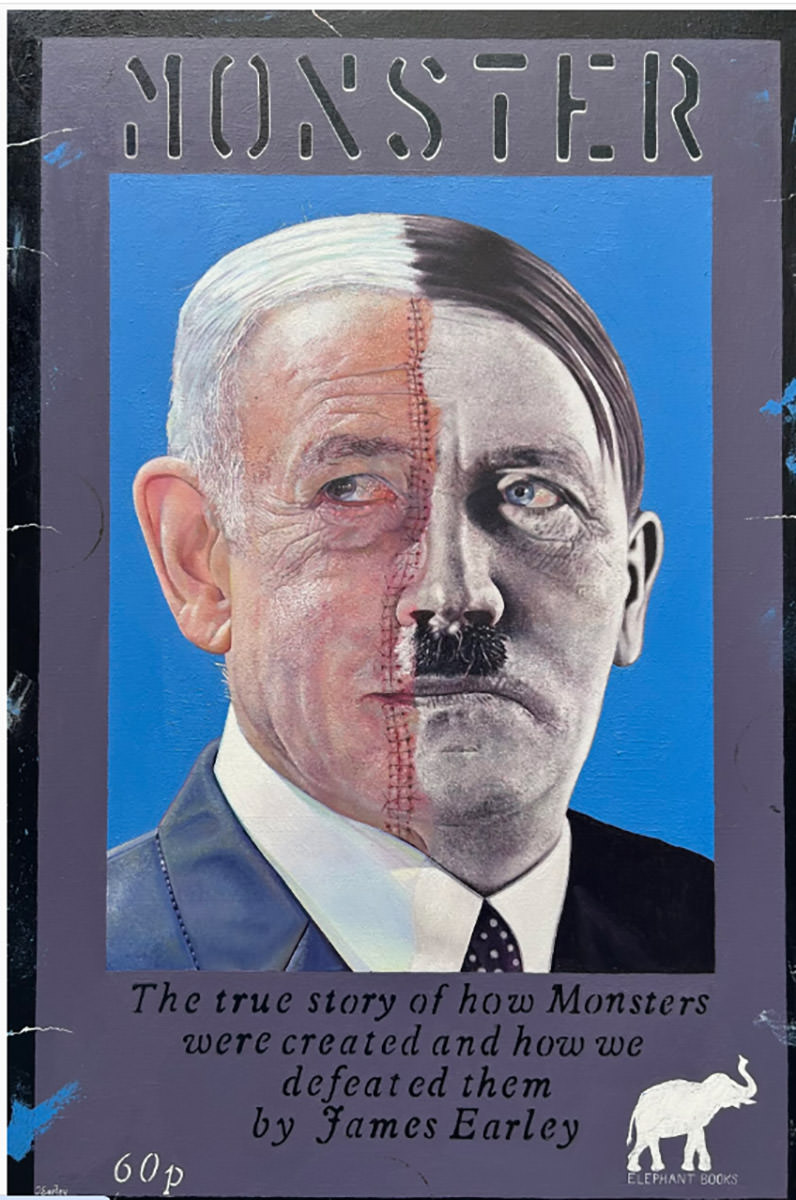
“Modern antisemitism offers its caricature of Jews to help its audience understand who is responsible for all that is evil in the world. This is important for fantasies of global conspiracy because the all-powerful evil is necessarily not visible in such fantasies. Antisemitism gives them a human face”, wrote David Hirsh in The Jewish Chronicle.
“According to the International (IHRA) Definition of Antisemitism, ‘Drawing comparisons of contemporary Israeli policy to that of the Nazis’ is an example of antisemitism”, Campaign Against Antisemitism stated. “Immediate action is required, and an apology and explanation of how this was allowed to happen in the first place is due.”
“I am not antisemitic”, James Early, the artist, said in his defense. “I have previously created paintings that call out the horrors of the Holocaust and how evil that period of our history is. I’ve been to Auschwitz and crumbled as I learnt the cruelty that took place there. I just want all the violence to stop, whether it’s done by Hamas or the IDF. My views are of Netanyahu and not the people of Israel”, the artist said.
14. Sealed With a Kiss
(Rome, Laika, May 2025)
A mural of Hitler and Netanyahu kissing, titled “The Final Solution”, meant as “Hitler congratulating Netanyahu on conducting the Gaza war”.
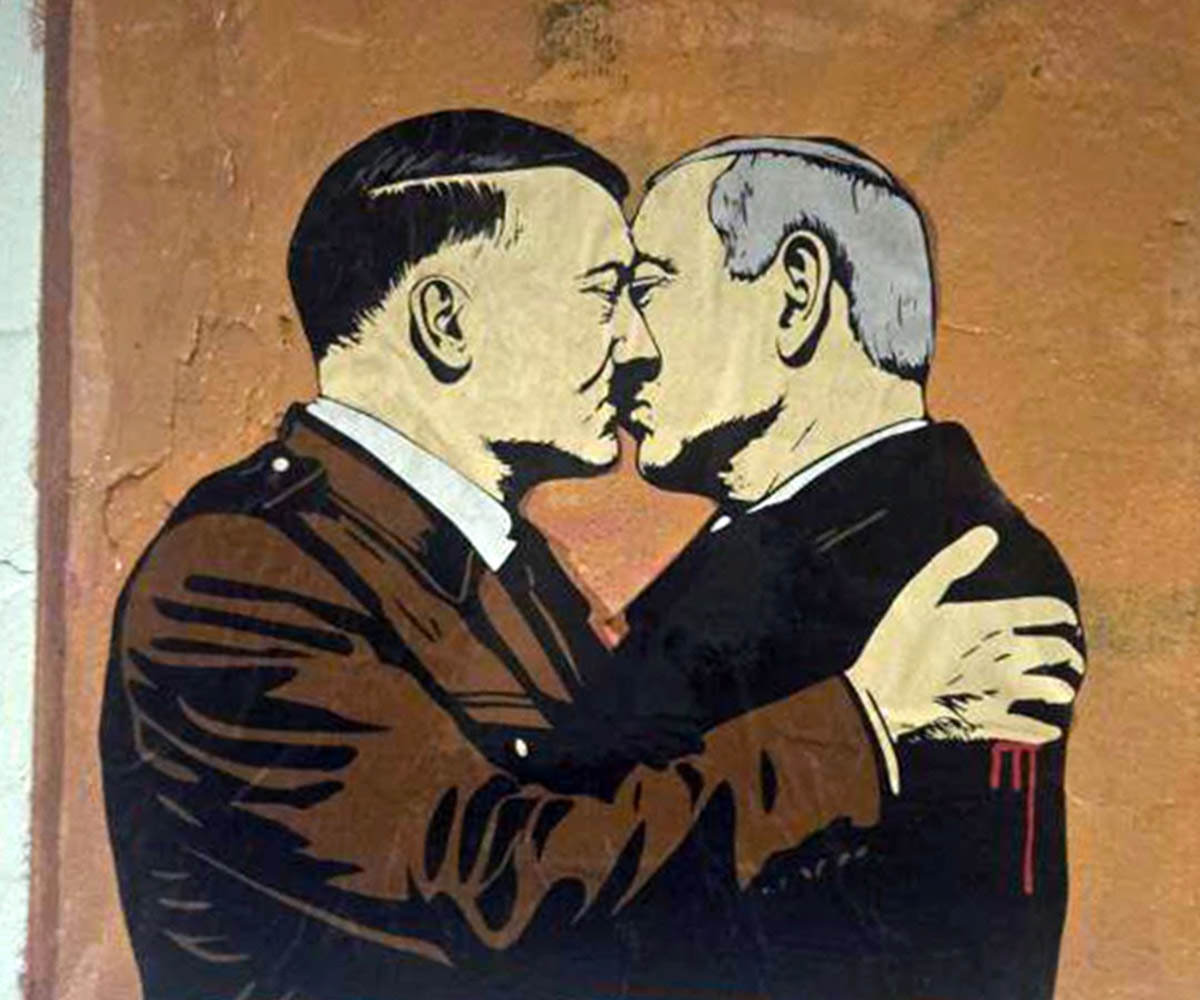
Israel Hayom (colloquially known as Bibiton, or Netanyahu’s mouthpiece) called Laika’s street art a dramatic escalation of European anti-Israel sentiment. Disturbed by the artist’s use of the words “ethnic cleansing” and “genocide” when referring to IDF operations, Hayom’s Dudi Kogan expressed “concerns about the spread of antisemitic imagery and Holocaust comparisons across the continent”.
Gila Isaacson from Jfeed news site referred to the “disgusting antisemitic mural” as “a deliberate assault on Jewish history and dignity”, calling the Nazi dictator’s approval of Gaza military operations “historically obscene and deeply offensive”. The commentator saw classic antisemitic tropes disguised as the artist’s political critique: “Her call for Jews to oppose Israel by invoking our Holocaust trauma is a manipulative low blow, exploiting unimaginable suffering to shame Jewish communities into submission.”
15. Seeing Stars
(Primal Scream, Roundhouse London, December 2025)
A concert backdrop displaying destroyed Gaza and world leaders, including Netanyahu, their eyes covered with Stars of David merged with swastikas. The message “Our Government is complicit in genocide” appears at the end of the “Swastika Eyes” number. Accused of antisemitism, Primal Scream was reported to police by the Community Security Trust.
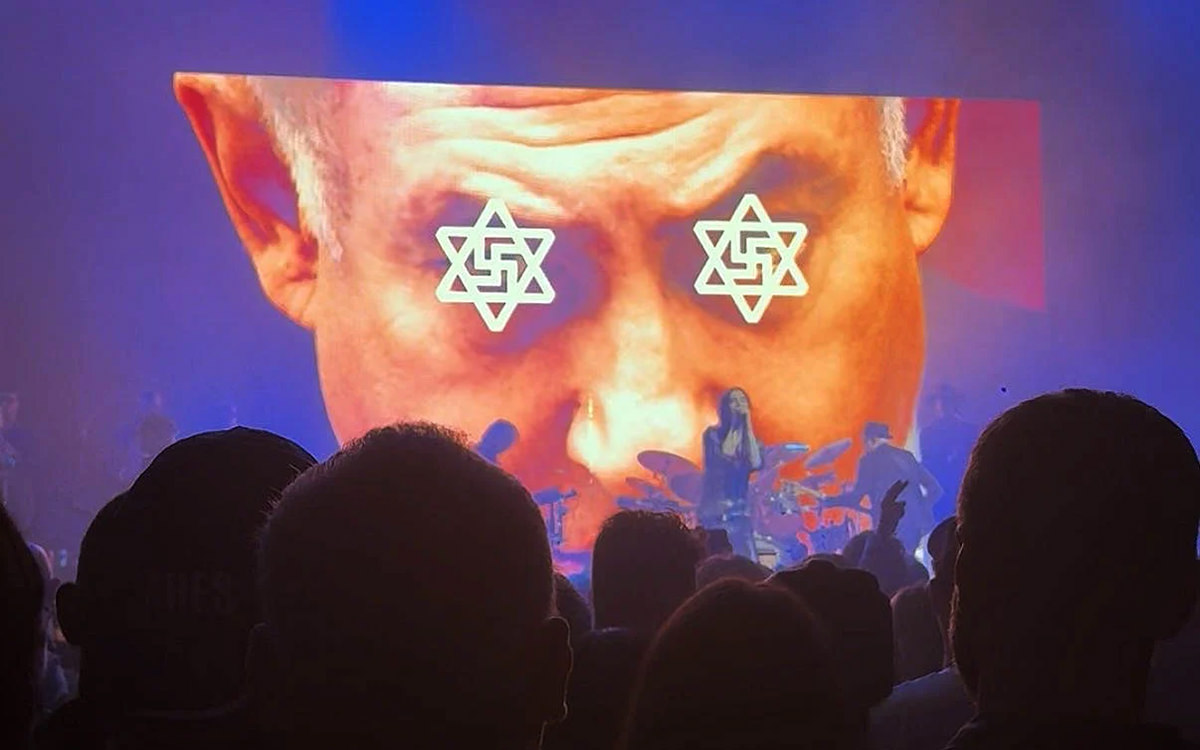
“Entwining a Star of David with a swastika implies that Jews are Nazis and risks encouraging hatred of Jews”, the agency explained.
The Campaign Against Antisemitism agreed: “The Nazi swastika represents the ideology that inspired people to industrially slaughter six million innocent Jewish men, women and children by bullet, gas and any other means available. To visually combine that with the Star of David – the pre-eminent symbol of Judaism – is absolutely sickening and totally inexcusable.”
“Jews, whether from Israel or from the U.K., have outworn their welcome and are being visually shown the exit door. There is really no other way to interpret the hateful presentation which was then characterized as art”, wrote Cookie Schwaeber-Issan in her opinion piece for All Israel News, a site whose official goal is to “explain and analyze events with a Biblical perspective and worldview.”
The band’s line: “The film is a piece of art. It clearly draws from history to question where the actions of current world governments sit in that context. It is meant to provoke debate, not hate. In a free, pluralistic and liberal society, freedom of expression is a right which we choose to exercise.”
The Roundhouse venue reacted differently: “We deeply regret that these highly offensive images were presented on our stage and unequivocally apologise to anyone who attended the gig and to the wider Jewish community.”
16. The Turd Reich Strikes Back
(Canberra, Grow Up Art, February 2026)
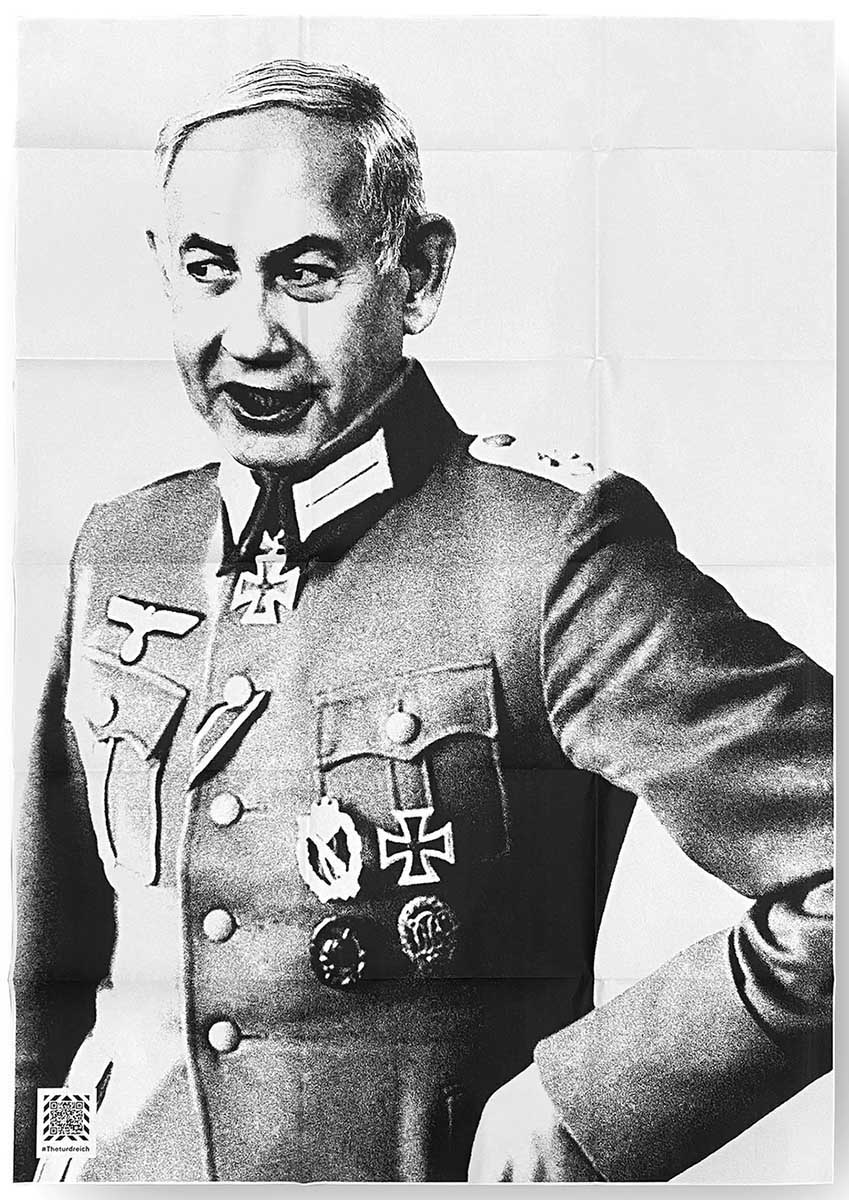
Photoshopped posters of Netanyahu, Trump, and Putin in Nazi uniforms, seized under Australia‘s new post-Bondi hate-symbol laws – the first case tested under them.
With the signs “Sanction Israel” and “Stop Genocide”, Canberra’s Dissent Café and Bar owner David Howe explained “The Turd Reich” (posters made by the British street art duo Grow Up Art) as an “anti-fascist statement” and “protest art”.
Following the report for hate imagery, the Australian Capital Territory police declared the bar a crime scene, and called a serious crime unit to remove the material. After a week-long analysis of the posters, the police had to return them, with no charges filed.
17. Ship of Fools, Full of Neocons
(Politico, Sean Delonas, March 2026)
A Hieronymus Bosch-style feast of Netanyahu, Trump, and Republican lawmakers sailing toward Iran on a money-masted galleon.
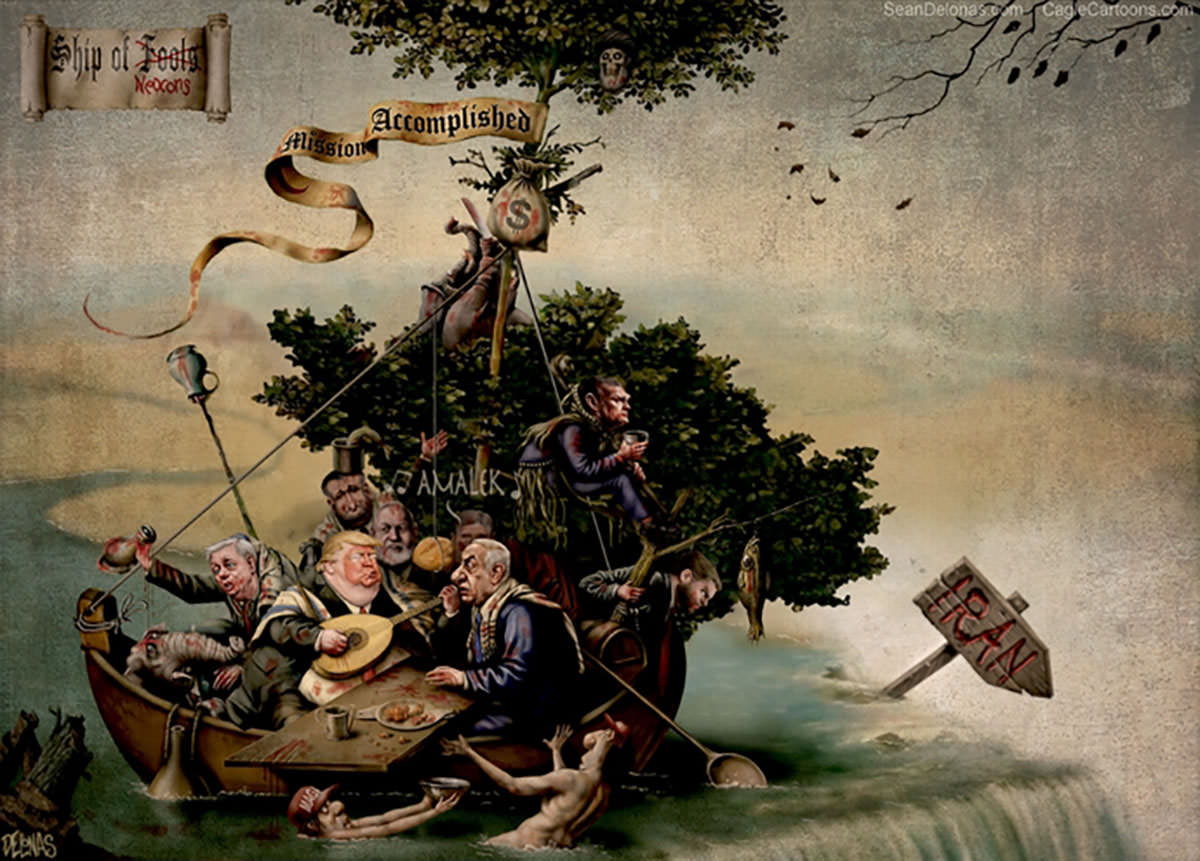
Alana Goodman wrote about it in pro-Israel Washington Free Beacon: “The cartoon plays on classic antisemitic tropes about Jews covertly controlling events, in this case the decision to launch the war in Iran, and using financial exploitation to do so. The exaggeration of Netanyahu’s nose in a grotesque, caricatured style plays on age-old efforts to dehumanize Jews.”
Following the criticism, Politico deleted the piece from its Cartoon Carousel, saying that “images that could be reasonably interpreted to rely on ethnic stereotypes or employing tropes that have been involved in historically hateful ways” are out of bounds.
18. Effigy of the Year
(El Burgo, Spain, April 2026)
A century-old Easter tradition of burning a giant effigy “symbolizing all bad” chose Netanyahu as this year’s Judas. Setting the seven-meter-tall puppet on fire was meant as a celebration of the victory of good over evil, and the crowd cheered.
Israel’s embassy in Spain called the El Burgo event an act of “appalling antisemitic hatred”, blaming Pedro Sánchez‘s government for “systemic incitement to violence”.
The town mayor Marilo Narvaez’s response was blunt: “We are by no means antisemitic, not in the slightest. We are an open, welcoming and peace-loving community. We decided to create a puppet condemning genocide and war. I don’t think there has been anything more relevant this year.”
Netanyahu and “Antisemitic” Portrayals – Conclusion
Benjamin Netanyahu, one of the most controversial political figures of the modern world, has found the perfect tree to hide behind – that proverbial tree one can’t see the forest for.
Faced with criticism, Israel’s Prime Minister and a chorus of defenders lean on genuine Jewish historical trauma to victimize the head chief of the ‘Holy Land’ and disarm anyone who opposes him.
Hitler must be
laughed atCharlie Chaplin
In the last decade, the endeavor to control the narratives of Israel’s reality among the artists ‘speaking’ freely in international art and media forums has only been increasing.
Aiming to censor everything from caricatures to puppets, the playbook demands a prompt reaction: conflate the examinable political leader with the persecuted Jew, and the argument ends before it starts.
But to borrow Bob Moran’s line: the man in the middle is not a Jew. His actions, despite the efforts to be portrayed as a fundamental fulfilment of an ancient prophecy, have nothing to do with Judaism, or any reputable religion, in fact.
The artists reaching for Holocaust imagery aren’t referencing it because they forgot Jewish suffering, but because they exactly – remember it. And they see the pattern recurring in front of them.
Mason Storm, selling his bland Netanyahu-on-toys installation to a respected Swiss art collector for an undisclosed sum before the public ever saw it, is mostly a businessman riding a wave of artworks whose authors sacrificed much more for their point to come across. While they were putting their jobs and reputations on the line, these maskless individuals did not tone down their voice while calling the emperor naked.
On October 7, 1940, German forces entered Romania, to secure the oil fields. The Luftwaffe planes bombed the hell out of southern England, while Hitler’s submarines sank Allied ships. In occupied France, Jews were ordered to immediately register.
Eight days later, Charlie Chaplin, falsely branded a Jew by Nazi propaganda, released “The Great Dictator”. The usual Tramp character became Jewish Barber, and, in another role, Adenoid Hynkel – the parody of Hitler of his time.
“Free speech was suppressed, and only the voice of Hynkel was heard”, the script said.
Satirizing the Dictator was a risk major studios would never have taken. In Chaplin’s world, there was no hesitation. Because, he said, “Hitler must be laughed at”.
P.S. The villain in “Toy Story 5” is Lilipad, a frog-shaped smart tablet. The franchise’s first tech-coded antagonist competes for Bonnie’s attention, causing an existential crisis among traditional toys.
What do you think about Netanyahu-inspired art?
Leave a comment below and pin this article for later!