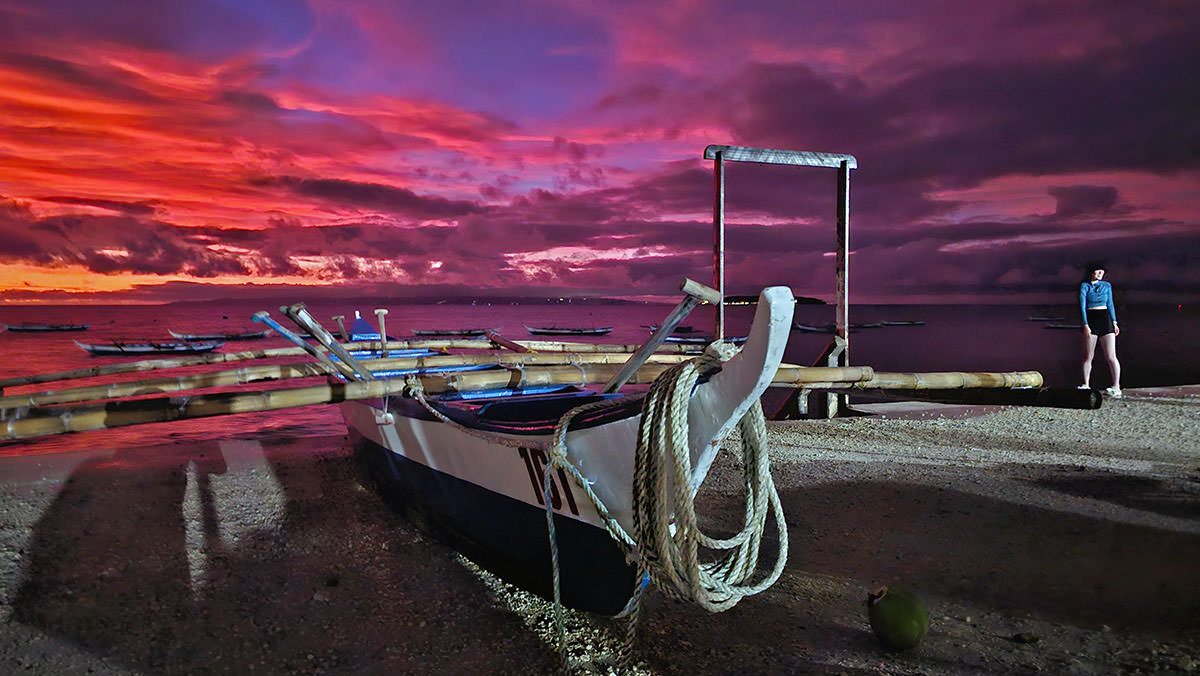
The dawn sky above the southern tip of Cebu Island looks like someone spilled a watercolor palette. As otherworldly hues of pastel pink wash out the sleep in my eyes, I start thinking that Filipinos could probably make serious money just from selling sunrises to their guests. But here, in Oslob, tourists form queues in wee hours because of a much greater attraction: meeting the largest fish on Earth face-to-face. Oslob whale shark watching is a breathtaking wildlife encounter. It is also a highly controversial one.
Conditioned by an open krill buffet, whale shark appearances become less magical and more of a well-trained, choreographed circus act
Every single morning, thousands of visitors make their way down the winding coastal roads of Cebu, toward a small fishing village called Tan-awan. They come from Cebu City, from Manila, from Tokyo and Berlin and São Paulo. And they’re all here for the same reason: to slip into the warm Bohol Sea and swim beside the sharks described as gentle giants.
Unlike most shark encounters out there, which require hours of searching the open ocean with no guarantee of a sighting, the animals here are not simply passing through. They are intentionally fed to remain near shore, making Oslob whale shark sightings practically guaranteed.
For many travelers, that certainty is an irresistible invitation to snap a photo of their lifetime. For scientists, conservationists, and ethically minded tourists, difficult questions arise: Is this wildlife tourism or wildlife exploitation? Are visitors helping local communities or harming an endangered species?
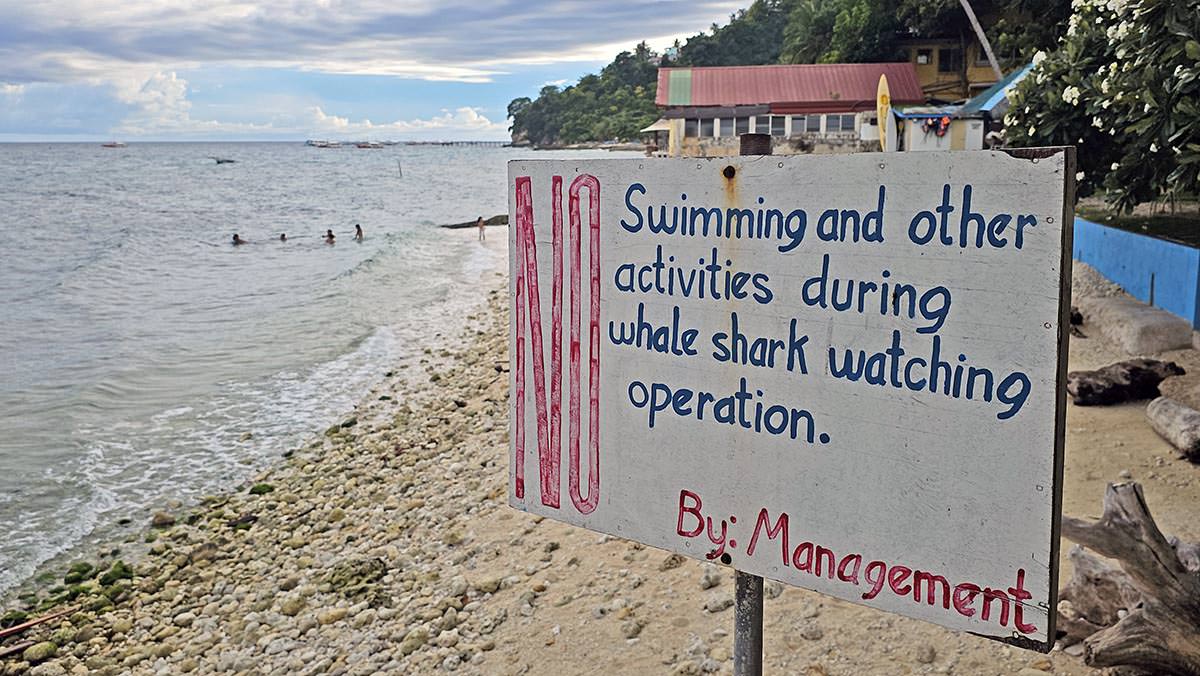
One doesn’t need to pay for the swimming and “other activities” at Tan-awan’s beach only in the afternoon hours
Oslob’s whale shark experience, one of the most debated wildlife attractions in Southeast Asia, sits in a moral gray zone where economics and ethics collide.
Indeed, these gigantic fish seem free to leave. Their fins are not chained. There are no walls around this shoreside selfie aquarium. But conditioned by the krill thrown at the sea surface as an open buffet, whale shark appearances become less magical and more of a well-trained, choreographed circus act.
So what is really happening in the overcrowded shallows in the Philippines?
And more importantly: is Oslob whale shark watching ethical?
This article gives you both: a complete practical guide to the experience, and an honest, research-backed examination of whether you should be here at all.
A local community in Africa started feeding one of the continent's most terrifying wild animals. Meet the Harar hyenas!
What Is Oslob Whale Shark Watching?
Oslob whale shark watching is a popular tourism activity in the town of Oslob, where, for the last 15 years, visitors can snorkel or dive alongside whale sharks in shallow coastal waters.
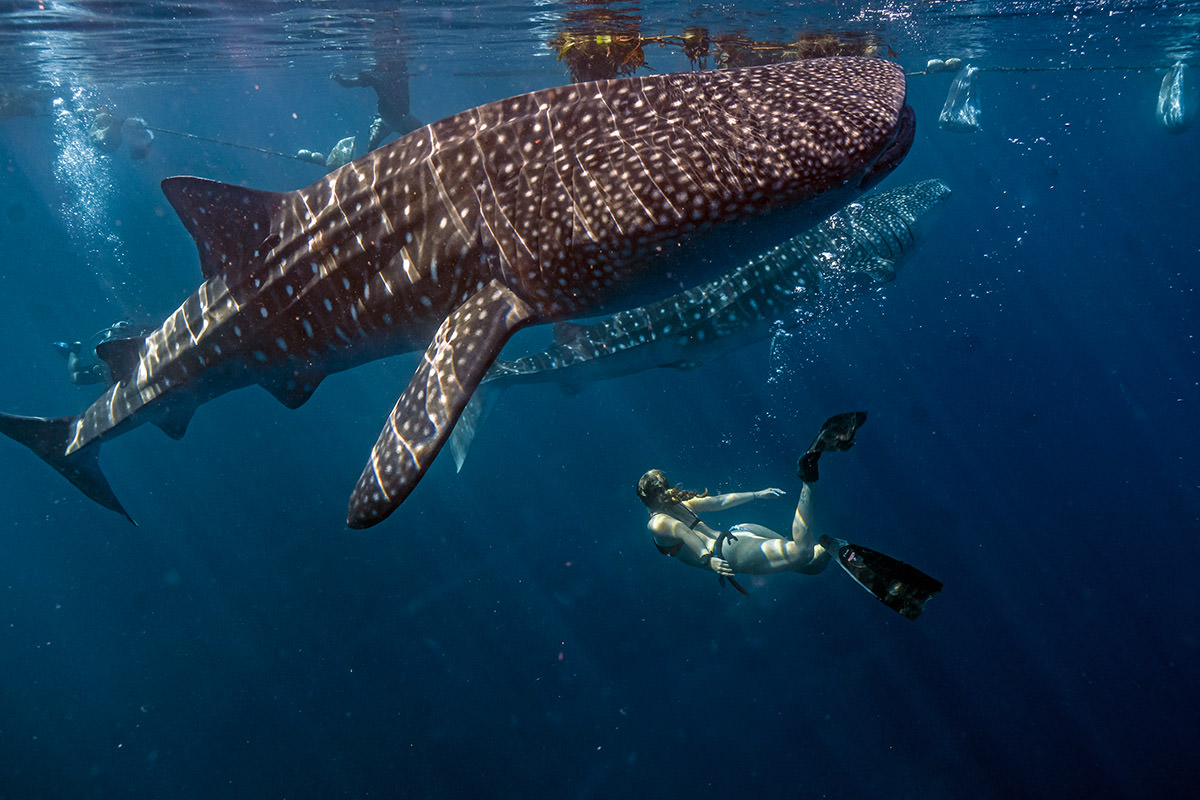
The enormous fish, called butanding, tuki, or balilan in the Philippines, and scientifically Rhincodon typus, is covered in a constellation of white spots and lines, as unique as human fingerprints.
As the world’s largest sharks, they are capable of reaching 20 meters in length and 20 tons in weight. Despite this impressive size, whale sharks are gentle filter feeders, vacuuming plankton, small fish, and sergestid shrimp through wide-open mouths. They pose no threat to humans.
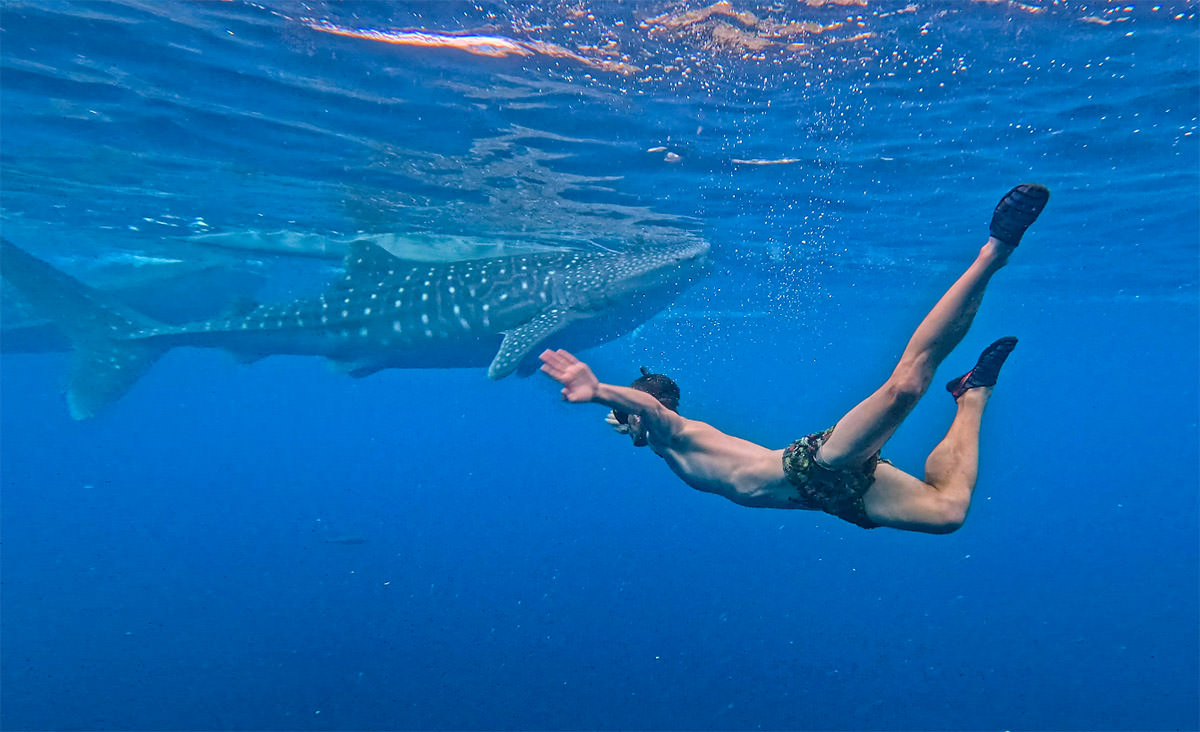
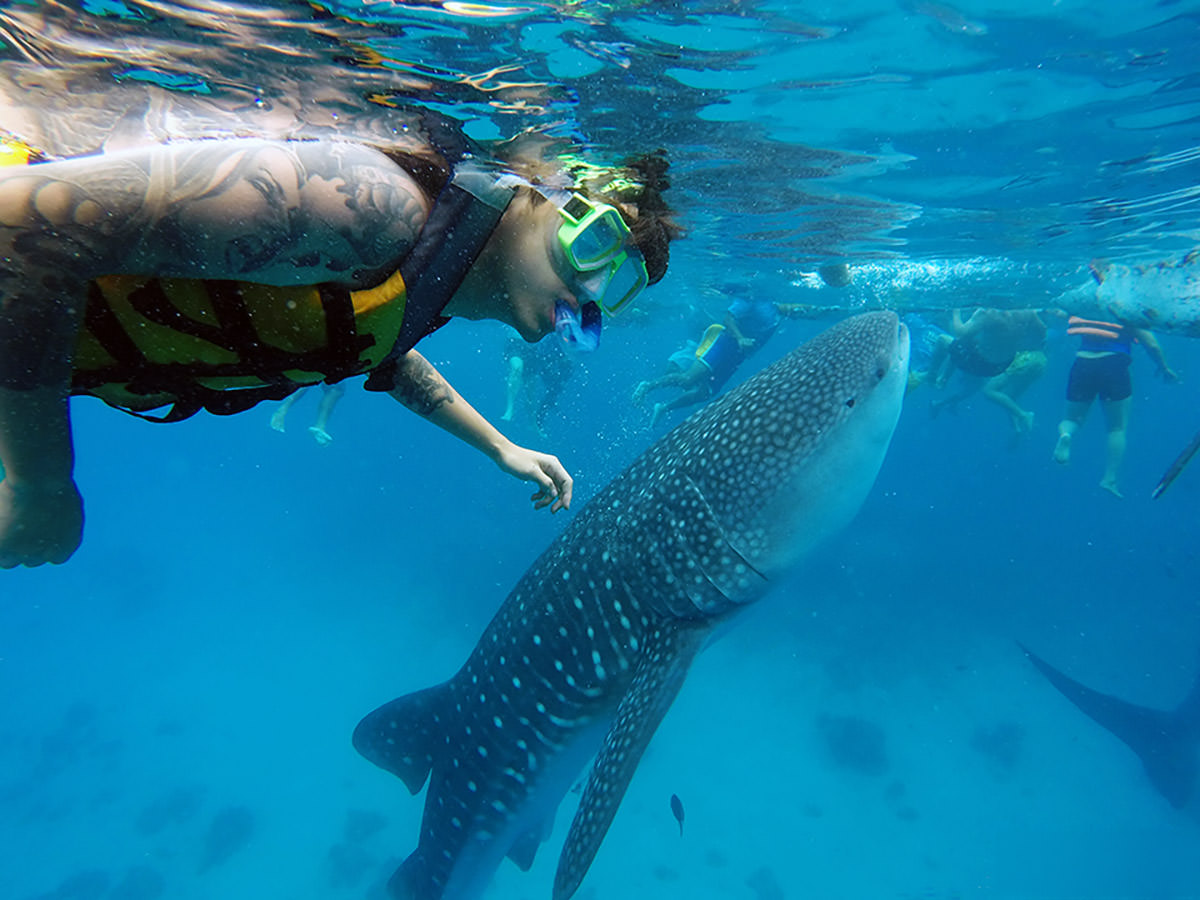
Me diving with one of Oslob’s whale sharks
In Oslob’s waters, around a dozen of them, mostly juvenile males, gather every morning just 100 meters from shore. Not because of any ancient migratory instinct, seasonal plankton bloom, or coincidence. Because of a bucket of baby shrimp.
Unlike natural aggregation sites, where sightings depend on migration patterns, plankton cycles, weather, and substantial amounts of luck, Oslob offers near certainty.
What was once a chance wildlife sighting has been engineered into something closer to a scheduled performance, running year-round, six hours a day, seven days a week.
GETTING TO OSLOB

Oslob is a municipality on the southeastern coast of Cebu Island in the Philippines, with its barangay (village) of Tan-awan clinging to the coastline roughly 130 kilometers south of Cebu City.

If you exclude Dumaguete and Panglao airports on the neighboring islands, the major airport nearest to Oslob is Mactan-Cebu International Airport in Lapu-Lapu City, the second busiest in the country. From there, your route to Tan-awan depends on your budget, patience, and appetite for local buses.

Waiting for the bus at Bato station provides an opportunity to meet local "wildlife"Are you considering Oslob whale shark watching DIY? Self-organizers, follow my lead. I landed in Lapu-Lapu from Manila and spent a night at a quite nice Otravel Hostel near the airport. The next day, I paid PHP 450 (6 euros/7 dollars) for a Grab ride to the South Bus Terminal, and then PHP 210 (3 euros/dollars) for a bus to Moalboal. After chasing sardines for several days, I took a bus to Bato, and then another one to Tan-awan, which cost me PHP 141 in total, or 2 euros/dollars.

Traveling to Oslob for whale shark watching mainly? It might be easier to join an organized excursion.

From Cebu City (if you're going direct): The drive runs 130 kilometers and takes about three to four hours. Shared group tours leave between 1 and 5 am (yes, AM!). Private transfers are also widely available, and cost 65 euros or 75 dollars per person for foreigners (entrance fee included).

From Moalboal (the diver's base, 80 kilometers north): Private taxis with a 3 am pickup can be arranged. A shared tour with pickups in Moalboal, Lapu-Lapu, Oslob, Talisay, Cebu City, and Mandaue City is available for 73 euros or 84 dollars per person (whale shark watching ticket included).

The Apekop Travel ferry dock on Panglao; when exiting on the Cebu side, prepare to take off your shoes if you don't want to get them wet
From Bohol (whose governer, nota bene, banned operations with whale sharks on his island in February 2025): A 6:30 am boat from Momo Beach in Panglao to Quartel Beach in Oslob takes up to 1.5 hours and costs 19 euros or 22 dollars one-way (if Panglao to Oslob ferry is not full, you can also buy the ticket at the spot with cash, for PHP 1,200). From Quartel, a short 20-peso bus or tuk-tuk ride reaches the Oslob whale shark viewing point.

One note of caution: don't attempt this on a motorbike or self-driven car in those early morning hours. The roads are dark and winding, the tour vans are abundant and fast, and in 2024, ahead of my visit, I could read the reports of a sleeping driver crashing into a roadside fence and a speeding tourist van colliding with a truck.
How it All Started: Oslob Whale Shark Watching History
From Vulnerable to Endangered
In the early 2000s, Oslob was a quiet place, virtually unknown outside the province.
Its waters were just an occasional stop for a migratory species of whale sharks, back then still classified as ‘vulnerable’ (the IUCN Red List would update their status to ‘endangered’ in 2016, after it was estimated that more than half of the global population was lost since the 1940s).
Whale shark hunting and trading their fins, skin and oil were prohibited in the Philippines in 1998. Swimming into a new, technically safer millennium, now threatened mainly by ship strikes and microplastic pollution, these majestic animals became a nuisance to Oslob’s fishing boats, tearing up nets and stealing bait with impunity. They were a nemesis that one was not allowed to fight.
Until local fishermen discovered that, instead of showering them with rocks, they could divert whale sharks from their nets by throwing tiny shrimp in the opposite direction.
At the beginning of the century, Andreas Luethold, a Luzern-born Swiss, traded the Alps for the Philippines to follow his passion for the undersea. He was in his 30s, had a decade of diving experience in Búzios, Brazil, and continued with divemaster and technical diving courses at one of the first dive shops in Moalboal.
“Hermann Pauli, a German friend who passed away two years ago, and I used to run liveaboard trips for Savedra Dive Center“, Andreas recalls. “I had a deal with the shop owner; I’d help out with guiding and dive safaris and, in exchange, I could always dive there for free.”
In 2010, a word reached him about researchers feeding whale sharks somewhere along the Oslob coast. And the sharks would come by every day.
“Whenever we came back from the safaris, we’d search for them”, Andreas continues. “One day, we found the spot. We asked if we could dock there and dive. For a small fee – more than just a thank you – they let us do it. We jumped in and, sure enough, there were four or five big ones in the water.”
A Swiss expat had just become the first person to dive with Oslob’s whale sharks. He didn’t know it yet, but the millions of others would follow.
The first experience of Oslob whale shark diving, before it became a massive tourism attraction, now lives as a memory. And there is even a video of it; you can check it out on Pipeaway’s YouTube channel.
Animal Cruelty Complaints
Andreas and Hermann shared their once-in-a-lifetime experience with the dive shop owner, and shortly after, they teamed up with the fishermen to bring the sharks to the designated watching area. The diving center started organizing group tours to Oslob, back then for a symbolic fee. Word spread fast. A Philippine TV segment went viral.
“This caused problems for the dive shop because it had received recognition for environmental protection and sustainable diving, such as the Green Fins Award“, Andreas says. “People complained about animal cruelty. So the dive shop stopped offering the service, and the secretary, who also ran a transfer company, or rather, Par Vans, continued the whole operation under the radar.”
Within a year or two, Oslob whale shark watching became so well-known that vans from across Cebu and dive boats from other islands were converging on Tan-awan. Tourists were arriving in thousands.
Within a decade, Oslob had become the world’s largest non-captive provisioned whale shark tourism destination, receiving over 500,000 tourists in 2018, with an estimated US$10 million in ticket sales. That grew to nearly 12 million in the pre-pandemic record-breaking 2019. In 2022, whale shark tourism generated approximately 6 million dollars.
“Today, the whale shark encounter costs ten times as much, and is somehow in the hands of local politicians, bringing 2,000 visitors on some days”, says Andreas, who, meanwhile, swapped active diving with running a superb resort with parrots in Moalboal.
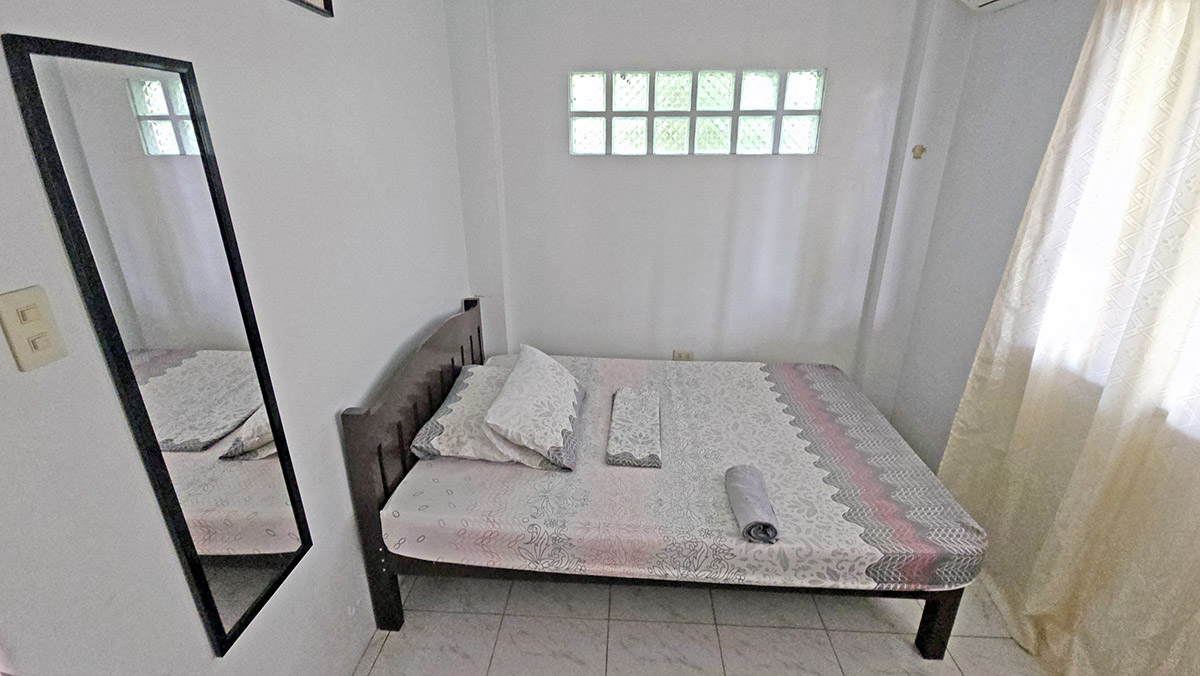
WHERE TO STAY IN OSLOBA simple setting at D'Downhill Place - do you need more?I booked a room at D'Downhill Place, a basic guesthouse 600 meters from the whale shark meeting point. Two can sleep in here for 15 euros per night already. Basic is the operative word, but when your alarm goes off at 3:30 am, "basic" is all you need.
For the budget-conscious, Sharky Hostel (aptly named) sits literally steps from the Oslob whale shark watching location, with dorm beds from 7 euros per night.
Whale shark is the omnipresent symbol in the branding of local businesses
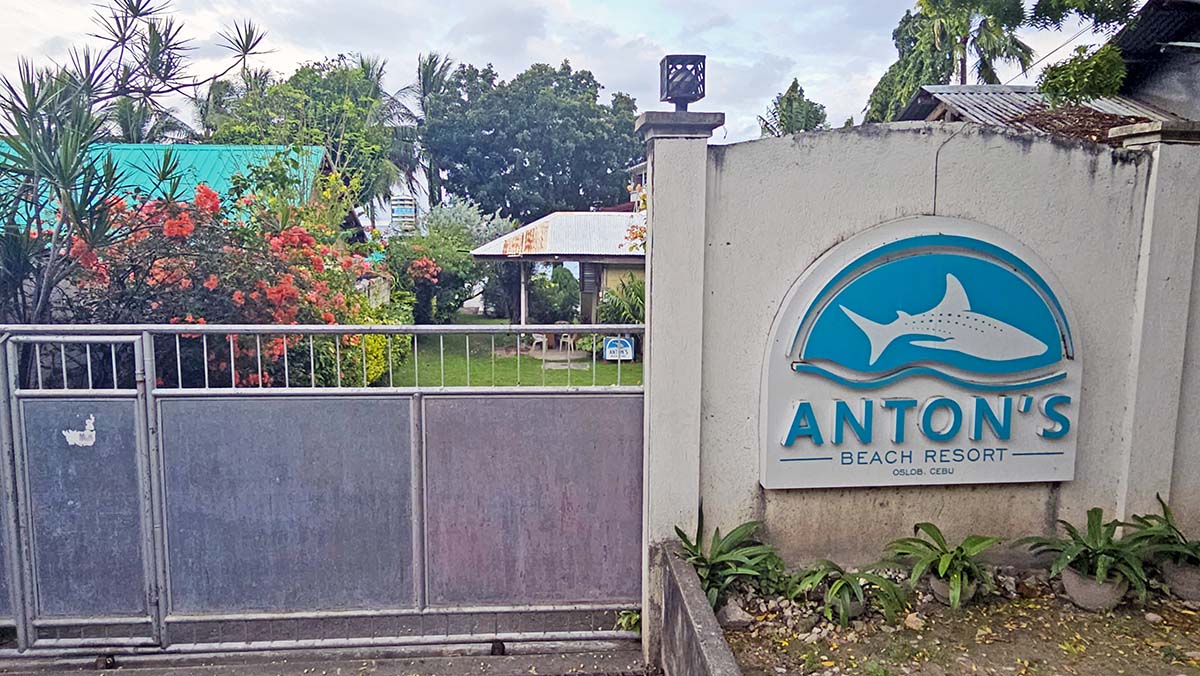
For those who prefer a swimming pool between shark encounters, Anton's Beach Resort offers direct beach access and considerably more comfort at around 28 euros per couple. It also consistently collects rapturous reviews as one of the most exceptional and affordable Oslob resorts.
As the Oslob whale shark watching experience begins at 6 am and rewards those who arrive by 4, staying nearby the night before is the sanest approach to logistics.
What to Expect From Oslob Whale Shark Watching: The Full Experience Guide
Reserving your spot
An advance booking for the whale shark interaction is possible (and recommended) through the official Facebook page, which handles reservations up to two days ahead between 9 am and 6 pm. You’ll need to pick a preferred time (hourly time slots run from 6 am to noon), and provide each guest’s name, date of birth, nationality, gender, and contact number. In response, you’ll get a reservation code to present on the day of the experience, together with a valid ID, at least 30 minutes before your time slot. You’ll exchange your reservation code for a priority number and pay on the spot.
Walk-ins are also accepted at a separate booth, on a first-come, first-served basis.
As I planned to visit Tumalog Waterfalls after swimming with the whale sharks, and still needed to check out from my Oslob accommodation by 11 am so I could catch the Apekoptravel ferry to Bohol/Panglao, departing at 11:30 am from Quartel Beach, it was in my interest to finish my grand fish adventure as early as possible.
So I did both simultaneously: reserved a 7 am slot via Facebook (the 6 am was already full) and showed up at 4 am to try my luck as a walk-in for 6 am. It worked. With so many walk-ins, I knew nobody would hate me for my double reservation, as someone else would surely fill the empty pre-reserved spot.
Arrival
Arriving before 6 am is strongly advised. From D’Downhill Place, the walk takes only 8 minutes, so I showed up at the Oslob Whale Shark Watching site at 4. At that hour, there were already 60-odd people quietly arranged in four rows of plastic chairs. I’m sure some arrived as early as 2 am, when the snack-selling shop opens its doors, like I learned the day before, when Oslob experienced a power outage, and that was the only place to get some food. I bought noodles, and the owner even managed to heat some water for me on their stove while sharing tips for the experience.
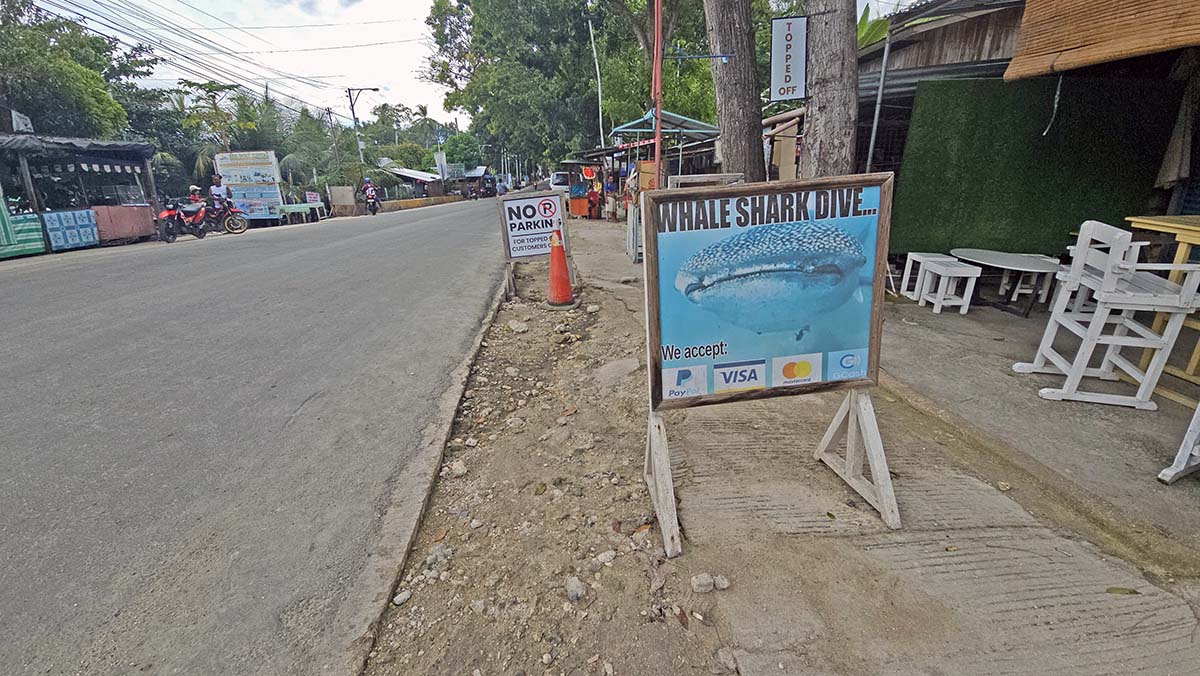
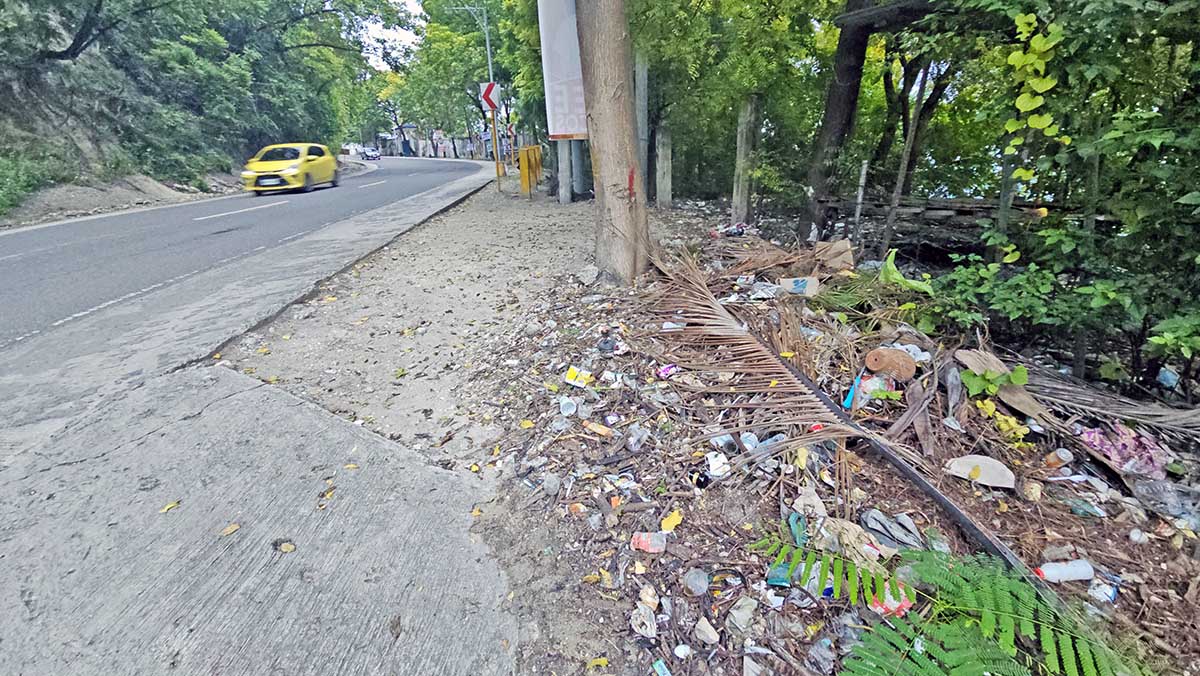
Despite charging with every possible payment option, still no money for a proper sidewalk in Oslob
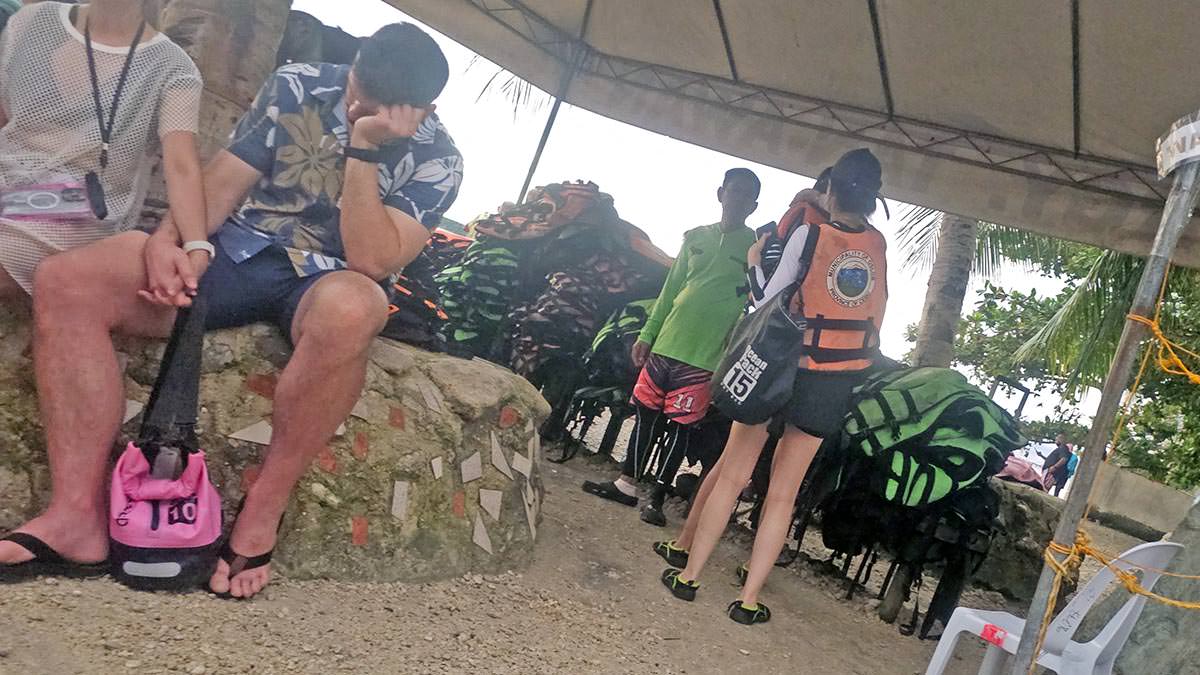
An early arrival means you’ll inevitably encounter many “where do you go?” questions from a variety of local entrepreneurs trying to sell you something, from breakfast to a parking spot. A seller dressed in a cluster of waterproof phone cases weaved between the chair rows, shouting “Okaaaay!” to nobody in particular. “We already have them”, responded a Japanese man. The Americans sitting next to him hid behind gigantic fins, which I thought were forbidden. Then, there was a young man, his head between his knees, napping. Other sleepy travelers clutching their selfie sticks and half-finished coffees.
In Oslob, it’s never too early to conduct business
By 4:15, additional staff had arrived and added four more rows of chairs. At that time, a local rooster woke up.
The clock said 4:30 when a third seating area started to fill. Even in front of the female restroom, a waiting room had been improvised, with several chairs.
A man sitting next to me was guarding four empty chairs for his late-sleeping family members joining the Oslob whale shark watching queue at 5 am.
Just at that moment, a long, didgeridoo-style foghorn sound boomed from the speakers, as if a gigantic cruise ship would run against bangkas, traditional double-outrigger boats ready to bring us to the whale sharks. Was the audio signal a wake-up call for them or for us?
Our snake-line queue began moving, as if playing a game of musical chairs, and one by one, we arrived at the registration desk. I got number 16. That sounded good.
The lady informed us that the cashier would open at 5:45, so our waiting group dispersed on the beach, observing the bloody sunrise penetrating through the morning clouds and eye gunk.
A magical start to a morning in Oslob – you can’t put a price tag on sunrise, can you?
OSLOB WHALE SHARK ENTRANCE FEEOslob whale shark watching rates depend on whether you are a foreigner or a local. For Filipino snorkelers, the price of seeing Oslob whale sharks is PHP 500 (7 euros or 8 dollars). International visitors who would like to snorkel next to the world's largest fish pay double – PHP 1,000 (14 euros or 16 dollars). If you want to skip the line and have someone else sort out the transfer logistics, you can arrange the entire day trip from Cebu for 55 euros or 64 dollars.
Oslob whale shark entrance fee is higher for those who want to do scuba diving. Locals pay PHP 1,000, while foreigners need to cash out PHP 1,500 (21 euros or 24 dollars). If you opt for a scuba diving experience, you'll also need a guide and equipment, so it might make sense to take the entire package with admissions and transfers included – the price is 98 euros or 113 dollars.
If you want to add Sumilon Sanctuary as an additional diving site, choose this program for 217 euros or 252 dollars.
Unlike snorkelers who might end up waiting in line up to 2 hours, scuba divers normally don't need to queue. Their actual time spent with the sharks is also typically longer.
Briefing
Before entering the water, visitors are expected to attend a short safety orientation at the Oslob Whale Shark Watching briefing area. Listening to the guidelines felt more like a suggestion than a strictly enforced task, if I may say. Nobody ever told me I needed to go through it; I just noticed people sitting in front of a talking lady, so I joined in.
A staff member explained to us the Oslob whale shark watching rules:
No sunblock or skin protection. The chemicals can be harmful to the sharks and the surrounding reef. If you have sunscreen or body oil on you, rinse it off before boarding. Alternatively, wear a long-sleeve UPF rash guard and leggings for sunburn protection.
Remove jewelry. Necklaces and bracelets present a safety hazard, both for the wearer and for the animals. Also, you take an unnecessary risk of losing that beloved earring.
A life vest is mandatory. Paradoxically, once you’re in the interaction zone, you may remove it. Apparently, responsibility for bad swimmers stops wherever the bangka stops.
Enter the water slowly. Never jump off the boat. The whale shark may be where and when you least expect it. Also, water splashing is exactly how fishermen draw the shark’s attention. You don’t want them rushing into you, thinking you might be krill. Use the ladder attached to the bangka to gently enter the water.
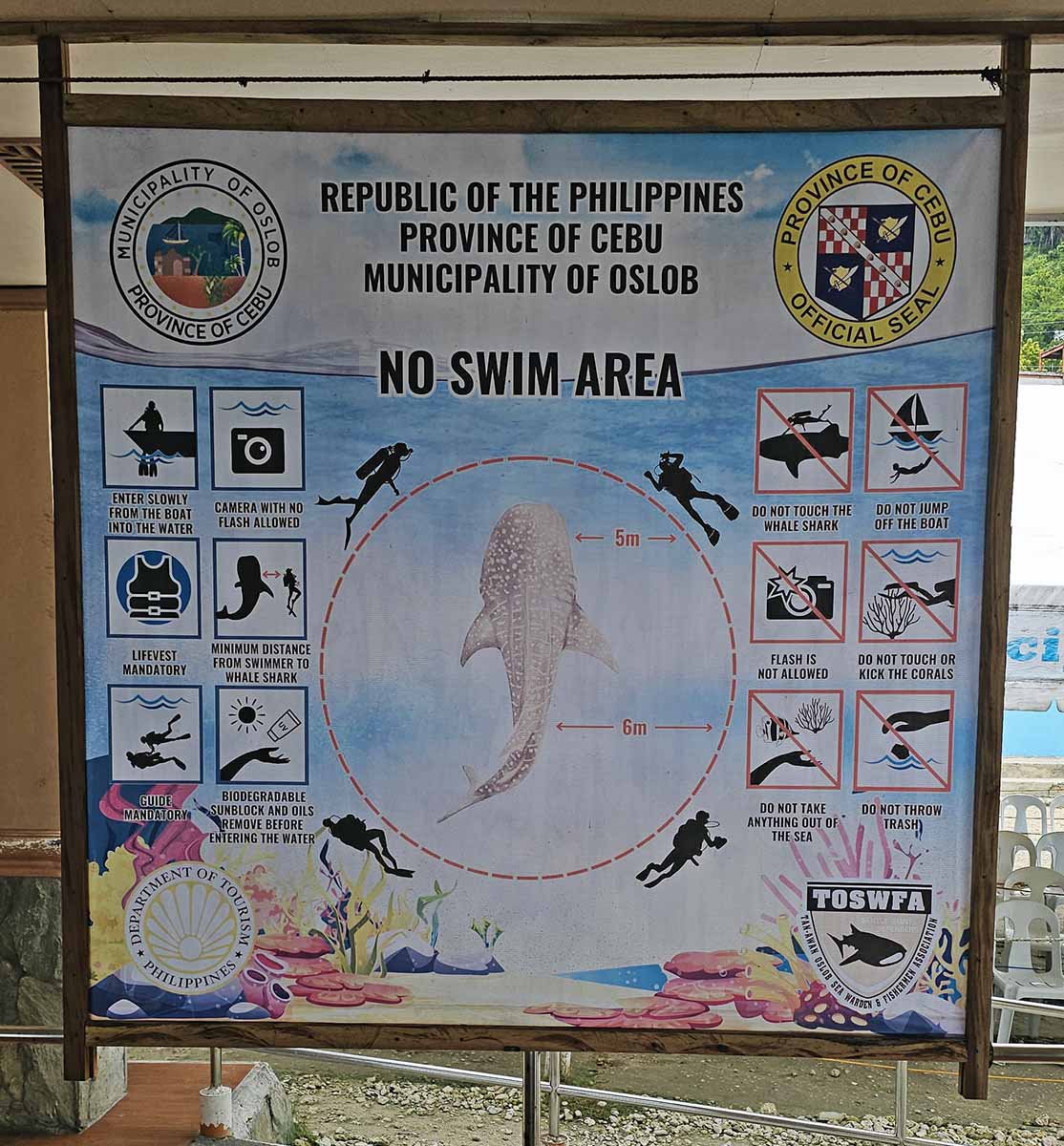
The conflicting messaging on the allowed distance from the whale sharks – 5-6 meters on paper, 4 meters in oral briefing, less than 1 meter in reality
Maintain at least a four-meter distance at all times. The large poster conflictingly instructed five meters as a minimal distance from the whale shark’s body and six meters from the tail. Peer pressure in the water is real, but try to hold the line on the rule even when others don’t.
No touching the animals. Besides whale sharks, the ‘no touching’ rule refers to turtles and corals as well.
Stay calm. If a shark swims toward you, move aside. If it doesn’t approach you, don’t chase it.
No flash photography. Most of their time, whale sharks spend in deep waters. They are sensitive to sudden light exposure, and intense flashes could damage their eyes, cause stress, and weaken their immune system.
Take nothing from the ocean. Rocks, shells, fish, and everything else you might fancy cannot be taken home.
Leave nothing in the ocean. Your trash belongs to you.
Well, this was my interpretation of the important rules to follow. I might have missed an instruction or two from the presentation, but, more or less, you understand the drill.
If you don’t, you’ll be happy to know that this theoretical introduction ends up like a Christian prayer, with the Sign of the Cross. “In the name of the Father, and of the Son, and of the Holy Spirit”, the lady said. “Amen”, the congregation responded. So, help us, God.
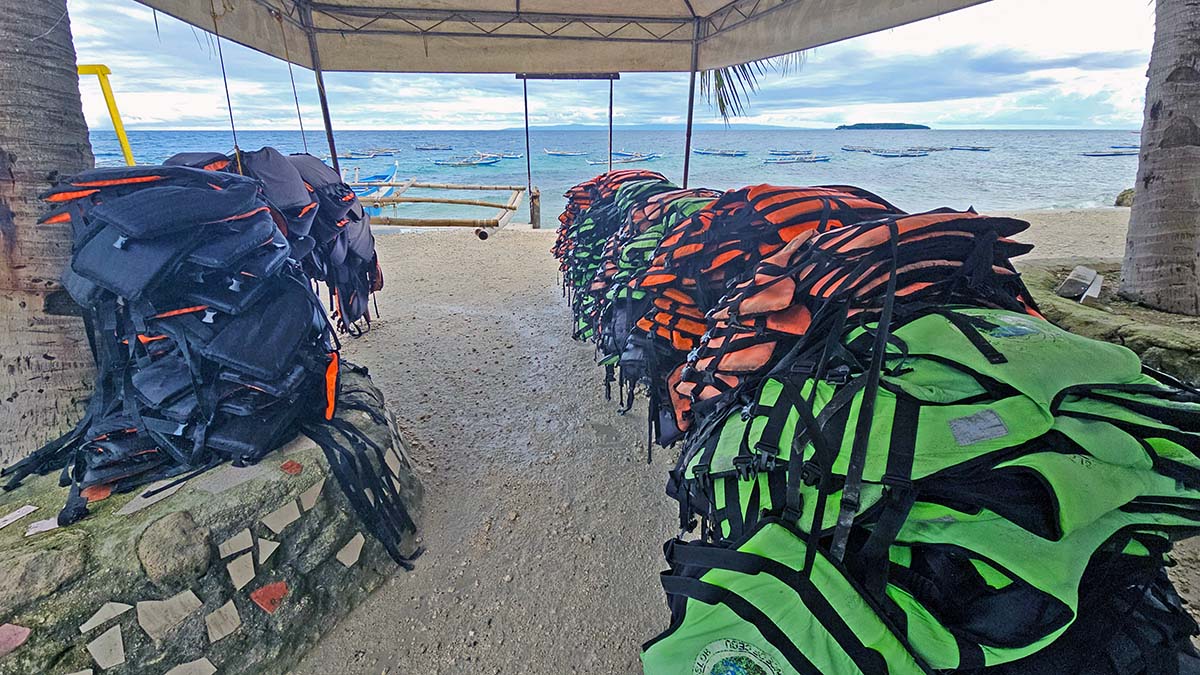
Grab a life vest, take a nap
In the Water
The chaotic organization then continued with verification (that you have paid), and waiting for your number to be called. From a pile of life jackets, you’d pick one, and an hour or two after the arrival, you’d be ready to go.
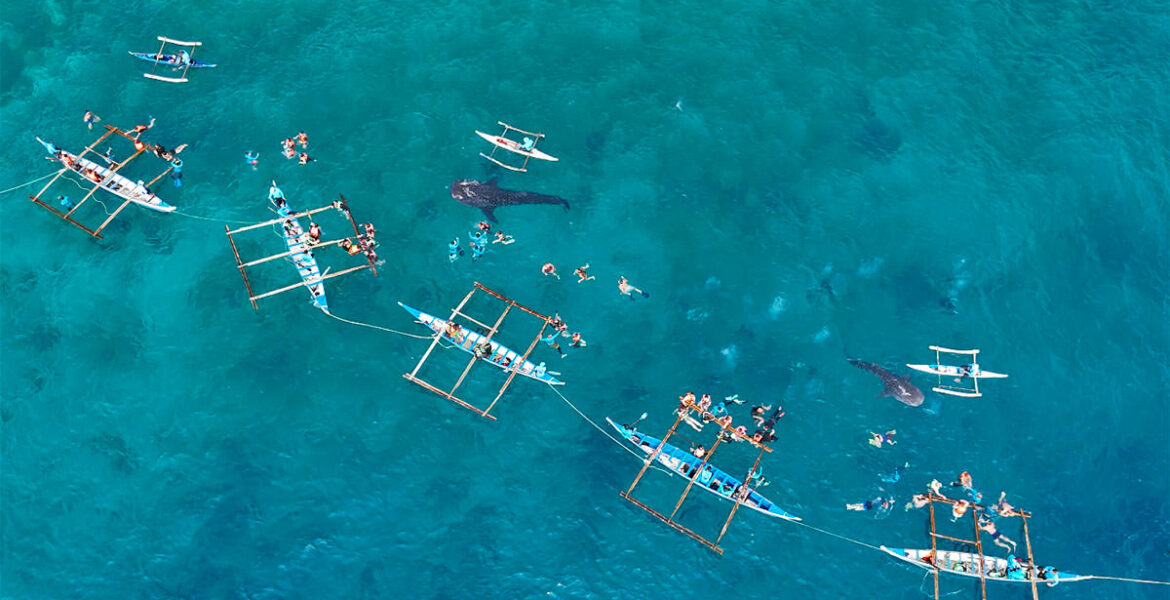
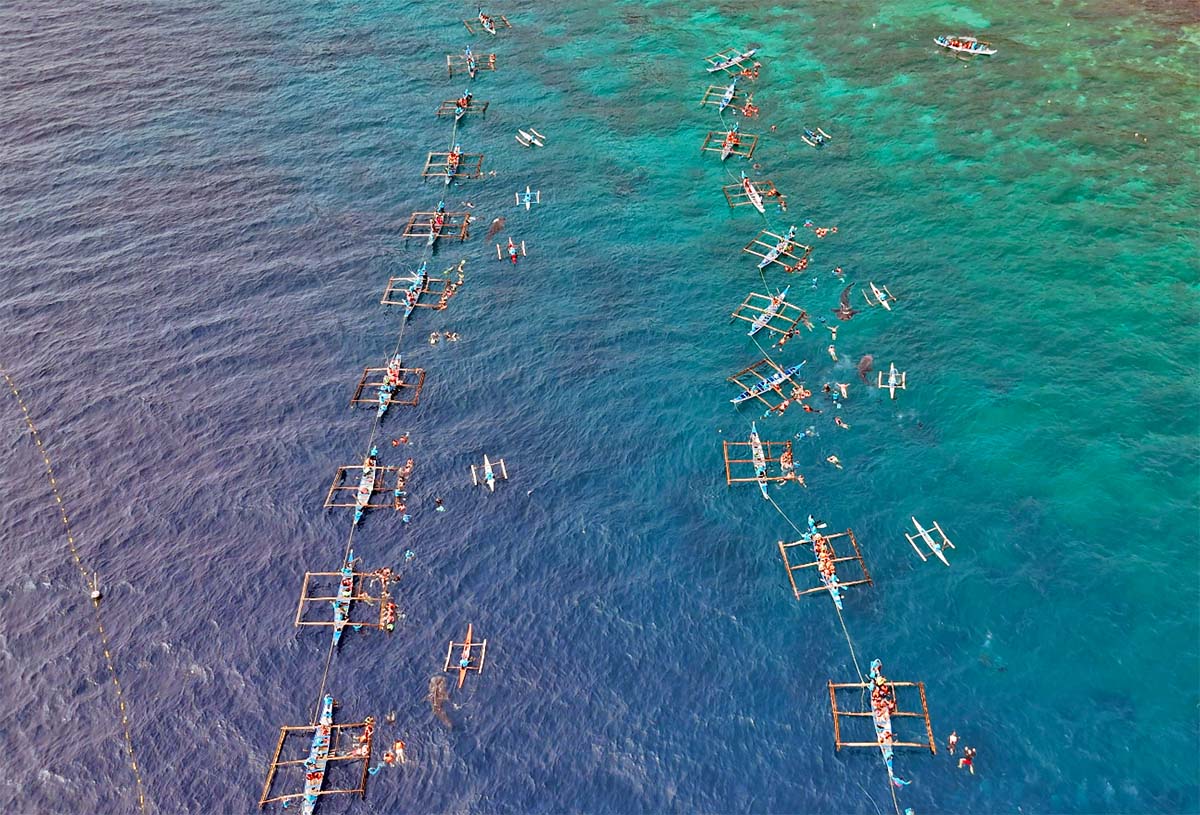
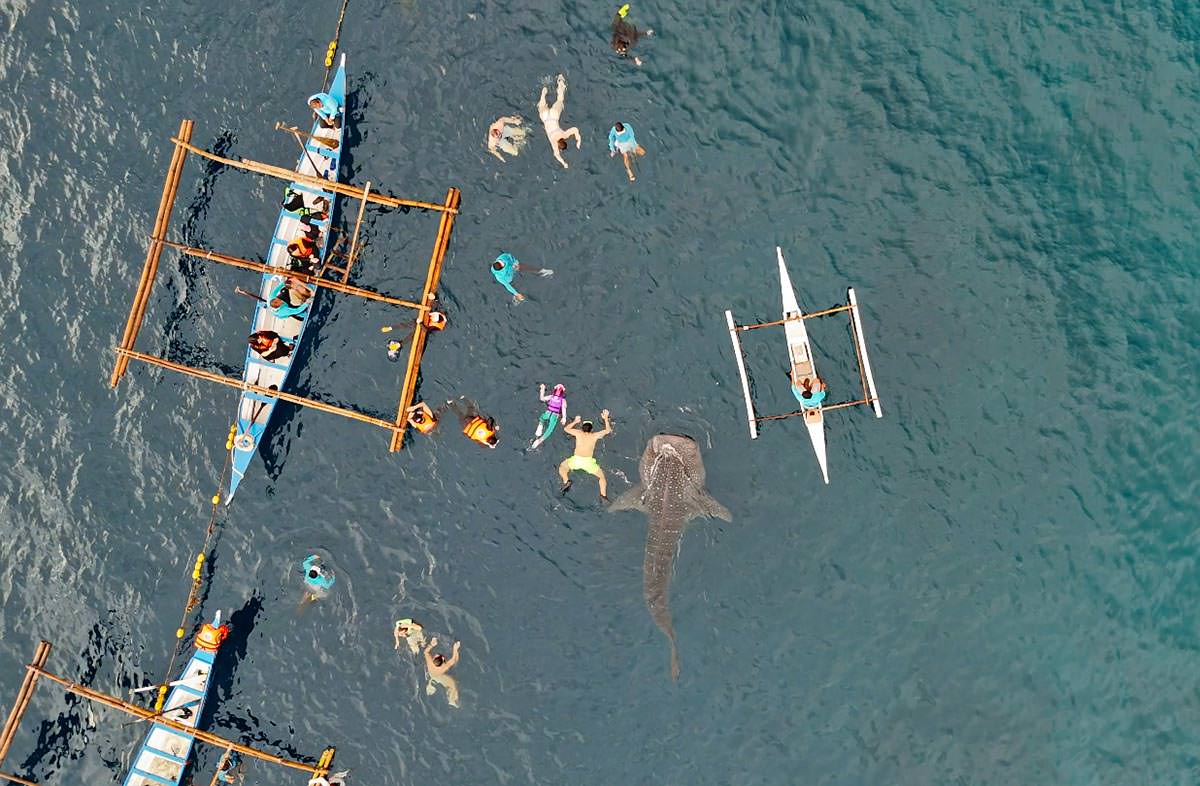
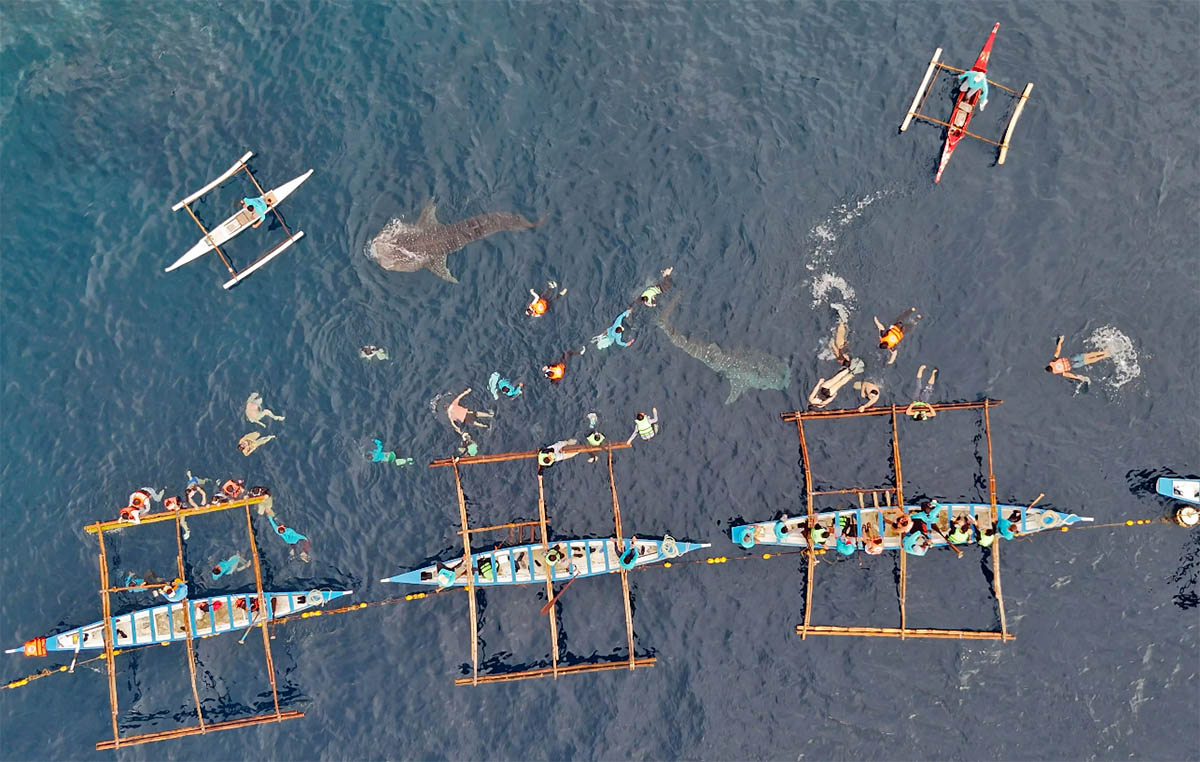
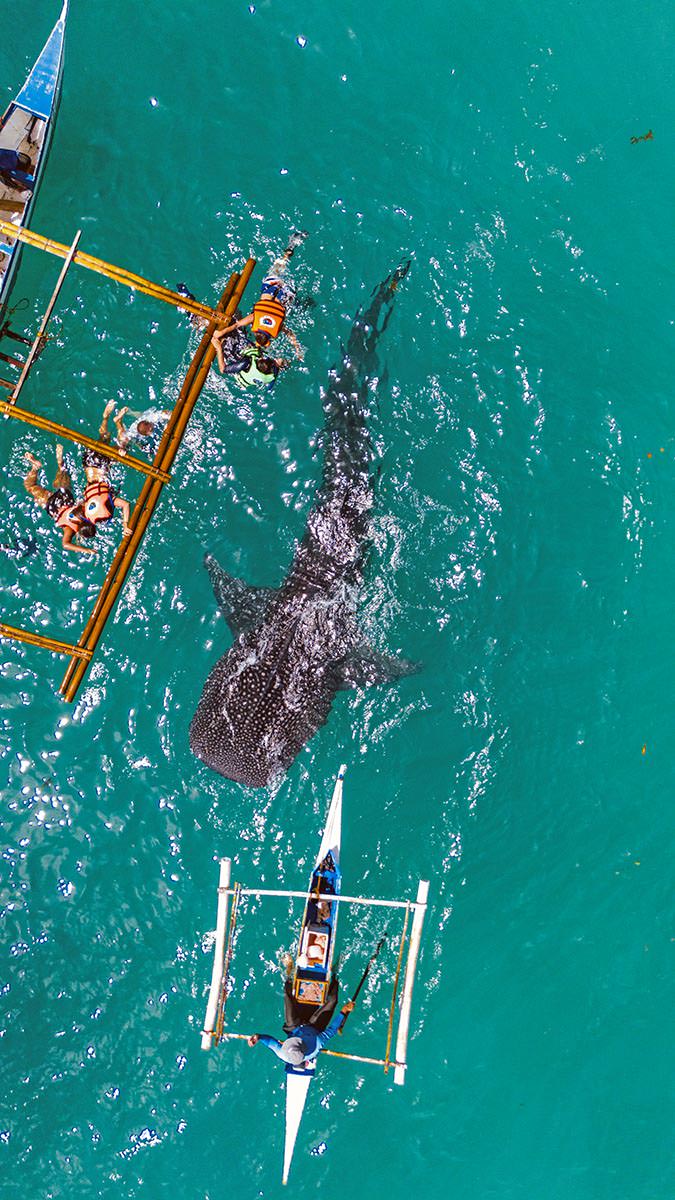
Wooden bangka outrigger boats, non-motorized, carrying up to a dozen visitors each, were rowed approximately 100 meters from shore (although from the drone footage I took afterward, some boats were tying up barely 30 meters out, where anyone could technically swim to; that is, if informal swimming would be allowed during the operation).
Oslob – the world’s largest provisioned whale shark tourism destination
Once in the position, we slid into the water. As spotters, maneuvering small feeder bangkas, were already passing by the rows of approximately two dozen tourist bangkas, scattering small shrimp (uyap or alamang) into the water, the “show” was already on.
Five magnificent creatures, between 3 and 5 meters long, slowly glided through the water. Well, slowly in whale-shark can-grow-to-the-size-of-a-bus terms. I repeatedly felt surprised by their appearance, closer than I would expect, quicker than a human can react. Despite instructing us to stay at least four meters away from the whale sharks, it was obvious they were being fed at much closer proximity to tourist bangkas, a human and their world brushing against each other on purpose. Sometimes it literally resembles a petting zoo.
6 meters? 5 meters? 4 meters? Where’s the measuring tape when you need it the most?
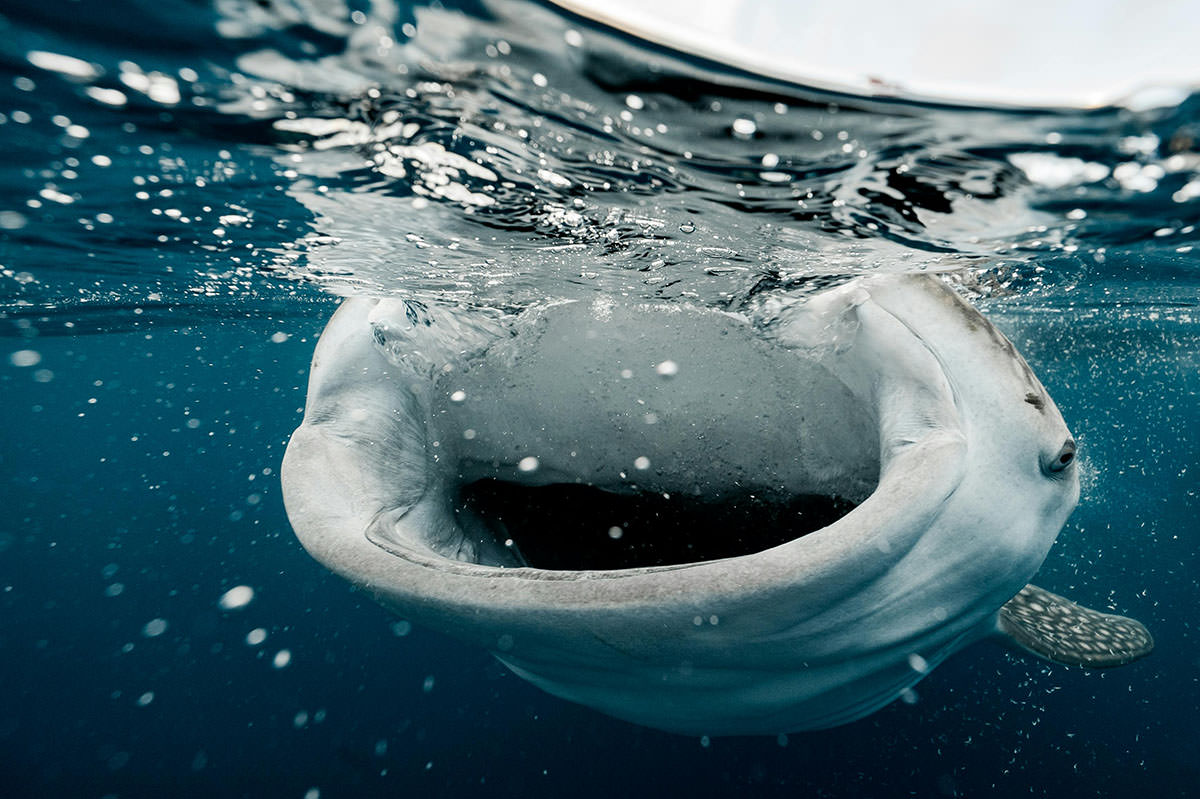
Their distinctive spotted hides felt vast, their wide mouths open to filter out the shrimp-clouded water. Even if these were technically baby sharks, their presence seemed massive.
The guides were entering the water as well, chasing tips by pushing bad divers deeper for better shots, or diving down themselves to capture a passing sea turtle on a guest’s GoPro.
Our 30 minutes in the water seemed less than enough, but a new group of tourists was waiting to take our place floating next to one of the world’s most ancient surviving shark species.
Get an even clearer impression of the Oslob Whale Shark Watching experience in this 4-minute YouTube video!
COMBINING SHARKS WITH OTHER OSLOB ATTRACTIONS

Things to do in Oslob are not that abundant. As whale shark watching wraps up by midday, you might have a free afternoon, and not know what to do with yourself.

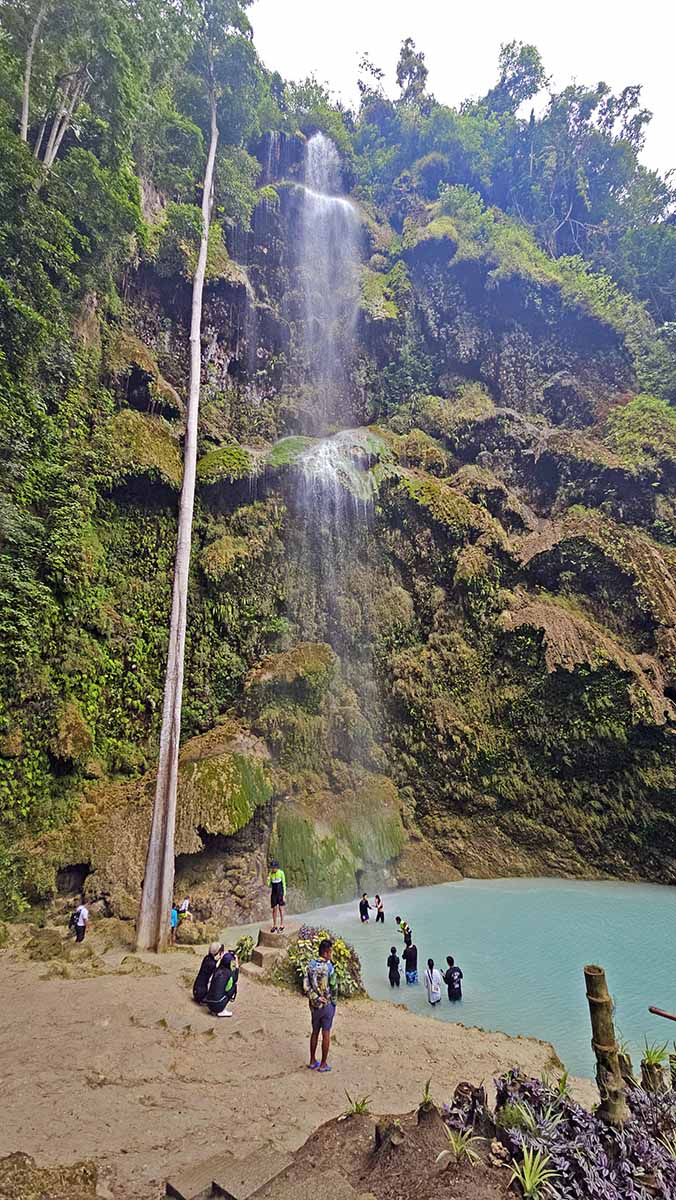
Tumalog Falls, a nice place to get a shower after swimming in what is essentially a shrimp soupI decided to pair my Oslob visit with Tumalog Falls, a stunning curtain waterfall 15 minutes away from the interaction site. If you don't want to organize the transfers by yourself, join the waterfall hopping tour and see more cascades in southern Cebu.

Many visitors continue with a day tour to Sumilon Island, a pristine marine sanctuary with a shifting sandbar and excellent snorkeling at colorful coral reefs. Combine the tour here, or even stay at the Bluewater Sumilon Island Resort.

Another option is to add Moalboal's sardine run to your Oslob mix. Check out the option here or here.

If one cetacean encounter wasn't enough wildlife for the day, there's also an Oslob Macaque Sanctuary. Add monkey watching to your Oslob visit here.

The adrenaline-inclined visitors could combine Oslob with Kawasan Falls canyoneering in Badian, around 60 kilometers north. Mix your preferred activities here.

If you want to extend your Oslob adventure in the air, consider taking a tandem paragliding flight, with packages starting at PHP 3,500 (49 euros or 57 dollars). Get all the info at Oslob Paragliding Cafe.

For history enthusiasts, a visit to the well-preserved Spanish-era Cuartel Heritage Park, with barracks made of coral stones and a watchtower against pirate attacks. The 19th-century Our Lady of Immaculate Conception Church, also known as Oslob Church, is another monument to the region's colonial past.
Is Whale Shark Watching in Oslob Ethical?
Swimming with whale sharks can surely be an unforgettable, but also morally uncomfortable experience. The ethical debate around Oslob, however, should not be driven solely by sentiment.
The peer-reviewed science spanning more than a decade of on-the-ground research, as well as the arguments in defense of Oslob’s whale shark tourism, can help you get a clearer picture of the issues and find your own answer when considering whether to engage in the interactions with the world’s largest fish.
Ethical Red Flags – The Case Against Oslob Swim With Whale Sharks
1. Widespread Physical Injuries
LAMAVE (Large Marine Vertebrates Research Institute Philippines) is a nonprofit conservation organization that monitored Oslob’s whale sharks continuously from March 2012 to January 2020.
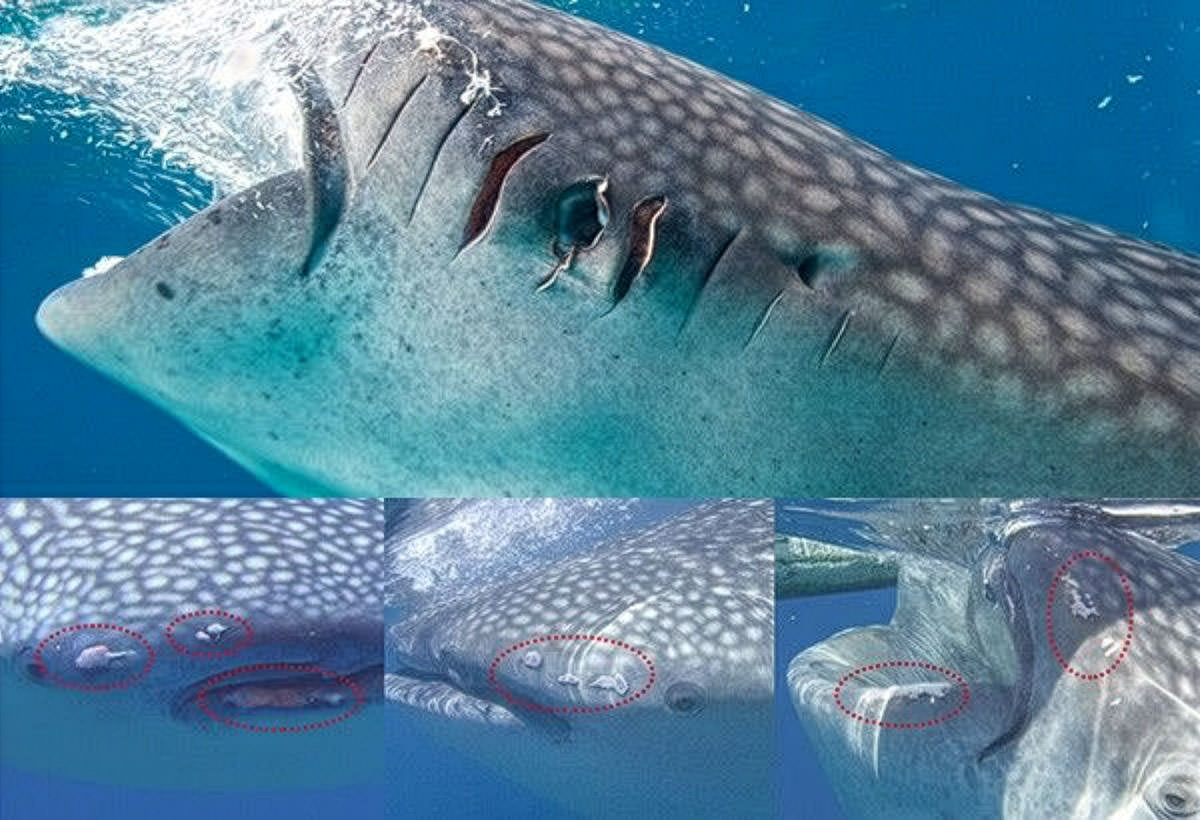
What they found was striking: analyzing photographic data from 152 individual sharks over 34 months, researchers documented that whale sharks visiting the provisioning (feeding) site have a significantly higher incidence of injury and scarring than at non-provisioned sites in Australia, Mozambique, and the Seychelles.
Steve de Neef’s photographs showing the wounds sustained by Oslob’s whale sharks
95% of Oslob whale sharks carry white lesions with a spongy consistency, the result of repeated skin abrasion from boat hulls and propeller strikes.
The cause is behavioral: daily hand-feeding has conditioned these animals to approach rather than avoid boats, including those with propellers. In training them to treat boats as an all-you-can-eat buffet, the provisioning has made them catastrophically bad at self-preservation.
2. Behavioral Modification
A 2015 study found that sharks in Oslob have learned to associate the location with food rewards. Long-term residents arrive, on average, just five minutes after the feeder boats, and show significantly reduced avoidance response to human contact and boat proximity.
Instead of their natural horizontal swimming through the water column, Oslob’s regulars spend significant time swimming vertically near the surface, mouths open, waiting. Scientists have described this behavior as “begging”.
One of Oslob’s beggars assuming a vertical position while expecting the fisherman to throw food
For naturally migratory animals, the desensitization to human contact extends the problem beyond Oslob’s waters. A whale shark conditioned to approach boats as a food signal may do the same in the open ocean, swimming toward fishing vessels (including those actively looking for sharks), with potentially fatal results.
A 2020 study in Scientific Reports documented that Oslob sharks’ time spent at the warm water surface increased sixfold on provisioned days, exposing them to much more direct sun than normal. This could explain almost regular deep dives after the feeding, possibly related to thermoregulation needs. These behavioral changes ripple outward: whale sharks play a role in the vertical and horizontal cycling of ocean nutrients, meaning their altered movement patterns may affect the broader ecosystem and its biodiversity.
3. Disrupted Migration Patterns
Whale sharks are built to travel. Their usual existence involves crossing vast distances to follow seasonal plankton blooms across multiple ocean systems.
In Oslob, some individuals have simply stopped doing that and become year-round residents.
Scientists worry that prolonged dependency on provisioned food could reduce foraging capability and breeding opportunities, delay sharks’ biological clocks, and alter natural distributions in ways the evidence doesn’t yet fully capture.
4. Shark’s Raised Energy Costs
Whale sharks normally feed slowly and intermittently. But in Oslob, the buffet is open for hours, with no rest, resulting in shark fatigue.
A 2023 Flinders University study fitted 16 whale sharks with accelerometers and measured what Oslob’s tourism site actually costs them: a metabolic rate increase of up to 55%, driven by the rapid acceleration and constant navigation around other sharks and boats.
According to available data, fishermen feeding the sharks spend around 130 kilograms of baby shrimp bait per day. Researchers estimated that 220 kilograms of food would be needed just to offset the energy expenditure, meaning the provisioning may not be nutritionally compensating the animals for the physiological costs it imposes.
The whale shark’s mouth can grow up to 1 meter wide
5. Poor Food Quality
Besides its quantity, the food provisioned for the Oslob sharks is also nutritionally deficient.
In the wild, whale sharks consume a very diverse diet of plankton, krill, fish eggs, and small fish.
When local plankton, which includes 12 different types of organisms, runs out, Oslob imports the replacement food from neighboring islands of Panay and Negros, where plankton is less diverse. Furthermore, because this shrimp is transported from hundreds of kilometers away, it loses significant nutritional value in transit.
Marine biologists have compared Oslob’s whale shark diet to a human living entirely on fast-food French fries.
6. Coral Reef Damage
LAMAVE data documented coral density in the interaction area running more than 2.5 times lower than at a control site, alongside elevated macroalgae cover. The reef ecosystem is degrading. More research is needed to fully parse cause and contribution, but it is suggested that the concentration of tourism activity is linked to it.
7. Rule-Breaking Routine
Despite legislation carrying financial and even criminal penalties for touching the sharks, the researchers have been continually warning that regulations in Oslob are poorly enforced. Compliance monitoring over 3,849 minutes of observation recorded 1,823 touches of the animals, approximately 28 per hour.
Repeated touching of the animals normally living in the ocean’s depths may significantly impact their immune system and overall health. The mucus layer on their skin is a barrier against pathogens, and removing it leaves them vulnerable to infections and disease.
LAMAVE research showed that 92.7% of tourists breached the minimum 2-meter distance, and an average of 17 tourists were observed within 10 meters of a single shark, far exceeding the permitted maximum of six. In that density, local marshals have almost no practical ability to enforce the rules effectively. In my own observation, guides in the water even push less capable swimmers toward sharks, for a better photo.
If you have a hard time estimating the distance between a shark and a tourist, just imagine that, at any given moment, an entire shark should be able to fit in the space between them
8. Guilty Pleasure Loop
A study analyzing TripAdvisor reviews found that two-thirds of visitors who raised ethical concerns still classified their experience as a “guilty pleasure” (being aware that feeding an endangered species for tourism might be morally wrong, yet still choosing to do the Oslob whale shark tour and recommending it to others).
Awareness of harm, the study found, does not reliably translate into behavioral change when the experience is spectacular enough. The review cycle feeds the demand. The demand feeds the shrimp buckets. The shrimp buckets feed the loop.
9. Economic dependency of the community
Oslob’s local economy now revolves entirely around the daily presence of these sharks. Hotels, restaurants, transport businesses, and dozens of family livelihoods are staked on the animals showing up every morning.
Putting all your eggs in one basket is precarious enough when the basket is, say, the tech industry. When the basket is an endangered migratory species that you’re actively pressuring to stay put, the fragility compounds.
Economic dependency creates pressure to keep feeding the sharks regardless of harm, because the alternative – the animals leave, and the operation closes – is financially unthinkable for the community.
Despite the authorities collecting the “environmental fee” from the participants of the Oslob whale shark watching, the roadside garbage in Tan-awan is a sad reality. If only whale sharks could walk through the forest and say “thank you for the food” by collecting garbage!
Ethical Green Flags – The Case For Swimming With Whale Sharks in Oslob
1. Economic Transformation
Before whale shark tourism began, Tan-awan was a poor, sleepy fishing community where most residents earned less than $1 per day. The whale shark operation has generated approximately US$18.4 million in ticket sales in its first five years (2012-2016), creating alternative livelihoods for 177 fishers and diversifying income throughout the wider community (guides, drivers, resort and restaurant staff), enabling them a greater quality of life. The money from the tours funds local healthcare, infrastructure, and education.
Income distribution looks as follows: 60% goes to the fishermen’s association, split among its members, 30% to the municipality of Oslob, and 10% to the Tan-awan barangay general fund. The municipal share funds five marine reserves and the sea wardens who patrol and protect the sharks.
The influx of tourists in Tan-awan has literally served as a life vest for the local economy
2. Protection From Poaching
Before 1998, when whale sharks gained national legal protection, hundreds were killed annually in Philippine waters for meat, fins, oil, and skin – a single animal fetching tens of thousands of dollars on Asian markets, China in particular.
The economic value of live sharks attracting tourists has given local communities a powerful incentive to protect the species rather than hunt it. Poaching is now economically irrational.
Fishermen feeding the whale sharks have no time to fish for other fish
3. Reduced Fishing Pressure
The fishermen feeding sharks and ferrying tourists in the Oslob whale watching park are no longer netting fish from already-depleted reefs. Local reports suggest fish abundance in the area has increased since the tourism operation began.
The shrimp supply chain also provides income to fishers on neighboring islands, further diffusing pressure on wild stocks.
4. Contested Science
Not every researcher reads the LAMAVE data the same way. A 2019 peer review concluded that studies claiming negative impacts on Oslob whale sharks were characterized by a “lack of baselines, limited methodological approaches, and poor interpretation of results”, and did not provide a sound empirical basis for condemning provisioning. The science is not as settled as advocates on either side often suggest.
5. The Sharks Are “Free to Leave”
The whale sharks in Oslob are not captive. They can and do depart after a few days or weeks. Only around 4% have become year-round residents. If the site were acutely harmful, the argument goes, fewer animals would return. This reasoning has limitations (behavioral conditioning complicates any clean reading of “free choice”), but it is not completely without merit.
In Lopburi, Thailand, locals feed the town's greatest pests, hoping they would not terrorize them. Learn how to attend the Monkey Buffet Festival!
Ethical Alternatives to Oslob Whale Sharks
If the evidence gives you pause, the whale shark tourism in the Philippines has ethical alternatives. They involve trade-offs, primarily around certainty of sightings, but they offer encounters that do not carry the same documented costs and ethical guilt as the Oslob ones.
Donsol, Sorsogon (Luzon Island)
If you want to experience ethical whale shark tourism in the Philippines, head to Donsol. Whale sharks congregate naturally in Donsol Bay to feed on abundant plankton, with no feeding by operators. Tours follow strict WWF-Philippines guidelines, ensuring sustainable interactions, and are accompanied by a licensed Butanding Interaction Officer (BIO). Sightings are uncertain and seasonal (November–May, peak February–April), depending entirely on luck and patience.
Pintuyan, Sogod Bay, Southern Leyte (Eastern Visayas)
Less visited and championed by conservation scientists, Southern Leyte offers wild whale shark encounters in a quiet, non-intrusive, minimal-impact setting. LAMAVE has trained local guides in eco-friendly interaction practices, group sizes are tiny, and daily visitor numbers are a fraction of Oslob’s. The remoteness is its greatest asset, but sightings at sharks’ natural migration route are not guaranteed.
These inverted Dalmatians in the presence of food behave like hungry puppies; just like in Pavlov’s dog experiment, they can be conditioned
Is Oslob Whale Watching Ethical? – Conclusion
Should you swim with whale sharks in Oslob?
Oslob is not a simple story. It is not a tale of pure exploitation, and it is not the innocent bucket-list experience its marketing presents. It is something more complicated: a community that found a better life by forming an unusual relationship with an endangered species, producing measurable benefits for people and documented costs for the animals.
The whale sharks of Tan-awan are alive. They are protected from poachers. Their presence has funded marine reserves and lifted a village from extreme poverty. These are real outcomes.
So are the propeller scars on 95% of the sharks’ bodies, the behavioral conditioning that has made them approach boats they should flee, the degraded reef, and the image of a wild migratory animal orbiting a shrimp bucket in a fixed mechanical loop, every single morning.
It remains contested whether these impacts, taken together, constitute a long-term population-level threat.
The Philippines has put the whale shark on the 100-peso bill. It reads either as an honorable acknowledgment or as a reduction of an entire endangered species into currency
After spending eight years gathering evidence, LAMAVE, the organization with the longest presence at the site, paused its Oslob research in 2020 because people in power repeatedly refused to implement management improvements based on its findings. The organization stated it would only resume if substantial changes were made. That decision speaks louder than any individual study.
Personally, I feel conflicted about joining the Oslob whale shark snorkeling, even if for reporting purposes. Equally, I must say I didn’t know nearly enough when I entered these waters in 2024.
The video of my encounter sucked. When one of the guides grabbed my GoPro, asking me to dive for the shot as soon as the next shark passed, shouting “Go again, go again!”, it felt like an awkward circus act. Both the tourists and the whale sharks had been trained to perform for the same social media feed, extending the marketing of the project so that even more people decide to jump into this clueless arena.
The back side of the 100 Philippine peso bill – with the perfect cone of the sacred Mayon Volcano, and a whale shark – both not extinct yet
The Philippines has put the whale shark on the 100-peso bill. It reads either as an honorable acknowledgment of a magnificent animal or as a frank admission that we’ve reduced an entire endangered species into currency. Possibly both.
The clear recuperation of the local economy, in any case, does not free us from responsibility for our actions. Hopefully, this guide brought you useful insight that I may have lacked when I went swimming with Oslob’s whale sharks. The information is here. The decision is yours.
Northern white rhinos have been reduced to just two individuals. Meet them in our exclusive interview with Matjaž Krivic.
Frequently Asked Questions
What does Oslob mean?
In the Cebuano language, oslob means ‘to descend’ or ‘to go down’. The name is not a tribute to the diving opportunities, but a reference to the town’s geographical position on a low-lying, narrow coastline, descending from the hills to the sea.
How many whale sharks are left in the world?
The global population of whale sharks is estimated between 100,000 and 200,000 individuals. The Indo-Pacific population (the one that includes Oslob) is declining twice as fast as the Atlantic one.
Is it safe to swim with whale sharks in Oslob?
Yes. Whale sharks are filter feeders with no interest in humans as prey. Their mouths, though enormous, cannot swallow anything larger than a small fish; their throats are roughly the size of a human fist, which makes you definitely off the menu. The main physical risk to visitors is accidental contact with the shark’s large and powerful tail. Non-swimmers should wear life vests and stay close to the boat. The risk of an intentional whale shark attack is effectively zero.
Is there an age limit for Oslob whale shark watching?
Children 8 and older may enter the water. Younger kids can watch from the boat, accompanied by a parent.
What to bring on a whale shark tour?
While you can borrow the snorkeling gear from the boat, I’d suggest bringing your own (a familiar mask is always better than a provided one you spend five minutes fighting with). Even if there are lockers available near the shower area, a waterproof bag for your belongings is always smart to have with you. Include some drinks and snacks in your pack, and of course – a camera.
Can you wear reef-safe sunscreen in Oslob?
Local regulations prefer no sunscreen in the water at all; wear UPF clothing instead.
When to visit Oslob?
The whale sharks can be seen here year-round, but the best time to visit Oslob is in the dry season (November–May), which offers clearer water and calmer seas. You don’t want to face a cancellation of your boat trip to Oslob due to rough waters. For visibility, the optimal months in the Oslob whale shark watching season are March to June. Avoid peak periods (Chinese New Year, Holy Week, and the Christmas-to-New Year stretch), as you might have to queue up to three hours. When choosing the time, pick the earliest possible time when the sharks are more active.
How many nights to spend in Oslob?
Frankly, one night is more than enough for what the area offers. But if you prefer slow traveling and want to make Oslob your base for experiencing other local attractions, extend your stay for a couple of nights.
Which one is better, Oslob or Moalboal?
For this particular writer, Moalboal wins, no contest. The sardine run is natural, requires no feeding of marine life, and you can access it directly from the beach at any hour of the day without a queue number, a 4 am alarm, or a moral hangover.
Is it ethical to swim with whale sharks in Cebu?
Leave your comment below and pin the article for later!
Disclosure: This post may contain affiliate links, meaning if you click on them and make a purchase, Pipeaway may make a small commission, at no additional cost to you. Thank you for supporting our work!

The authors of all photographs used in this article are mentioned in image titles and Alt Text descriptions. Ivan Kralj is the author of the majority of the images, except for the following, in order of appearance:

Shark injuries - Steve de Neef, LAMAVE
Vertical feeding - KangHeeRhee, licensed under CC BY-NC 2.0
Shark mouth - Elianne Dipp, Pexels
Vertical photo of a shark following a feeder boat ('reduced fishing pressure' segment) - Mounish Raja, Unsplash
Woman diving under shark - wirestock, Magnific
Banknote - Vintage Printery, licensed under CC BY-NC-SA 2.0
Female diver with a shark (pin image) - Elianne Dipp, Pexels