Israel‘s Eurovision appearances have long attracted scrutiny far beyond the usual contest chatter. Across Europe, a growing chorus of critics questions whether one of the world’s most-watched televised events should serve as a platform for what cultural commentators increasingly call artwashing – the use of soft-power spectacle to launder a country’s international image. Against that backdrop, every editorial decision surrounding Israel’s participation carries weight. And what unfolded on screen during Tuesday’s Semi-Final in Vienna raises questions that deserve a direct answer.
We are a public service broadcaster, so we show the world as it isMichael Krön, ORF
Asked about the potential use of anti-booing technology, Austrian public broadcaster ORF, as host of Eurovision 2026, made a deliberate, public commitment to transparency. Producer Michael Krön stated it plainly at the media briefing on the day of the Semi-Final: “The crowd volume will be the same for all the contestants, and we won’t do anything about it. There will really be no conscious choice to avoid or soften the sounds in the arena. The world is as it is. We are a public service broadcaster, so we show the world as it is.”
So why did the world, as shown to viewers at home, look so conspicuously curated during Israel’s performance?
Despite Martin Green, the Eurovision boss, also speaking a lot about the freedom of speech, the EBU decided to censor the anti-Israel chants out of the official YouTube video of the act, replacing it with the audience soundtrack from the rehearsal, without informing the YouTube audience about it.
Audience Caught in the Act
Do you remember those jihad-funding messages we found in last year’s Baby Lasagna’s performance, which initiated a cybercrime investigation and a large-scale takedown of YouTube videos? Well, this time, no frame-by-frame forensics was required. The editorial choices in question lasted seconds, not milliseconds, and they were visible to anyone who watched the broadcast with even modest attention.
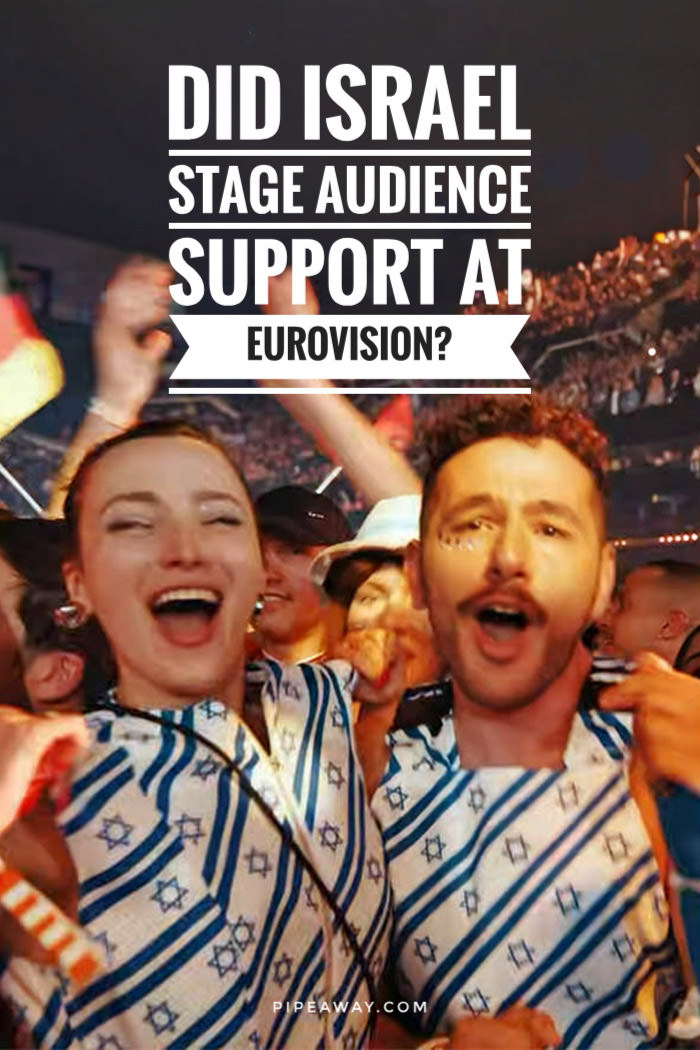
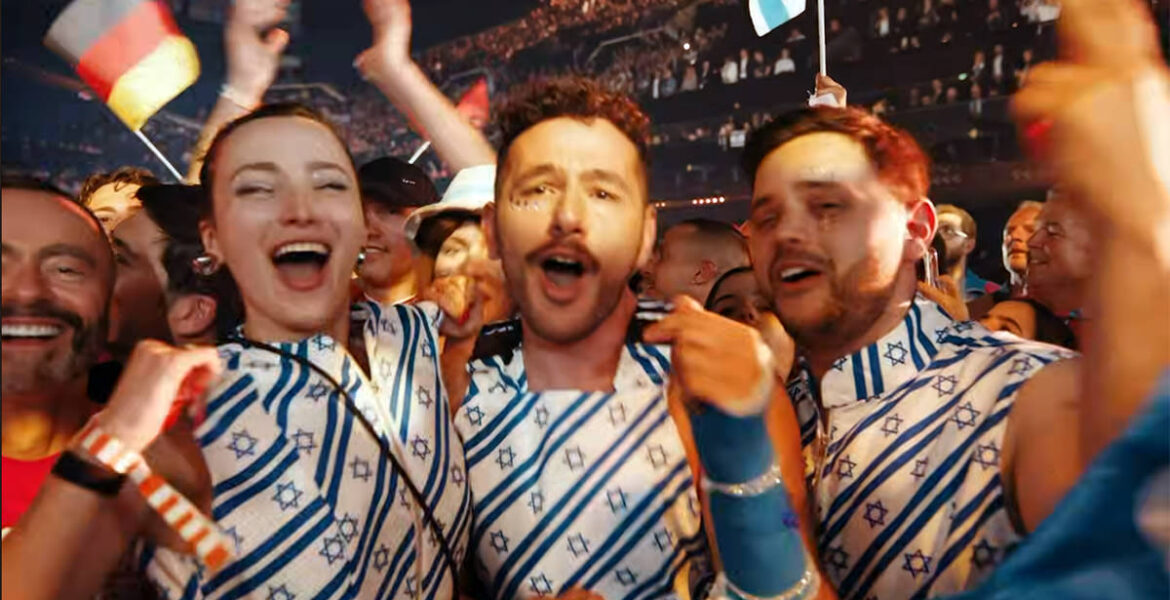
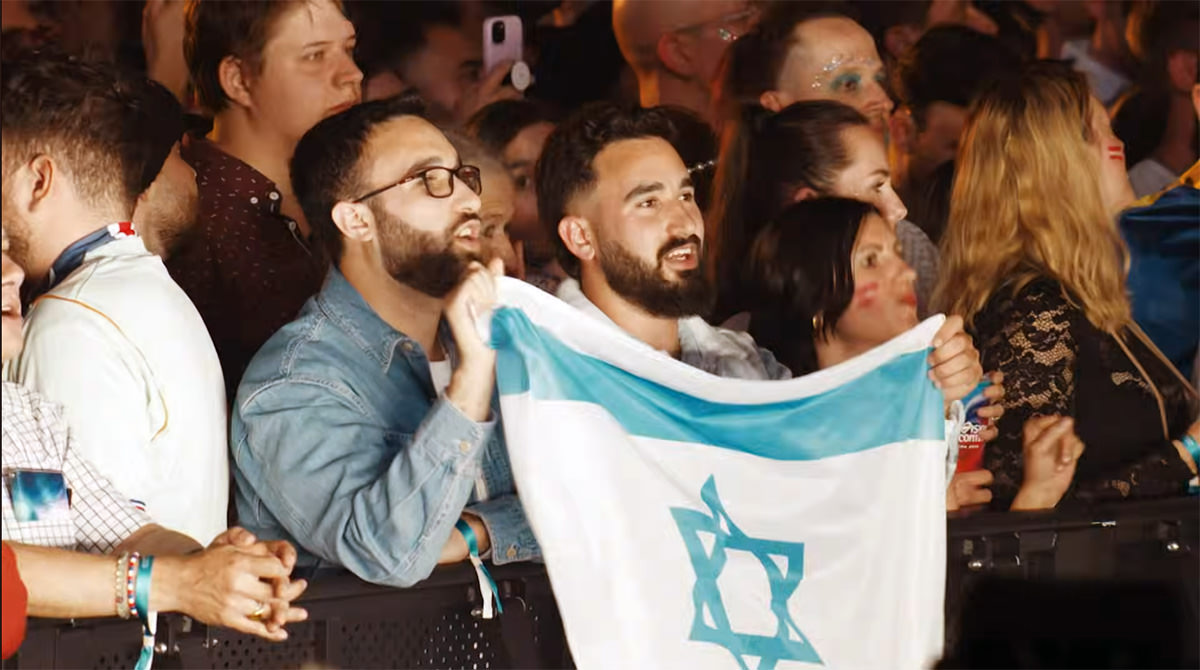
At 01:37 into Noam Bettan‘s performance of “Michelle”, the broadcast cuts to two audience members with an Israeli flag, visibly singing along. At 02:20, three more people dressed in Israeli-themed costumes appear, this time directly in front of the camera, performing for it with unmistakable enthusiasm. Both shots are tight, deliberate, and flattering. Neither appears by accident.
Here is what makes that significant: Eurovision is not a spontaneous event. Every second of the live program is choreographed through weeks of technical rehearsals. Camera operators follow predetermined shot lists. Directors in the production booth make real-time choices, but those choices are made within a structure that has been planned and approved in advance. A close-up of fans having a time of their life does not make it to air because a camera happened to swing past them. Someone decided to put those shots in.
The question is: who?
The Eurovision boycott is ongoing - still confused why Russia is banned from Eurovision but not Israel?
Eurovision’s rule of six
If those shots were requested or coordinated by Israel’s broadcaster, KAN, the motivation could be very obvious – to visually neutralize the booing and protest chants that have followed Israel’s representative in Eurovision arenas in recent years (during the very same performance, off-camera chants of “Stop the genocide” broke through the broadcast audio; this interruption attracted significant public attention). Flooding the screen with smiling, flag-waving supporters is a textbook counter-programming tactic.
But if KAN directed those audience moments, a problem arises. Eurovision enforces a strict rule: no more than six performers may appear during an act.
This rule has been applied without sentiment. Last year, when a fake fan rushed the stage during Tommy Cash‘s “Espresso Macchiato”, she was formally counted as the sixth performer under the rule.
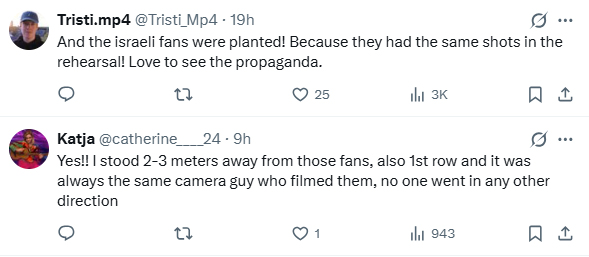
Yet, individuals, especially the trio enthusiastically singing directly into the camera, while the other audience members look in a different direction (direction of the stage), should leave an impression of a spontaneous shot? Either they are part of the act, in which case the rule applies, or they are not, in which case their appearance in directed broadcast shots becomes harder to explain.
If you want to see the questionable audience inclusion in the live broadcast (and boost Israel’s YouTube video), here it is!
What does the ORF say?
If we were completely naïve, we could think that ORF made an independent editorial decision to cut to supportive audience members during Israel’s performance (after asking them to turn toward the camera?). That explanation carries its own burden. If ORF’s directive is to show the world as it is, mid-song crowd reactions included, why was this courtesy in the first Semi-Final extended exclusively to Israel?
No other act in the first Semi-Final received a dedicated visual testimonial from its supporters mid-song
A review of the broadcast does not reveal comparable directed shots of enthusiastic fan sections during any other country’s performance. No other act in the first Semi-Final received a dedicated visual testimonial from its supporters mid-song. Why does Israel’s representative alone merit that treatment?
And if ORF was exercising its editorial freedom to focus on positive crowd reactions, what became of the commitment to showing “the world as it is”? The world inside that arena also contained people who did not share the shown enthusiasm. Viewers at home did not see that part of the world.
Showing fan support in the audience, especially at Eurovision, which made its name on a strong fan base, is not problematic as such. But usually, we see crowd reactions after the song, as every shot during the act is directed. When the audience enters the act itself, directly performing for the camera, they seem to be a part of the marketing. For the sake of transparency, Eurovision should respond to who decides which countries will be supported with such marketing.
We have approached both the ORF and the Eurovision press team for comment and explanation, and we will publish them when and if we receive them.
Do you think the inclusion of Israel’s fans in the live broadcast was directed?
Leave your comment below, and pin this article for later!