Some cities hide their best-kept secrets in speakeasies or unmarked doorways. Basel keeps its in plain sight – on a gravel bank by the river, where perfectly ordinary people have been getting perfectly naked for decades. This is the story of Naturistenstrand Basel-Stadt, the undisputed leader among Basel’s FKK beaches on the banks of the Rhine.
Basel City’s nudist beach is a place where you can simultaneously be very exposed and completely ignored
Imagine walking along the river in Kleinbasel, like so many tourists before you. Enjoying the promenade is literally among the most recommended things to do in Basel, whichever guide you consult. And for once, the guides are right. The air smells of summer. The mood is unhurried. Life is good.
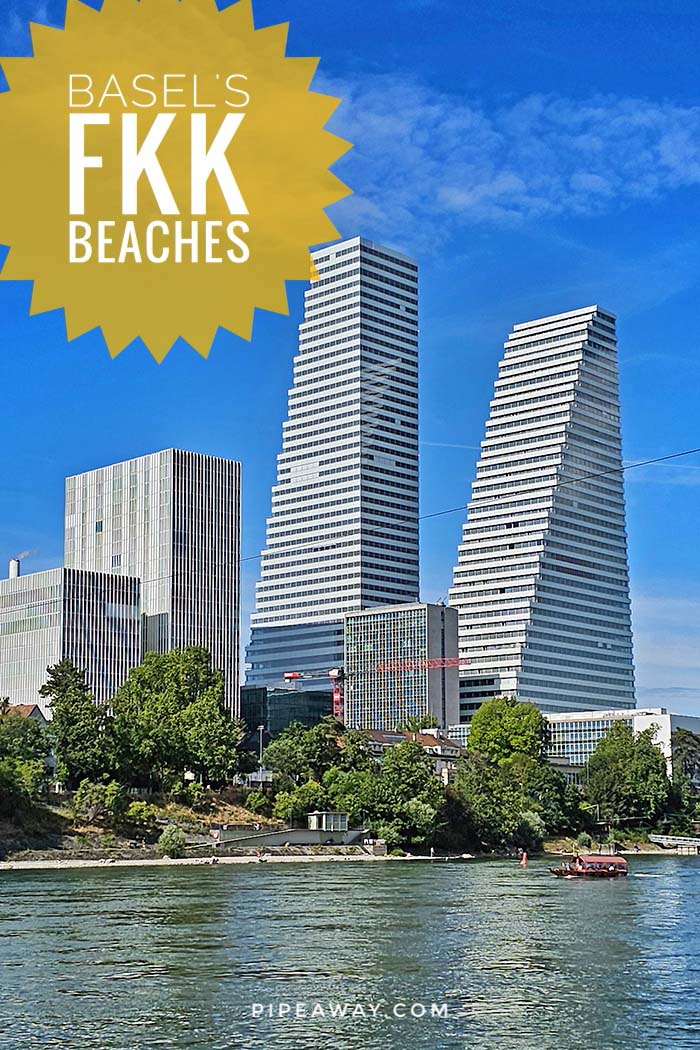
The Roche towers loom in the background, gleaming monuments to Swiss pharmaceutical precision. A couple of cyclists zip past. A woman strolls by with a dog. And then, just ahead, a man in absolutely nothing whatsoever is lying on a beach towel, reading a free local newspaper.
Nobody bats an eye. Not the cyclists. Not the dog walker. Not the man himself, who turns a page with the serene calm of someone who has long since stopped caring what the world thinks about his sunbathing habits – or indeed, about anything at all.
Welcome to Basel’s official nudist beach – the Naturistenstrand (FKK) Basel-Stadt – one of the most casually liberated stretches of riverbank in Switzerland, a place where you can simultaneously be very exposed and completely ignored.
You can feel at home in Basel even when gloriously overdressed. Here’s how to visit Fantasy Basel, the extraordinary cosplay convention.
FKK – A Brief, Unclothed History
If you didn’t grow up in a German-speaking country, the initials FKK might need a little unpacking. Freikörperkultur (literally “free body culture”) is the Central European tradition of non-sexual social nudity. It emerged in Germany in the early 20th century, fuelled by a combination of body positivity and freeing oneself from societal norms, a back-to-nature philosophy in an increasingly polluted industrialized world, and a general desire for a health and wellness ritual that’s affordable and accessible to everyone.
By the mid-20th century, FKK was utterly mainstream across Germany, Austria, and Switzerland. It wasn’t edgy. It wasn’t erotic. It was just… Tuesday afternoon. People sunbathed naked at lakes, swam without swimsuits in rivers, and joined tidy little clubs where they played volleyball in the nude with a cheerfulness that baffled everyone south of the Alps.
That spirit is alive and well in Basel. The city has designated stretches of the Rhine where nudism is not just tolerated but officially approved. The law is on your side: Swiss legislation doesn’t prohibit public nudity as long as it isn’t lewd or provocative. And at Basel’s nudist beach, “provocative” is about as far from the vibe as it gets. The word you’d reach for is gemütlich – cosy, unhurried, at ease.
The history of the European naturism movement is closely associated with Croatia. Check out how it all started at FKK Kandarola Beach in Rab.
The Naturistenstrand Beach Itself
The Naturistenstrand runs along the right bank of the Rhine, the Kleinbasel side, from below Solitude Park (just opposite the Rheinbad Breite, the 19th-century bathing platform) to the Schaffhauserrheinweg riviera. If you’re navigating by landmarks, the Tinguely Museum is your eastern anchor, the St. Alban Fähre ferry the westernmost point. Walk anywhere between these two, and you’ll find your clothes-free corner.
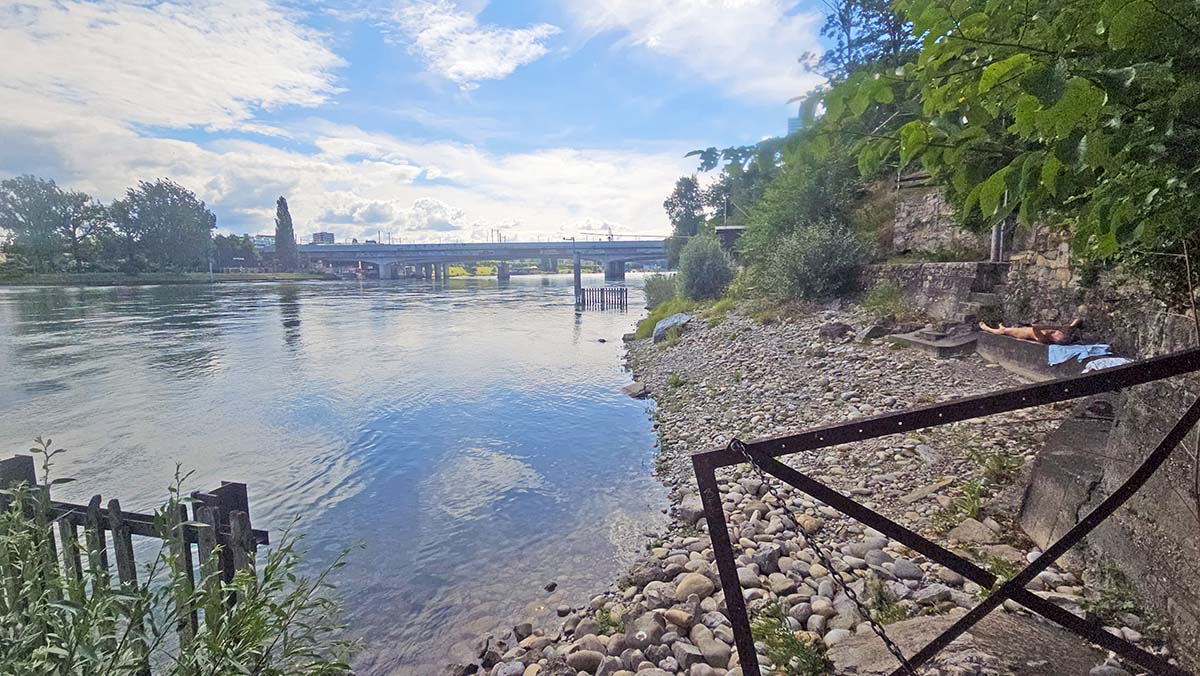
“Beach” is used loosely here. This is Switzerland, not the Maldives. What you get is a redesigned gravel bank, sun-drenched in summer, with the Rhine flowing alongside it at a pace that oscillates between “relaxed drift” and “oh, am I in France already?”. The water is acceptably clean, the result of decades of environmental cleanup that turned the Rhine from an industrial sewer back into a proper river. In summer, it reaches a respectable 20–24°C.
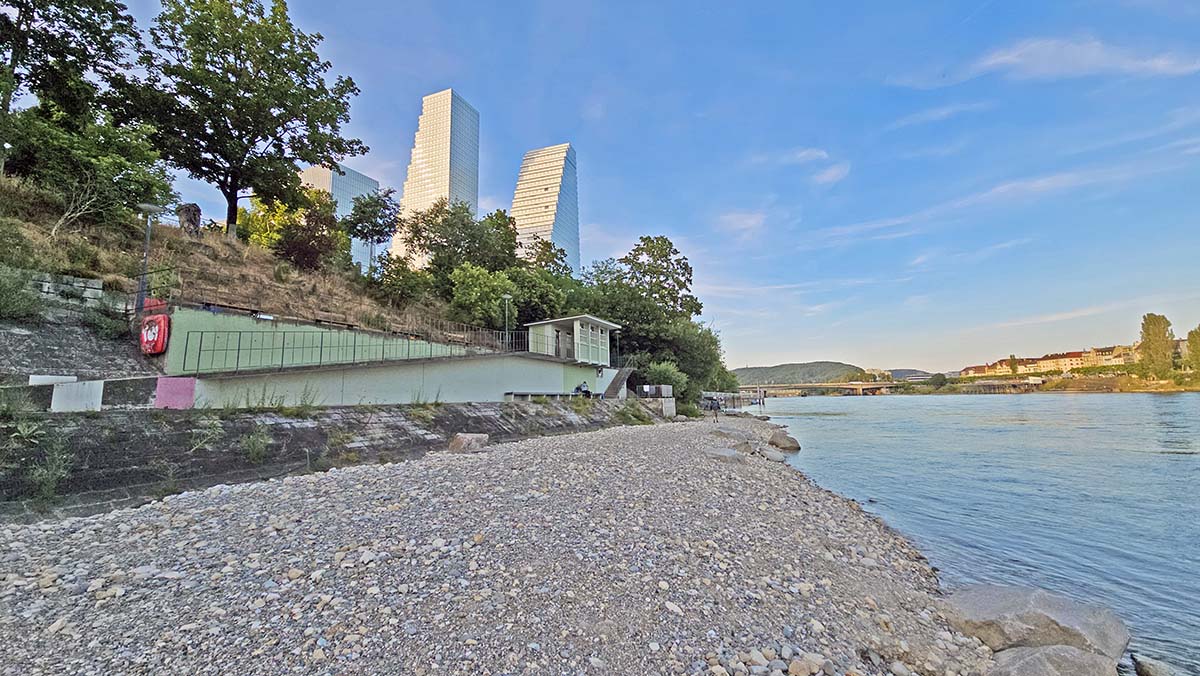
The social nucleus of the beach forms near a concrete ramp roughly at the level of the tennis courts on Schaffhauserrheinweg. This is where the regulars congregate, where the shower is located, and where you’re reasonably shielded from the road above.
The atmosphere is not glamorous. It’s a retired professor next to a twenty-something student couple next to a homeless woman using the fence to dry her freshly washed clothes. The crowd skews local, multigenerational, and resolutely unselfconscious. Nobody is here to be looked at. Everybody is here to be left alone, in the nicest possible way.
Officially, the beach is clothing-optional. You can wear a swimsuit. You won’t be turned away or side-eyed. But, depending on the number of nudists on the day, you might feel, after a while, like that person at a fancy dress party who didn’t get the memo.
Naked bathing in Basel is possible year-round in the sense that nobody will stop you, but in practice, the season runs from late May through October, certainly wrapping up before the Basler Herbstmesse fills the city with fried dough smells and carousel music. September is quietly glorious – warm enough to swim, cool enough to actually read a book without your paperback dissolving in your own sweat.
Where to stay near Basel City's nudist beaches?

The recommended 3-star hotels in Basel City's FKK beach area are Hotel Wettstein and Hotel Resslirytti. Check them out!
Getting to Basel’s FKK Beach
From Basel city center, the simplest approach is to walk across the Wettsteinbrücke to Kleinbasel and follow the Rhine path upstream. On foot from the Marktplatz, you’re looking at about 25 minutes at a gentle pace, which is, conveniently, also the amount of time it takes to mentally prepare yourself to take your clothes off in public.
By tram, lines 1, 2, and 15 stop at Wettsteinplatz, a short walk from the Rhine promenade. From there, follow the river upstream toward the Roche towers.
The closest bus stop to the beach is Rosenwartenweg, served by lines 31, 34, and 38. Alight here, then follow Peter Rot-Strasse and Stachelrain southward until you reach the river, right next to the tennis courts.
There is parking nearby, though arriving by bike is considerably more in the spirit of things. You can lock your bicycle to the promenade fence.
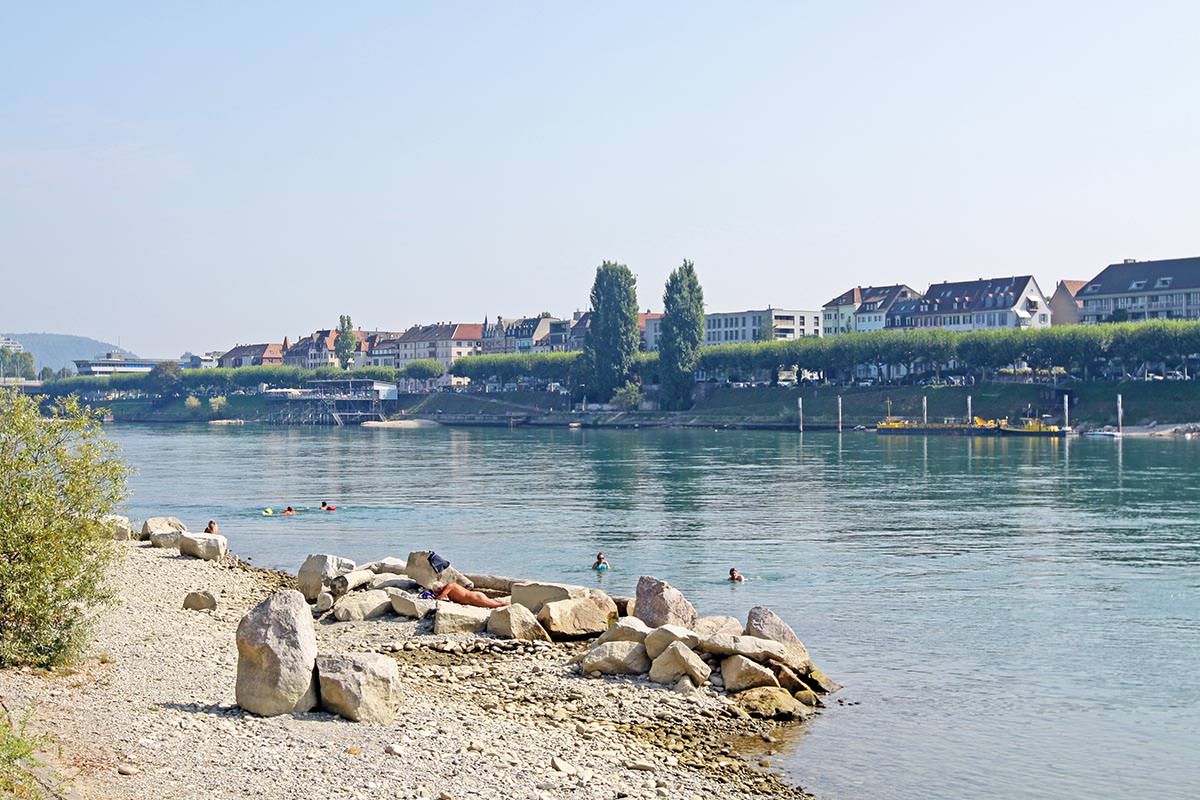
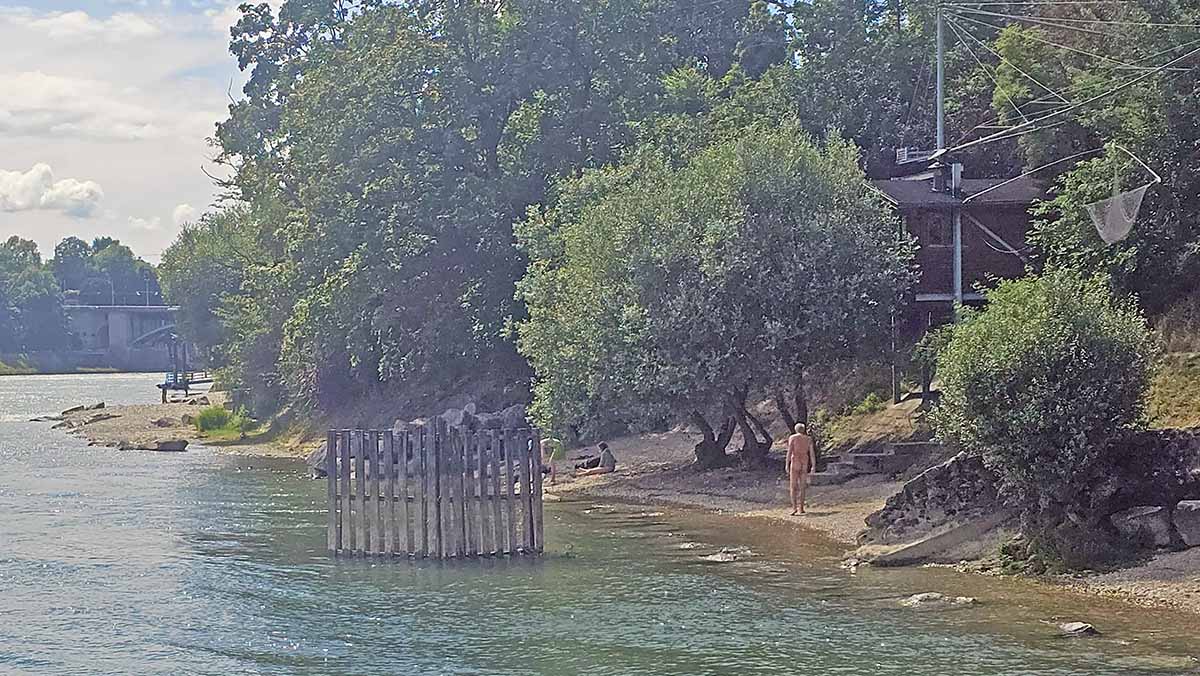
While the most organized section of beach sits beneath the Tennis Club Schaffhauserrheinweg Basel, where a shower, restrooms, and even a dozen lockers await (bring a padlock!), those seeking a little more seclusion should head toward the section beneath the Roche complex.
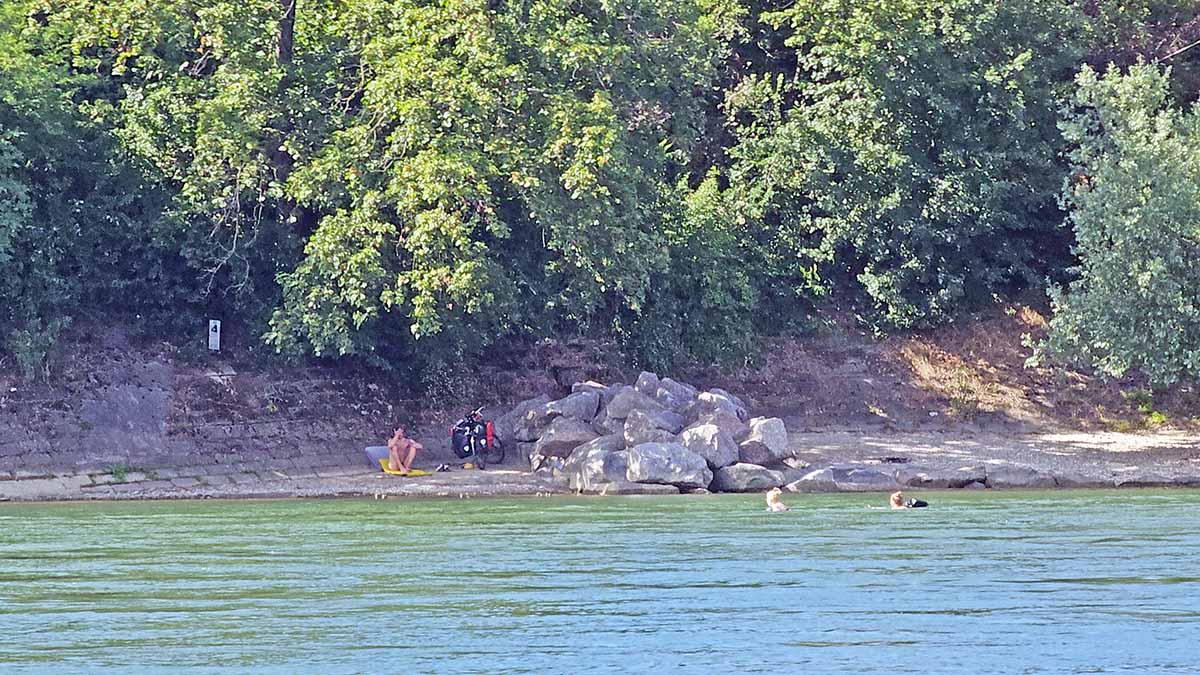
You can access these quieter stretches of gravel, rocks, and even small meadows in several ways:
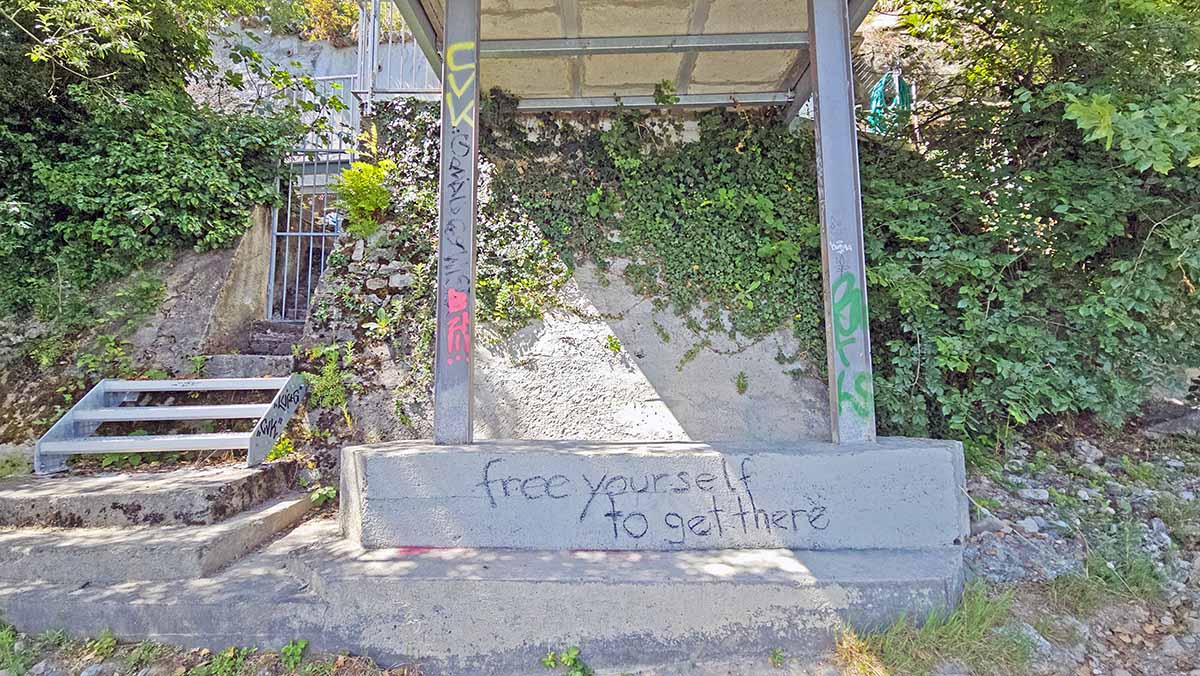
- via the main beach – walk the shoreline eastward and climb over the larger rocks concealing the view; a graffiti on the wall names this section Goa Beach
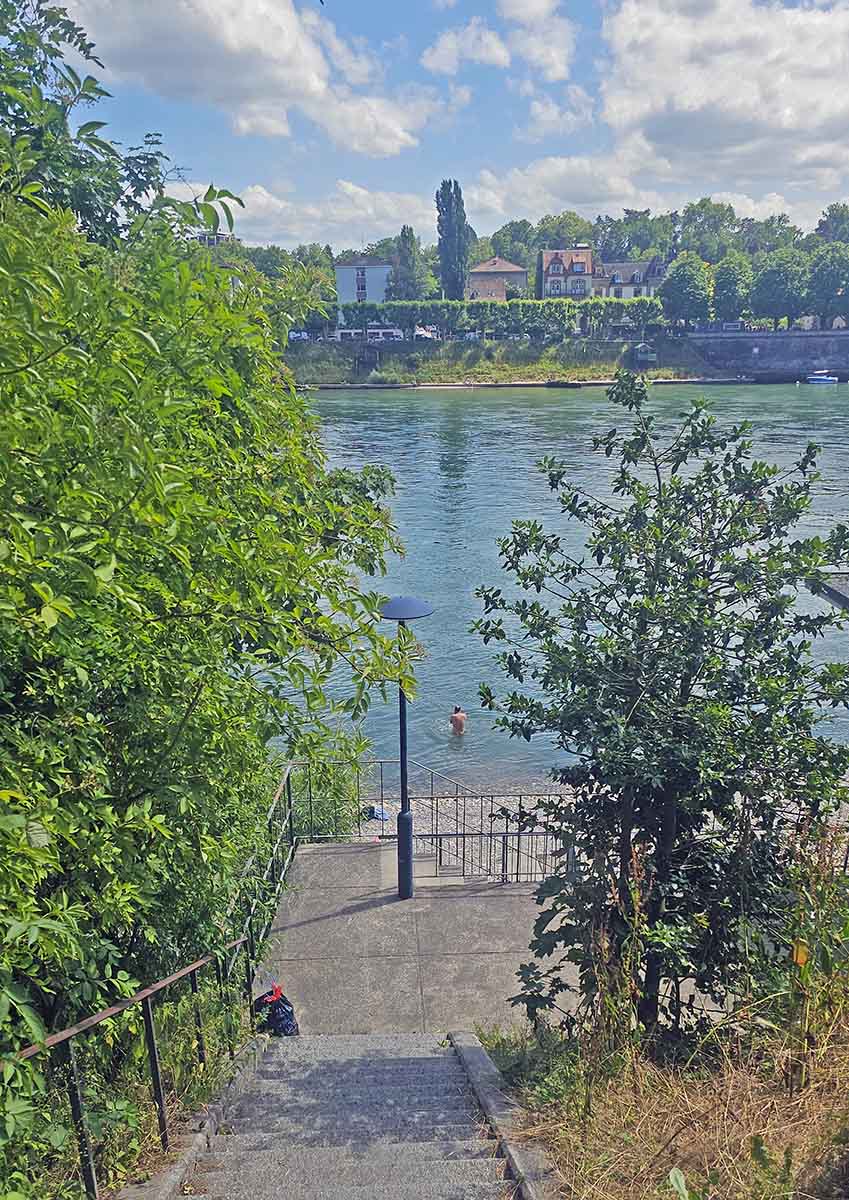
- via the defunct Museum Jean Tinguely Station pier – descend via the path and stairs toward the pier at Solitude Promenade, and access the beach on either side
- via the beach in front of the Tinguely Museum – follow the shore downstream along the rocky path, or simply float with the current until you find a spot to get out and naked
If you're a nudist cyclist in London, you don't need to hide by the Thames. Join this naked bike ride through the city center!
Getting In the Water
The Rhine at Basel is not a paddling pool. The current is real, sustained, and entirely indifferent to your hesitation. Strong swimmers find it thrilling. Less confident ones can still enjoy it, with the iconic Wickelfisch, a waterproof fish-shaped bag that doubles as a buoy.
The classic route runs from the Tinguely Museum to Dreirosen Buvette (just after the Johanniterbrücke) at the far end – a 30-minute-long, meditative float during which the city slides past on both sides, in a pleasing slideshow of church spires, crane arms, and the occasional barge carrying what appears to be very heavy things very slowly.
A word of caution: if the water level is high or the current is running fast, leave it for another day. The Rhine is beautiful, but the Rhine is also the Rhine.
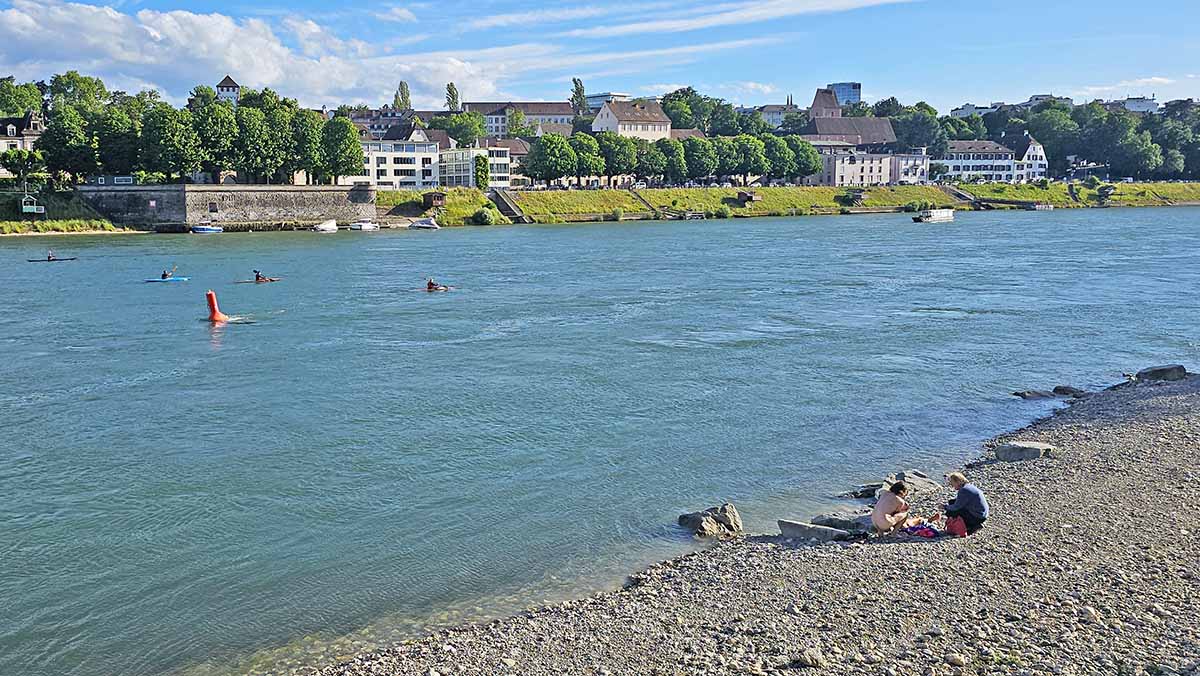
Less experienced swimmers should stay close to the bank, where the current is gentler, and terra firma is within reach. The same applies to swimmers without a swimsuit – once the current carries you beyond the nudist section, you are still expected to exit the river wearing at least something.
Water temperature peaks in July and August, hovering above 20°C: bracing on entry, refreshing once you’re in. The gravel bank shelves gradually, which is kind. The Rhine bed, however, is not soft: you might find water shoes handy (or feety?).
After your swim, the shower at the ramp is conveniently available.
Etiquette and What to Pack
Basel’s nudist beach runs on a few unspoken but universally understood rules. They’re not complicated.
1. Bring a towel.
Always sit on your towel. This is non-negotiable in Central European nudist culture and also just basic hygiene.
2. Leave your phone camera pointed at the sky.
People are here to relax, not to appear on someone’s Instagram. Photography of other beachgoers without obvious consent is the fastest way to make yourself unwelcome. Don’t treat this place as Basel Zoo.
3. Don’t stare.
The entire premise of FKK culture is that nudity is normal and unremarkable. Gawking undermines it. Look at the river. It’s lovely.
4. Wear Sunscreen.
Apply sunscreen generously. On all the parts you don’t usually think about.
5. Spare Your Feet from Nudism.
The gravel is manageable but not comfortable barefoot. Use water shoes.
6. Bring Some Cash.
You might want to spend money on the refreshment stalls (Buvettes) dotted along the Rhine path, offering cold drinks, beer, and ice cream. They are among the finest institutions in Basel, and that is not a statement made lightly in a city that also contains the Kunstmuseum.
For Those Who Want More: Heliosport and Beyond
FKK bathing in Basel continues further upstream, toward the Birsfelden power plant, on the eastern side of the Schwarzwaldbrücke, in the Eisenbahnweg area, which starts with the laptop-friendly Rhyläx Café, conveniently sharing the name with the city’s wordplay campaign that combines ‘Rhy’ (the Swiss-German word for the Rhine) and ‘relax’. This slogan is visible on riverside posters encouraging people to chill by the river while respecting others and the environment.
Don’t wander off too far. If you’ve heard of Basel’s hidden nude beach just under the Rankhof stadium, your source is outdated. After the 2021 flood, which made the area prone to rockfall, that section of the Rhine riverbank is officially closed, not only to naturists.
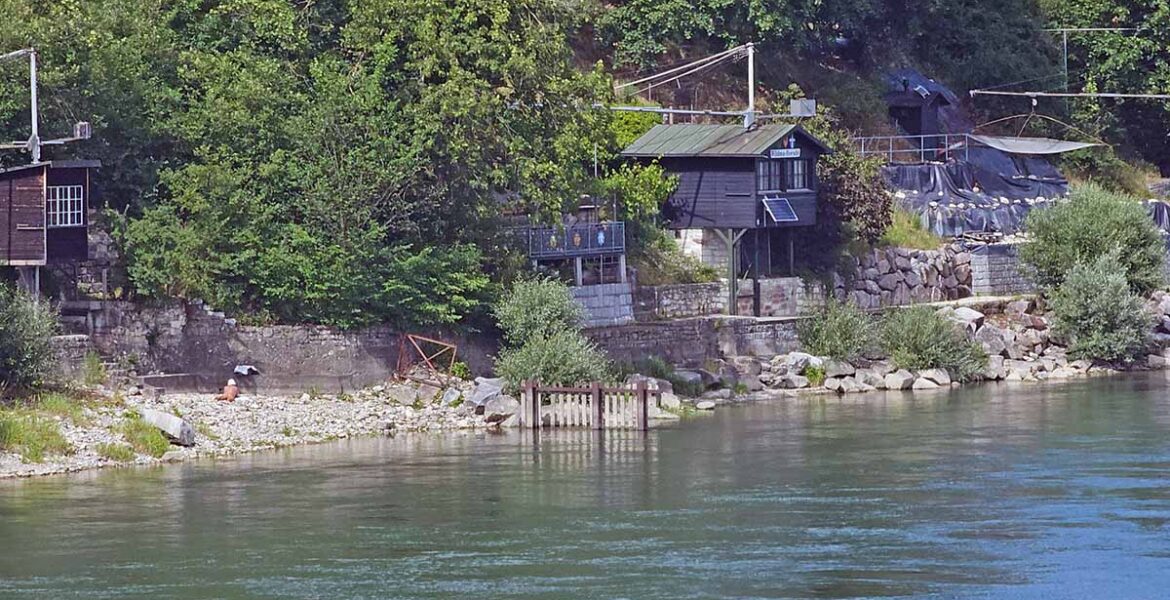
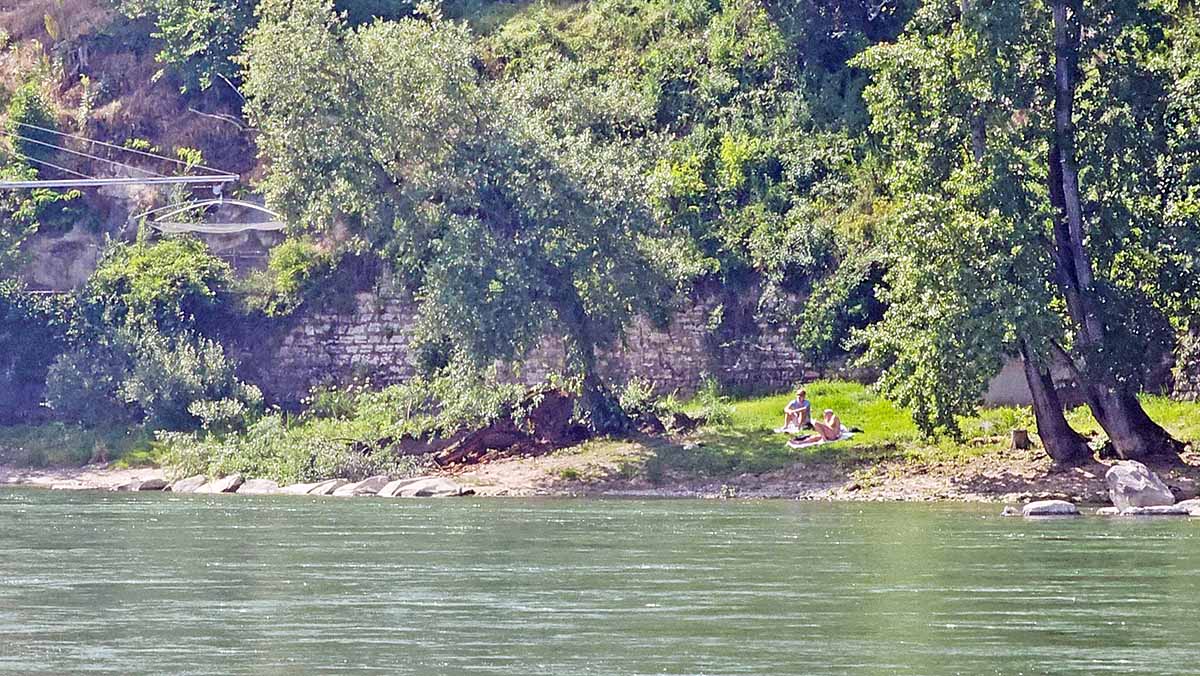
However, beneath the Grenzacher-Promenade, a row of wooden fishing huts secures a nude sunbathing section out of sight from passing pedestrians. To reach it, you’ll have to use one of the two gates integrated seamlessly into a timber fence along the pedestrian/bike path (if you have trouble spotting them at first, the giveaway is the diagonal wooden beams). Push them open, and follow the footpath and stairs down until you find a suitably secluded spot.
If you are open to something a little more structured, Basel also has a proper naturist club.
Naturisten Verein Heliosport Basel is an association founded in 1948, making it one of the oldest FKK clubs in the region. Its grounds, charmingly named Rhyblick Gelände (“Rhine View Site”), sit just across the German border in Grenzach-Wyhlen, about a 15-minute drive from central Basel. The 0.2-hectare terraced place, a former bird observatory, lies at the foot of the Hornfelsen, surrounded by forest and vineyards. Facilities include sunbathing lawns, a pool, a barbecue area, and a view of the Rhine that absolutely justifies the name.
The Naturistengelände has around 40 members from the Basel tri-border region (Switzerland, Germany, France). It’s warmly family-friendly and welcomes day visitors and curious newcomers. First trial visits are free; a standard guest entry runs CHF/€15, only by appointment.
For the truly adventurous visitors, the Isteiner Schwellen, rocky outcrops on the old Rhine channel in Efringen-Kirchen, about 15 kilometers from Basel, are a beloved nudist spot among locals in the know, good for both sunbathing and clothing-free hiking. Wilder, more scenic, and decidedly less signposted.
The nearest FKK camping to Basel is also across the German border – Dreiländereck Ferienpark der Naturisten is the country’s largest private nudist holiday park, complete with its own natural lake.
If you continue toward Freiburg, the eastern shores of Opfinger See offer textile-free meadows on a lake surrounded by forest.
Feeling sporty? Join one of the naked bike rides in the world!
Nudist Beaches of Basel – Conclusion
Basel is a city that takes things seriously. It hosts Art Basel, one of the world’s most prestigious art fairs. It is home to Novartis, Roche, and other pharmaceutical giants keeping much of the planet medicated. Basel museums are extraordinary, and the city’s architecture is meticulously considered.
A city that builds billion-franc towers designated the most beautiful stretch of its riverbank for naked sunbathing
And yet, on a warm Tuesday afternoon, a retired pharmacist, a graphic design student, and a French family who drove across the border will all be lying on a gravel bank by the Rhine with nothing on, perfectly content, watching the water, waterbirds, and rowers go by.
A city that builds billion-franc towers and then designates the most beautiful stretch of its riverbank for naked sunbathing has understood something about the balance between ambition and ease that a lot of places haven’t.
The nudist beaches ask very little of you. Just a towel, reasonable sunscreen discipline, and the willingness to stop performing for an afternoon. Here, in Basel, you are invited to do the one thing the city posters have been gently suggesting while you walked along the riverbank.
To rhylax.
The world of costumed theater can wait.
Do you plan to explore Basel’s nudist beaches?
Pin the article for later!